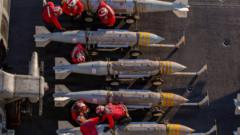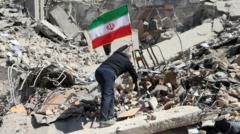
The prevailing narrative regarding the escalation of US-Israeli kinetic operations against Iranian interests often focuses on immediate casualty counts or tactical site damage. This perspective ignores the more profound strategic reality: the systematic compression of time and resource allocation within the Iranian state. When military strikes transition from occasional outliers to a "constant" operational cadence, the psychological and economic impact is best understood through the lens of Structural Attrition. This is not merely a series of explosions; it is a forced redirection of a nation’s cognitive and financial capital away from long-term development toward immediate, high-stress survival.
The Triad of Kinetic Compression
The Iranian experience of "every day feeling like a month" is a direct result of three interlocking mechanisms that degrade the functionality of a state and its populace.
- Temporal Distortion via High-Frequency Threat Cycles: In a standard geopolitical environment, the OODA loop (Observe, Orient, Decide, Act) operates on a manageable timeline. Constant strikes force this loop to reset every few hours. For the average citizen and the state bureaucrat alike, this creates a state of permanent "emergency footing" where the ability to plan beyond a 24-hour window evaporates.
- Resource Reallocation Under Duress: Every precision strike requires a disproportionate defensive response. The cost-to-damage ratio favors the attacker. Iran must spend an order of magnitude more on air defense, electronic warfare, and infrastructure repair than the cost of the munitions used against them. This creates a drain on the national treasury that functions as an unofficial, high-intensity tax.
- The Erosion of Social Cohesion: Constant external pressure usually creates a "rally 'round the flag" effect, but this effect has a shelf life. When the state fails to provide the basic utility of safety over an extended period, the social contract begins to fray. The psychological fatigue described by residents is the precursor to systemic domestic volatility.
The Economic Cost Function of Perpetual Vigilance
Standard economic metrics like GDP growth or inflation rates fail to capture the true cost of living under a sustained strike regime. To quantify this, we must examine the Opportunity Cost of Defensive Posturing.
In a stable environment, capital flows toward infrastructure, education, and technology—sectors with high multipliers. In a compressed environment, capital is diverted into "Sunk Cost Assets." These include reinforced bunkers, redundant communications arrays, and the maintenance of a massive standing military force in a state of high alert.
The Logistics of Paralyzed Commerce
The movement of goods within Iran is hindered not just by physical strikes, but by the potential for strikes. Logistics firms must factor in "kinetic risk premiums." This manifests as:
- Higher insurance premiums for domestic freight.
- The necessity of night-time-only transport to avoid satellite detection.
- Frequent closures of airspace and sea lanes, disrupting the "Just-in-Time" delivery models required for modern industrial production.
The cumulative effect is a deceleration of the velocity of money. When people expect a strike, they hoard liquidity. When liquidity is hoarded, investment stalls. The result is a stagnant economy that feels "fast" due to the chaos, but is functionally "slow" in terms of growth.
Infrastructure Vulnerability and the Cascade Effect
Modern urban centers are systems of systems. A strike on a single command-and-control node or a logistics hub does not merely destroy that physical asset; it ripples through the network.
Consider the Iranian power grid. While US and Israeli strikes often target military-industrial complexes, these facilities are high-demand energy consumers. The rapid fluctuation in load caused by the sudden removal or emergency shutdown of these facilities can cause frequency instabilities across the civilian grid.
Residents reporting that "life feels like a month" are often reacting to the secondary and tertiary effects of this instability:
- Intermittent Connectivity: Damage to localized fiber-optic nodes or the intentional throttling of networks for "security reasons" during strikes prevents the digital economy from functioning.
- Water Scarcity: In many Iranian regions, water distribution is heavily dependent on electric pumps. Grid instability leads to water pressure drops, turning a military engagement into a fundamental survival crisis for civilians.
The Psychological Mechanics of "Constant" Warfare
The term "constant" is often used colloquially, but in a strategic context, it refers to a frequency of attack that exceeds the recovery time of the target. Human beings possess a finite capacity for stress regulation. When the recovery period between strikes is shorter than the time required for the parasympathetic nervous system to return to baseline, the population enters a state of Chronic Hyperarousal.
This has measurable impacts on labor productivity. A workforce that is sleep-deprived due to air raid sirens or general anxiety cannot perform high-complexity tasks. This leads to an increase in industrial accidents, a decrease in cognitive output, and a general degradation of the "human capital" that any nation requires to sustain its economy.
Furthermore, the state's response—increased surveillance and restricted movement—adds a layer of friction to daily life. The simple act of commuting becomes a data-gathering exercise for the state and a risk-assessment exercise for the individual.
Defensive Fragility and the Intelligence Gap
The persistence of these strikes indicates a critical failure in the Iranian defensive architecture: the inability to close the Intelligence-Kinetic Gap. For an adversary to conduct "constant" strikes, they must possess real-time, high-fidelity intelligence.
The Iranian state’s inability to prevent these incursions suggests a penetrative intelligence environment that is likely both technological (SIGINT) and human (HUMINT). For the Iranian leadership, this creates a "Paranoia Feedback Loop." If every strike is successful, it implies that the inner circle is compromised. This leads to internal purges, which further degrade the efficiency of the bureaucracy and the military command structure.
Strategic Trajectory: The Threshold of Systemic Failure
The current trajectory is not sustainable for the Iranian state in its present form. The strategy of "Maximum Pressure" via kinetic means is designed to push the system toward a Phase Transition—a point where the internal pressures exceed the structural integrity of the government.
There are three likely outcomes based on the current data:
- Symmetric Escalation: To break the cycle, Iran may feel compelled to initiate a large-scale, high-consequence counter-strike to restore deterrence. This carries the risk of triggering a full-scale regional war.
- Internal Fracturing: The decoupling of the civilian population’s interests from the state’s ideological goals may reach a breaking point, leading to widespread civil unrest that the overstretched security forces cannot contain.
- The Controlled Pivot: The state may be forced into a strategic retreat, negotiating from a position of weakness to secure a cessation of strikes in exchange for significant concessions on its nuclear or regional ambitions.
The most critical variable to watch is the Internal Logistics Cohesion. If the Iranian state can no longer provide basic caloric and energy security to its urban centers due to the "kinetic tax," the transition will likely be rapid and disorganized.
Investors and regional analysts must prioritize the monitoring of domestic Iranian commodity prices and grid stability metrics over the rhetoric of military spokesmen. These are the true indicators of how much longer the system can withstand the compression of its temporal and physical reality. The move for external actors is to prepare for the volatility that occurs when a high-pressure system finally breaches its containment. This involves diversifying supply chains away from the Strait of Hormuz and hedging against a sudden, non-linear shift in Iranian domestic policy.