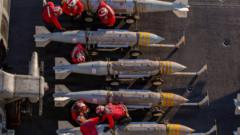
The defense establishment is currently obsessed with a math problem that doesn't exist. You have seen the headlines: "Stockpiles are dwindling," "The West is out of ammo," and "Ukraine has bled the cupboard dry." This narrative suggests that because we have shipped a few hundred thousand 155mm shells and a handful of ATACMS to Eastern Europe, we are suddenly defenseless against a Persian Gulf escalation.
It is a comfortable, bureaucratic lie. It serves the procurement officers who want bigger budgets and the legacy contractors who want to keep building 1980s hardware in 2026.
The reality? The "depleted stockpile" argument is a fundamental misunderstanding of how a conflict with Iran would actually function. We are not going to fight a war of attrition in the salt deserts of Iran using the same muddy, trench-bound logic of the Donbas. To suggest that a shortage of unguided artillery shells impacts our ability to project power against Tehran is like worrying about a shortage of bayonets before a drone strike.
The Shell Game of 155mm Math
The logic goes like this: Ukraine uses $X$ amount of ammunition. The US produces $Y$ amount. Since $X > Y$, the US is vulnerable.
This is amateur hour.
A conflict with Iran is a maritime and aerial engagement defined by the "Anti-Access/Area Denial" (A2/AD) challenge. It is a war of precision, electronics, and standoff distance. Iran’s primary threats are the swarm—thousands of low-cost Shahed-series loitering munitions—and their ballistic missile inventory, such as the Kheibar Shekan.
You do not stop a ballistic missile with a 155mm howitzer. You do not stop a swarm of 500-knot drones with the "stockpiles" currently being depleted in Ukraine. The interceptors we are "using up" are largely older generation Patriot variants and MANPADS that were slated for decommissioning or replacement anyway.
The defense industry is actually in the middle of a massive, forced "hot-swap" of its inventory. We are clearing out the basement of analog junk to make room for the digital, modular systems that actually matter in a Strait of Hormuz scenario.
The Asymmetry Trap
The "insider" consensus warns that Iran will overwhelm our Aegis systems through sheer volume. They point to the April 2024 barrage where Iran launched over 300 projectiles at Israel as proof that we can't keep up.
They are asking the wrong question. They ask: "How many $2 million interceptors do we have left?"
The real question is: "Why are we still using $2 million interceptors to hit $20,000 drones?"
The "depleted" narrative ignores the rapid pivot to Directed Energy Weapons (DEW) and high-power microwave systems currently being fast-tracked precisely because the Ukraine conflict exposed the cost-curve failure of traditional missiles. Systems like the Leonidas or various palletized laser platforms are moving from R&D to the field at a pace the Pentagon hasn't seen since the 1940s.
If you think a lack of traditional missile tubes means weakness, you aren't paying attention to the electronic warfare (EW) suites currently being installed on every carrier strike group. We aren't running out of bullets; we are making bullets obsolete.
Logistics are the New Lethality
I have watched the Pentagon burn billions on "just-in-time" logistics that failed the moment a real peer-level threat emerged. The critics are right about one thing: the old way of moving gear is dead. But they are wrong about the solution.
The solution isn't "more shells." It’s distributed manufacturing.
We are entering the era of the "Forward-Deployed Factory." Instead of shipping heavy munitions across the Atlantic or Pacific, the goal is the localized assembly of modular kinetic systems. The "stockpile" is no longer a warehouse in Nevada; it is a digital file and a shipping container full of carbon fiber and explosives in Qatar or Bahrain.
When someone tells you our "stockpiles" are low, they are thinking about war as a retail business—inventory on a shelf. Modern war is a streaming service. It’s on-demand. It’s data-driven.
The Vulnerability Nobody Talks About
While the pundits cry about shells, they ignore the actual bottleneck: Energetics.
The US has a catastrophic reliance on foreign sources for the chemicals required to make high-end explosives and propellants. Specifically, we are talking about RDX and HMX. We have outsourced the very soul of our munitions to a global supply chain that routes through the very countries we might find ourselves fighting.
That is the "depletion" that matters. It isn't that we don't have the missiles; it's that if the shooting starts, we might lack the chemical precursors to fill the next batch. This is the "dirty secret" of the defense industrial base. We can build the sleekest, most "AI-integrated" drone in the world, but if we can't make the spark that makes it go bang, it’s just an expensive paperweight.
The Iran Conflict Scenario: A Reality Check
Imagine a scenario where the Strait of Hormuz is mined and Iran launches a multi-axis swarm.
The "stockpile" hawks will tell you we’ll run out of SM-6 missiles in 48 hours. I’ll tell you that if the US Navy is still firing SM-6s at $30,000 drones after 48 hours, the Admiral in charge should be court-martialed for tactical illiteracy.
A confrontation with Iran will be won by:
- Kinetic Attrition via Low-Cost Interceptors: Think Coyote drones or APKWS rockets—systems we have in the tens of thousands.
- Cyber-Kinetic Degradation: Shutting down the command and control nodes before the missiles even leave the rails.
- Economic Blockade: This isn't "war" in the 20th-century sense; it's a systemic strangulation.
The "stockpile" fear-mongering is a psychological operation aimed at the American taxpayer. It’s designed to create a sense of urgency that justifies the "cost-plus" contracts of the big primes.
The Actionable Truth
Stop looking at the quantity of missiles. Look at the velocity of replenishment.
If you are an investor, a policy-maker, or just a concerned citizen, quit worrying about whether we have 5,000 or 10,000 Javelins. Iran isn't an armor-heavy threat. Start looking at who is building the software-defined radio systems and the autonomous underwater vehicles (AUVs). That is where the Iran conflict will be decided.
The status quo is a comfort blanket for people who miss the Cold War. They want a neat, measurable tally of "Our Stuff" vs. "Their Stuff."
But "Stuff" is becoming a liability. Heavy, static stockpiles are just targets for the very long-range missiles everyone is so worried about. The future of the Iran conflict isn't about having a bigger pile of rocks; it's about having the most agile arm.
We are currently trading our outdated, heavy inventory for a leaner, more lethal, and significantly more automated force. This isn't "depletion." This is an upgrade disguised as a crisis.
Stop mourning the empty warehouses. They were full of things that wouldn't have saved us anyway.