You’re standing in a kitchen store, or maybe you've got twenty tabs open on your browser, and you’re staring at that iconic twin logo. It looks premium. It feels like something a "real" chef would own. But honestly, buying a zwilling chef knife set is one of those decisions where it’s remarkably easy to spend $500 and still end up with the wrong tools for how you actually cook. Most people think "German steel" is a singular thing, a badge of indestructible quality that means they'll never have to sharpen a blade again. That’s a myth.
Actually, it’s a couple of myths wrapped in very clever marketing.
Zwilling J.A. Henckels has been around since 1731. That’s nearly three centuries of making steel in Solingen, Germany. But here’s the kicker: they make everything from $30 grocery store knives to $1,000 Kramer collaborations. If you walk into this blindly, you might get a set that’s too heavy for your wrists or, worse, a "budget" line that isn't actually made in Germany at all. We need to talk about what makes these knives work, why the "bolster" is a point of massive contention among professionals, and how to spot the difference between the stuff that lasts a lifetime and the stuff that’s just taking up space on your counter.
The Forged vs. Stamped Trap
If you’re looking at a zwilling chef knife set and the price seems too good to be true, check the construction. This is where most buyers get burned.
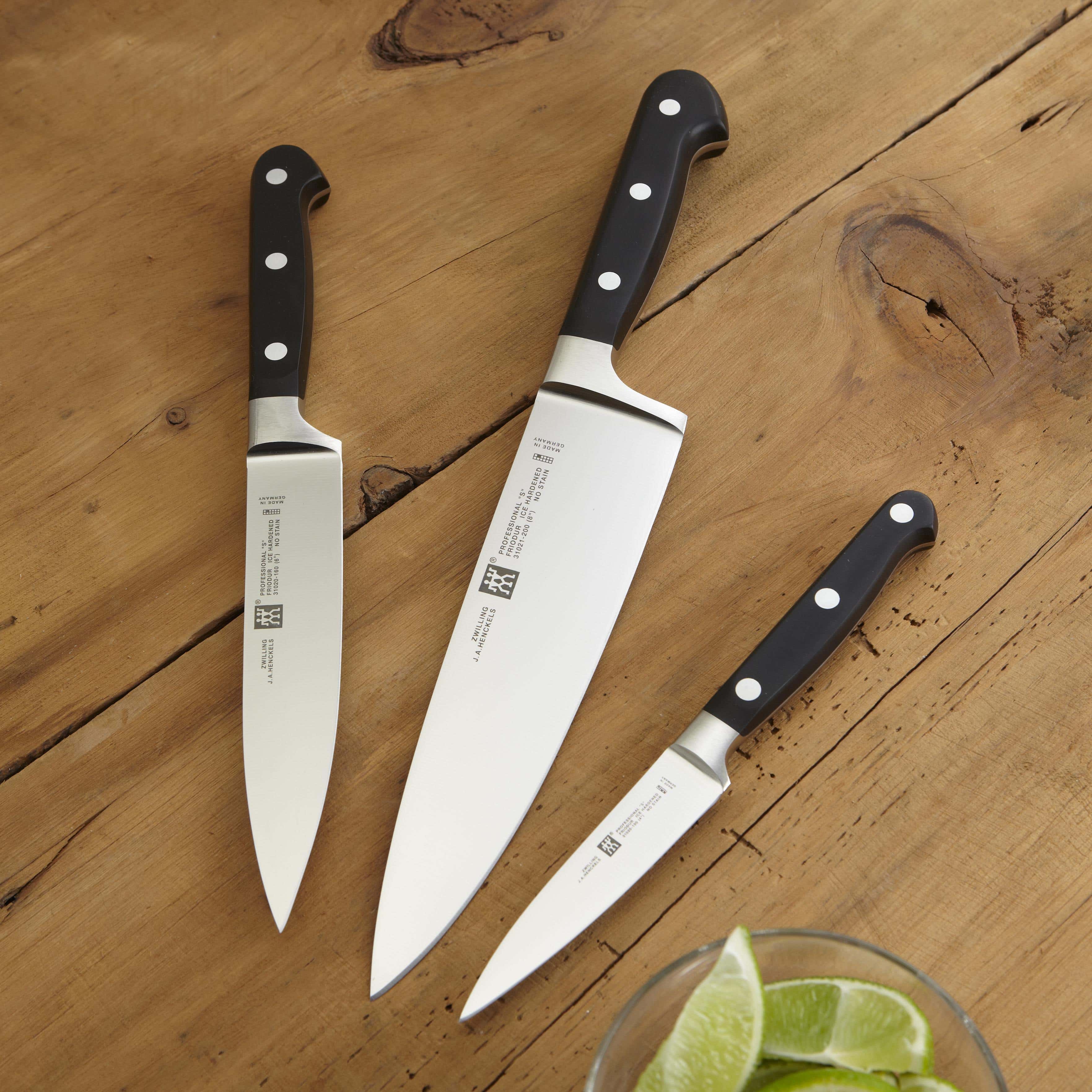
Zwilling has two main tiers: forged and stamped. Forged knives, like the Zwilling Pro or the Classic Professional "S", are hammered from a single piece of high-carbon stainless steel. They are heavy. They have a "bolster"—that thick chunk of metal between the handle and the blade. This gives you balance. It makes the knife feel like a natural extension of your arm if you have larger hands.
Then there’s the stamped stuff. These are basically cut out of a big sheet of steel like cookies. They are lighter, thinner, and generally lack that premium heft. Now, light isn't always bad. If you have arthritis or just hate heavy tools, a stamped knife is great. But don't pay forged prices for stamped metal. Look for the "Twin" logo—the two little stick figures. If you see only one stick figure, that’s "J.A. Henckels International." It’s their entry-level brand, often made in Spain, China, or Thailand. It’s fine for a college dorm, but it’s not the legendary German engineering you’re probably hunting for.
Why the Zwilling Pro Changed the Game
For decades, the standard German knife had a full bolster. It was a safety feature, honestly. It stopped your fingers from sliding onto the blade. But it created a massive problem: you couldn't sharpen the entire length of the edge. Over years of sharpening, the blade would wear down but the metal bolster wouldn't, leaving a "heel" that prevented the knife from touching the cutting board. It’s annoying. It’s actually kind of dangerous because it makes the knife pivot weirdly.
Enter the Zwilling Pro series.
Designed in collaboration with architect Matteo Thun, they shaved down that bolster. It’s curved now. You can grip it with a "pinch grip"—where your thumb and forefinger choke up on the blade—without getting a callus. It’s probably the most ergonomic zwilling chef knife set on the market today. It bridges the gap between the beefy, tank-like feel of traditional German cutlery and the precision of Japanese blades.
The Steel Science
Let's get nerdy for a second. Zwilling uses a proprietary steel called Friodur. Basically, they heat the steel up and then ice-harden it by plunging it into -70°C temperatures. Why? Because it changes the molecular structure to make it more corrosion-resistant and way tougher.
On the Rockwell Hardness Scale, most Zwilling knives sit around 55-57.
Compare that to a Japanese Shun or Global, which might be 60-62. What does that actually mean for your Sunday meal prep? It means the Zwilling is "softer." That sounds like a bad thing, but it’s actually a secret weapon. A harder Japanese blade is brittle; if you hit a chicken bone or drop it on a tile floor, it can chip like a piece of glass. A Zwilling blade is tough. It bends before it breaks. It’s the SUV of the kitchen world. You can abuse it a little, and it’ll just keep going.
The "Essential" Pieces vs. The Filler
Kitchen stores love selling 15-piece sets. You see this massive wooden block and think, "I'm going to be the next Gordon Ramsay." Stop. You don't need fifteen knives. Most of those sets are filled with "utility" knives that are too short for a cabbage and too long for an apple.
If you’re building or buying a zwilling chef knife set, you only really need four things:
- The 8-inch Chef’s Knife: This does 90% of the work.
- The Paring Knife: For peeling ginger or de-veining shrimp.
- The Serrated Bread Knife: Because trying to cut a crusty sourdough with a chef's knife is a recipe for a trip to the ER.
- Kitchen Shears: Specifically the Zwilling multi-purpose shears. They’re legendary.
Everything else—the 5-inch tomato knife, the boning knife, the six steak knives—is usually just fluff to justify a higher price point. If you find a 7-piece set that covers these basics, grab it. If you’re looking at a 20-piece set, you’re mostly paying for wood and steak knives that aren't as good as the main blades.
Maintenance is Not Optional
You cannot put these in the dishwasher. Period.
I don't care if the box says "dishwasher safe." It isn't. The high-heat cycle and the abrasive detergent will dull the edge in three washes. Even worse, the clanging around against other plates can cause micro-chips. Hand wash them. Dry them immediately. If you leave a high-carbon knife sitting in a pool of water in the sink, it will eventually show "pitting"—tiny little rust spots.
Also, get a honing steel. That’s the long metal rod that comes in the block. It doesn't actually "sharpen" the knife by removing metal; it just straightens the microscopic teeth on the edge that get bent over during use. Honing every time you cook keeps that zwilling chef knife set feeling razor-sharp for months.
Comparing the Lines: Pro vs. Four Star vs. Gourmet
It’s easy to get confused by the names.
- Four Star: This is their best-seller since 1976. It has a molded plastic handle. It feels a bit dated to some, but it’s incredibly comfortable for long sessions of dicing onions. It’s lighter than the Pro.
- Gourmet: This is the stamped line. It looks like the Pro but lacks the bolster. It's affordable. It’s great for someone who wants the brand name without the $150-per-knife price tag.
- Twin 1731: This is the high-end "luxury" line. It uses Cronidur 30 steel, which is stuff they use in aerospace engineering. It’s beautiful, expensive, and honestly overkill for most home cooks.
Choosing between them is mostly about how the handle fits your hand. The Zwilling Pro has a traditional three-rivet handle that feels substantial. The Four Star feels more seamless. If possible, go to a store and just hold them. A knife is a tactile tool; the specs on the screen don't matter if the handle digs into your palm.
Real-World Performance: What to Expect
I’ve seen Zwilling knives that have been in families for forty years. They get thin from decades of sharpening, but they still cut. That’s the "why" behind the price. You aren't just buying a tool; you're buying a piece of hardware that can be serviced.
When you first use a zwilling chef knife set, it might feel "heavy" if you're used to cheap supermarket knives. That weight is your friend. Let the knife do the work. When you're cutting through a butternut squash, you shouldn't have to muscle it. The weight of a forged Zwilling provides the momentum.
One thing to watch out for: out-of-the-box sharpness. Usually, Zwilling is excellent, but because they are mass-produced, you occasionally get a "Friday afternoon" knife that needs a quick stropping. Don't be discouraged. A quick run through a pull-through sharpener (if you must) or a professional sharpening service will wake it up.
Actionable Steps for Your Knife Journey
Don't just go out and buy the biggest block you can find. Start small and smart.
- Audit your current habits. If you mostly eat takeout and just need to slice a lime for a drink, don't buy a $600 set. Buy a single Zwilling Gourmet 8-inch chef knife.
- Test the "Pinch Grip." Go to a kitchen store and hold the Zwilling Pro. If your index finger and thumb feel cramped, try the Professional S.
- Check the "International" label. If the price is under $100 for a full set, check the blade. If it says "Henckels International," it's the budget line. Nothing wrong with it, but know what you're paying for.
- Invest in a wooden or plastic cutting board. Never, ever cut on glass, marble, or granite. It will ruin a Zwilling edge in seconds.
- Budget for a sharpener. Whether it's a set of whetstones or a motorized Work Sharp, these knives are designed to be sharpened. A dull Zwilling is just an expensive crowbar.
The reality is that a zwilling chef knife set is a foundational purchase. It’s the "buy once, cry once" philosophy of kitchen gear. If you pick the right line—specifically focusing on the Pro or Four Star series—you’re getting a tool that handles the grunt work of a kitchen with a level of durability that most modern products just can't match. Stick to the forged blades, keep them out of the dishwasher, and focus on the pieces you actually use. Your hands (and your tomatoes) will thank you.