You’re staring at a flight itinerary or a military log and there it is: a time followed by a lonely, mysterious "Z." It looks like a typo. It isn't.
That "Z" is the heartbeat of global coordination. It's the reason a pilot in Tokyo and an air traffic controller in Los Angeles don't crash into each other while trying to figure out if "10:00 AM" means breakfast time or bedtime. Honestly, the Zulu time zone is probably the most important thing you’ve never actually thought about, yet it keeps the modern world from dissolving into absolute chronological chaos.
What Zulu Time Actually Is (And Why the Name is Weird)
Basically, Zulu time is just another name for Universal Coordinated Time, which we all know as UTC. If you want to get really technical—and we might as well—it’s the successor to Greenwich Mean Time (GMT).
Why "Zulu"?
It’s not because of the South African ethnic group. In the world of aviation and the military, people use the NATO phonetic alphabet to avoid confusion over the radio. "A" is Alpha, "B" is Bravo, and "Z" is Zulu. Because the zero-meridian time (the one at 0° longitude) is often referred to as "Zero Time," and the letter Z is used to designate that zone, pilots started calling it Zulu.
It stuck.
It’s a bit of a quirk of history that we ended up with a system where we track time based on a line running through a specific observatory in Greenwich, London. Back in the day, every town had its own time based on when the sun was highest. Noon in New York was different from noon in Boston. You can imagine the nightmare that was for the early railroad companies. They eventually forced the issue, and by 1884, the International Meridian Conference picked Greenwich as the world’s "Prime Meridian."
The Math Behind the "Z"
The world is a sphere. 360 degrees. We've decided to chop it into 24 slices, each representing an hour.
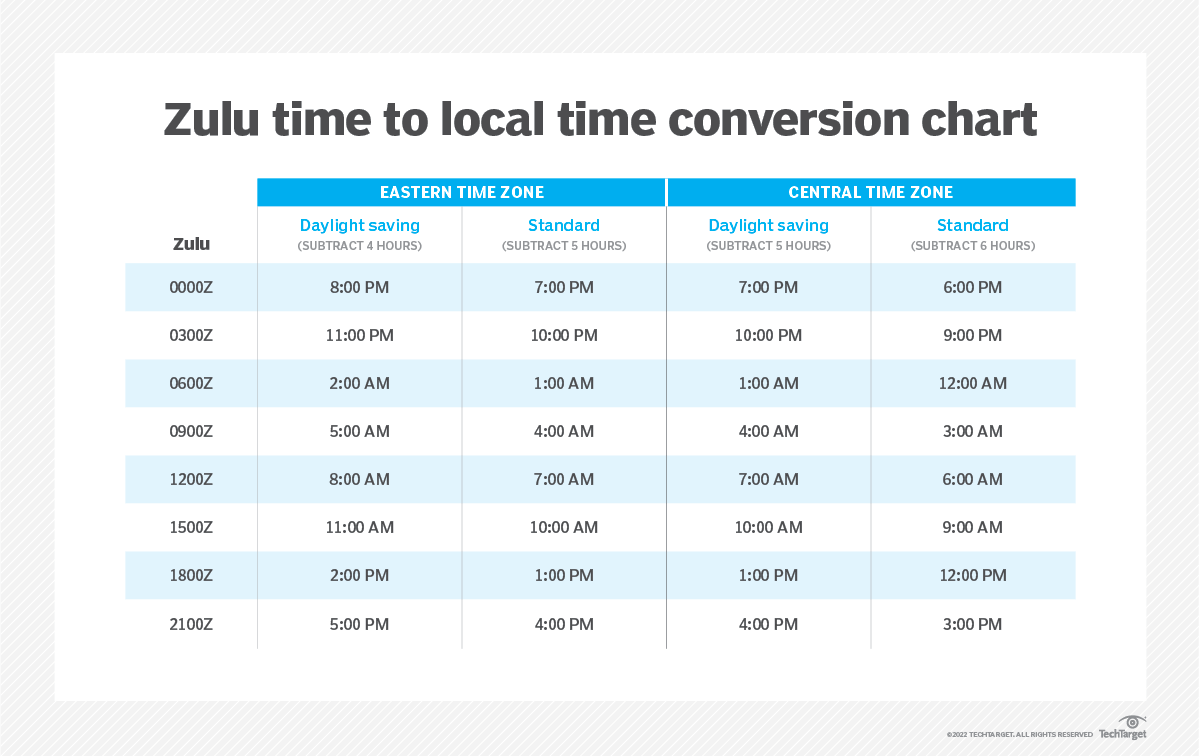
If you’re in New York during the winter, you’re in Eastern Standard Time (EST). You’re five hours behind the Zulu time zone. So, if it’s 1500Z (3:00 PM Zulu), it’s 10:00 AM in Manhattan. When Daylight Saving Time kicks in, the gap narrows to four hours.
This is where people usually trip up.
Zulu time never changes for Daylight Saving Time. It is the steady anchor. While the rest of us are frantically moving our clocks forward or back and complaining about losing an hour of sleep, Zulu stays exactly where it is. It’s the constant. If you’re a programmer or a data scientist, you probably love this. Dealing with time zones in code is a special kind of hell, but UTC/Zulu is the one thing that doesn't lie to you.
Who Actually Uses This?
It’s not just for people in flight suits.
- Aviation: Every single international flight plan is filed in Zulu. If a pilot hears a weather report saying a storm is hitting at 1800Z, they don't have to check what state they're currently flying over to know when to bank left.
- Military Operations: When the Pentagon coordinates a strike or a supply drop, they can't afford a "Wait, did you mean your time or my time?" conversation.
- Meteorology: Weather happens everywhere at once. To map it, scientists need a snapshot of the entire planet at the exact same moment. They use Zulu.
- The Internet: Your computer is likely syncing with an NTP (Network Time Protocol) server right now that is spitting out UTC/Zulu time. It's how servers know which email was actually sent first.
The GMT vs. UTC Confusion
You'll hear people use GMT and UTC interchangeably. Most of the time, they aren't wrong, but if you're a horologist or a physicist, there is a massive difference.
GMT is a time zone. It’s a regional thing used in the UK and parts of Africa.
UTC is a time standard.
GMT is based on the Earth's rotation, which is actually kind of wobbly. The Earth is slowing down very slightly over time. UTC, however, is measured by ultra-precise atomic clocks. These clocks are so accurate they won't lose a second in millions of years. To keep the atomic time of UTC in sync with the physical rotation of GMT, we occasionally add "leap seconds."
It’s a weird tug-of-war between the stars and the atoms.
Why You Should Care (Even if You’re Not a Pilot)
If you work in a global company, you've probably had that awkward Zoom invite where someone shows up three hours late.
Setting a "Company Zulu" can actually solve that. Instead of saying "Let’s meet at 9 AM Pacific," saying "Meeting at 1600Z" removes the ambiguity. It forces everyone to do the same math against a single, unmoving target.
Also, if you're into amateur radio (HAM radio), you basically live in the Zulu time zone. All logs are kept in Zulu so that a guy in Prague and a woman in Peru can confirm they talked at the exact same moment in history.
Common Misconceptions and Errors
A big one is thinking Zulu is just "London time."
It isn't.
During the summer, London moves to British Summer Time (BST), which is UTC+1. So, for half the year, Zulu time is actually an hour behind what's happening on the ground in Greenwich.
Another mistake? Thinking there's a "Zulu daylight savings." There isn't. Ever.
Actionable Steps for Staying On Time
If you’re dealing with international clients or travel, stop trying to memorize the offset for every city. It’s too much mental load.
- Add a Zulu Clock: Most smartphones let you add a second clock to your home screen. Set one to London or "UTC" and label it Zulu.
- Use 24-Hour Format: Zulu is almost always expressed in military time (0000 to 2359). Get used to it. It eliminates the AM/PM confusion entirely.
- Check the "Z": Next time you see a timestamp on an official document or a technical log, look for that Z. Now you know it's the absolute reference point.
- Sync Your Tech: If you're a developer, always store your timestamps in the database as UTC/Zulu. Convert to the user’s local time only at the very last second in the UI. Your future self will thank you for avoiding the "time zone bugs" that haunt most legacy software.
The world is messy, but the Zulu time zone is the one piece of order we’ve all agreed on. It’s a silent, invisible grid that keeps our globalized, hyper-connected life from crashing into itself.