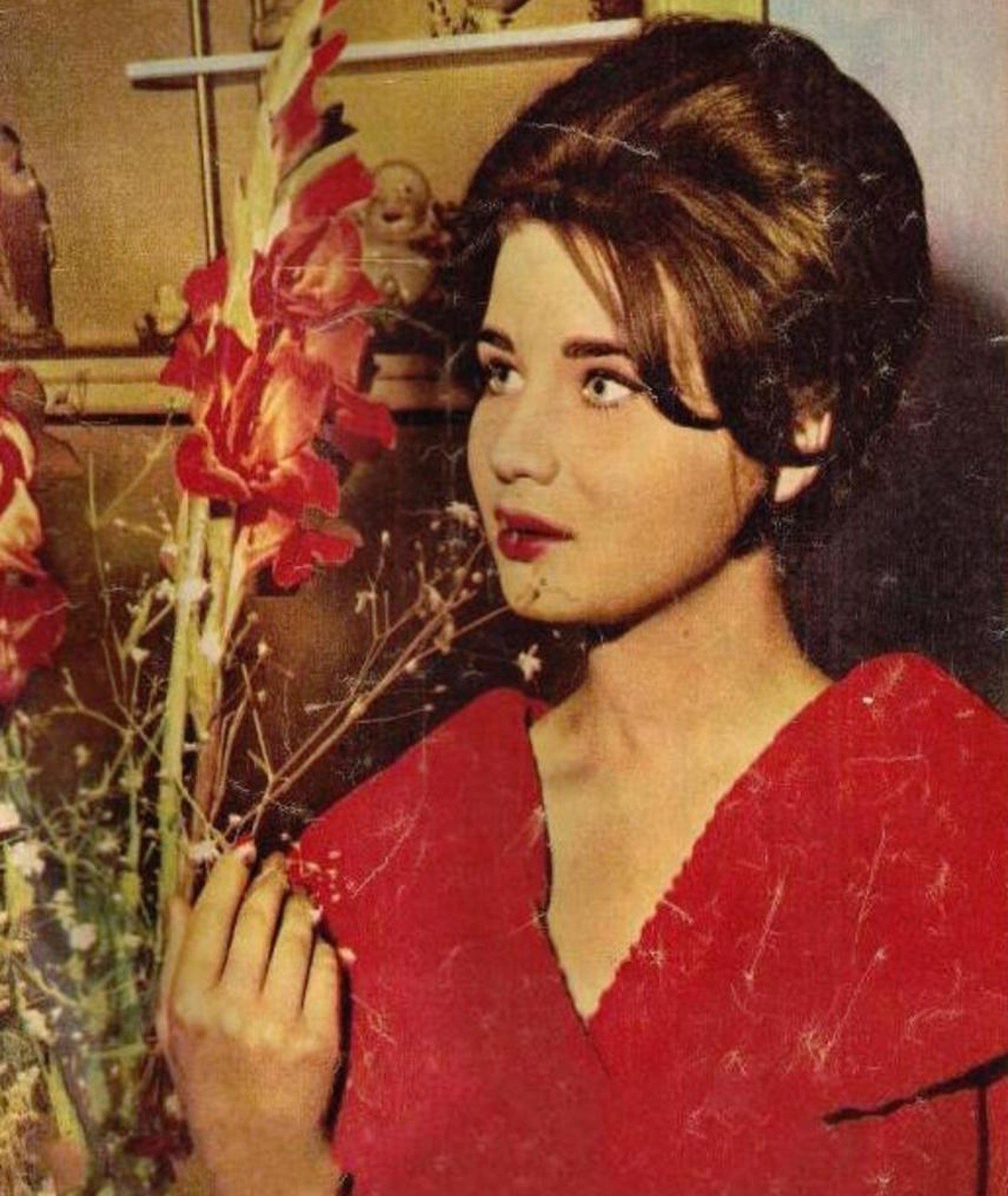
Honestly, if you’ve ever scrolled through social media and thought you saw a vintage, black-and-white photo of Jennifer Lawrence wearing a 1950s ballgown, you weren't hallucinating. You were just looking at Zubaida Tharwat.
The resemblance is uncanny. It’s one of those internet rabbit holes that never quite stops being weird. But for fans of classic Arabic cinema, she was so much more than a "historical twin" for a Hollywood star. She was the woman with the most beautiful eyes in the history of the Egyptian screen—often called the "Eyes of Venus" or the "Kitten of Cinema."
Zubaida Tharwat wasn't just a face, though. She was a powerhouse during the Golden Age of Egyptian film, a time when Cairo was the Hollywood of the Middle East. Her story isn't just about beauty; it’s about a girl from a strict aristocratic family who fought her way onto the screen, starred alongside legends like Omar Sharif, and then walked away from it all while she was still at the top.
From Law Student to Silver Screen Queen
Born in Alexandria in 1940, Zubaida came from a background that didn't exactly scream "actress." Her father was a high-ranking Navy officer. Her grandfather was a sultan’s son. In that world, young women were expected to become lawyers or socialites, not performers.
She actually did study law at Alexandria University. She even worked as a trainee lawyer for a bit just to keep her grandfather happy. But the universe had other plans. In 1955, a teen magazine called Al-Geel (The Generation) ran a beauty contest. Zubaida won. Her face was plastered on covers, and suddenly, every director in Egypt wanted a piece of that "innocent" look.
Her debut came in 1956 with the film Dalila. It was a small role, but she was sharing the screen with Shadia and Abdel Halim Hafez. Talk about a trial by fire. By the time she starred in A Day of My Life (Youm Min Omry) in 1961, she was a household name.
The Romance That Almost Was
One of the most enduring stories about Zubaida Tharwat involves her co-star, the legendary singer Abdel Halim Hafez. Their chemistry in Youm Min Omry was so intense that people refused to believe it was just acting.
Years later, in a rare 2015 interview with journalist Amr el-Leithy, Zubaida dropped a bombshell. She admitted that Abdel Halim actually asked her father for her hand in marriage. The answer? A hard "no." Her father reportedly told him, "I won't marry my daughter to a singer."
It’s a classic, heartbreaking "what if" of Egyptian pop culture. Zubaida eventually married five times, but she famously requested to be buried next to Abdel Halim Hafez after she died. Even though that request wasn't granted—she was buried in her family's plot in Heliopolis—it tells you everything you need to know about the depth of that connection.
Why She Walked Away
By the late 1980s, the "Queen of Romance" was done. She retired after her final play, Meen Ye'dar ala Reem (Who Can Beat Reem), in 1987.
Why did she quit?
She never gave a single, dramatic reason. Some say it was the changing landscape of the industry. Others think she just wanted to be a mother to her four daughters (from her marriage to Syrian producer Sobhy Farahat). For decades, she lived a quiet life, mostly avoiding the spotlight until that final, viral wave of fame brought her back into the public eye shortly before she passed away in 2016.
Essential Zubaida Tharwat: What to Watch
If you want to understand why people are still obsessed with her nearly 70 years after her debut, you have to see her in action. Forget the still photos; it’s the way she commanded the camera that mattered.
- A Man in Our House (Fi Baitina Ragol, 1961): This is arguably one of the best Egyptian films ever made. She stars alongside a young Omar Sharif. It’s a political thriller, a romance, and a historical drama all rolled into one.
- A Day of My Life (Youm Min Omry, 1961): The "Roman Holiday" of Egyptian cinema. It’s sweet, musical, and features that legendary chemistry with Abdel Halim Hafez.
- The Guilty (Al-Mothneboon, 1975): A later role that showed she could do more than just play the "innocent girl." It’s much darker and more controversial.
- Girl of 17 (Bent 17, 1958): A classic coming-of-age story that solidified her status as the face of Egyptian youth in the late 50s.
The Legacy of the Eyes of Venus
Zubaida Tharwat died in December 2016 at the age of 76 after a battle with lung cancer. She left behind a filmography of over 30 movies and a legacy that transcends just being "the pretty girl" on the poster.
She represented a specific era of Egyptian elegance—one that was sophisticated, romantic, and deeply emotional. While the internet might always link her to Jennifer Lawrence, for those who know the history of Arab cinema, she remains the ultimate icon of the screen’s golden years.
What you can do next
- Track down a subtitled version of Fi Baitina Ragol: It’s widely available on various streaming platforms specializing in classic Arabic content. It’s the best entry point for her work.
- Explore the "Golden Age" contemporaries: If you like Zubaida's style, look into the films of Soad Hosny or Faten Hamama to get a full picture of 1960s Egyptian cinema.
- Compare the "Twins": Look up side-by-side clips of Zubaida in The Little Angel and Jennifer Lawrence in The Hunger Games. The micro-expressions are actually pretty startling.