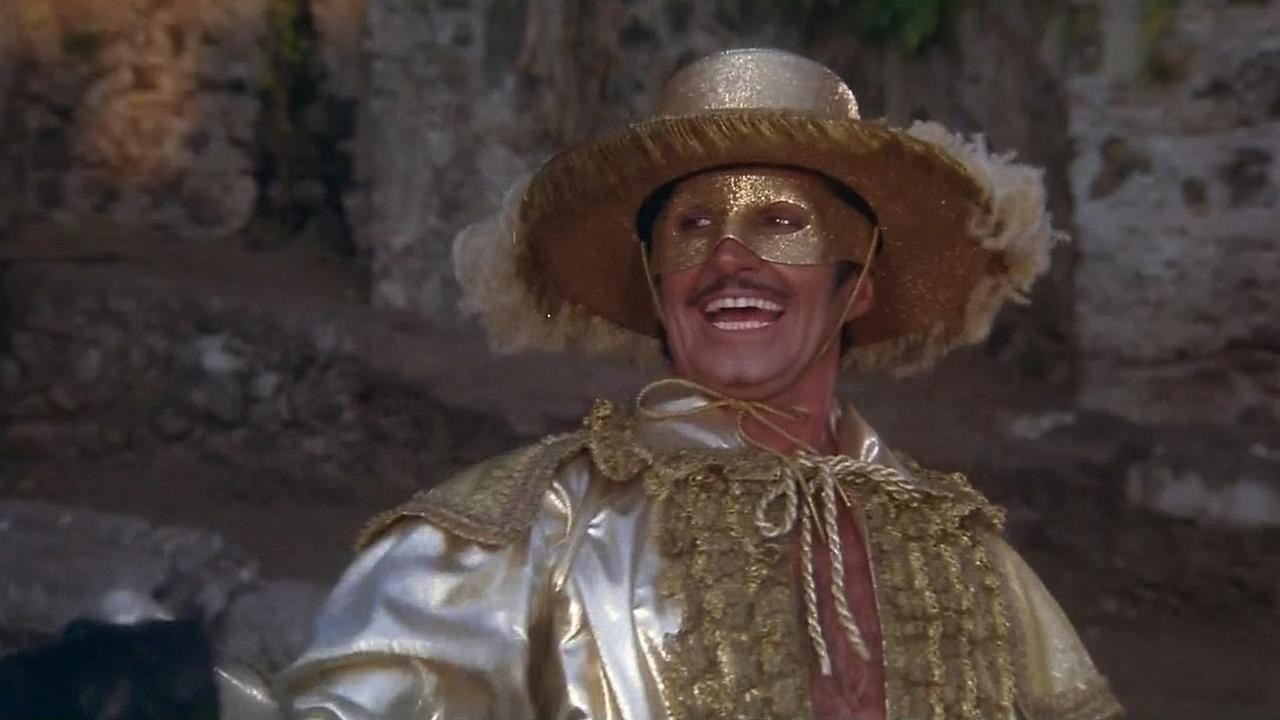
George Hamilton’s tan is legendary. In the early eighties, he decided to take that bronzed charisma and apply it to a swashbuckling hero who spends more time thinking about his wardrobe than his rapier. That’s how we got Zorro the Gay Blade. Honestly, if you haven’t revisited this movie since you saw it on a grainy VHS or caught it on cable at 2 AM, you’re missing out on one of the most self-aware comedies of the era. It’s a riot.
Released in 1981, the film didn't just parody the Zorro legend; it dissected the very idea of the hyper-masculine hero. At the time, critics weren't entirely sure what to make of it. Was it too camp? Was it offensive? Or was it just brilliant? Looking back through a modern lens, it’s surprisingly light on its feet. It avoids the mean-spiritedness that plagues a lot of eighties "spoof" movies. Instead, it leans into the absurdity of the "Secret Identity" trope with a level of commitment that few actors could pull off as well as Hamilton did.
The Dual Roles of Don Diego and Bunny Wigglesworth
The plot is basically a family reunion from hell. After the original Zorro dies, his son, Don Diego Vega, returns to Los Angeles to take over the family business of being a masked vigilante. But there's a problem. Diego gets injured. Enter his long-lost twin brother, Ramon. Except Ramon doesn't go by Ramon anymore. He’s spent time in the British Royal Navy, changed his name to Bunny Wigglesworth, and has developed a very specific, flamboyant aesthetic.
Hamilton plays both roles. It’s a masterclass in comedic timing.
While Diego is the traditional, somewhat bumbling hero, Bunny is the real star. When he takes over the Zorro mantle, he refuses to wear the boring black cape. Why be drab when you can be fabulous? Bunny’s "Gay Blade" version of Zorro terrorizes the villainous Captain Esteban (played with wonderful irritability by Ron Leibman) in a series of increasingly colorful outfits. We're talking plum, gold, and a very aggressive shade of scarlet.
Breaking Down the Satire: It’s Not Just About the Costumes
You've got to appreciate the writing here. It was penned by Hal Dresner, Greg Alt, Don Moriarty, and Bob Randall. They weren't just making "gay jokes." They were making "Zorro jokes." The humor stems from the clash between the rigid, authoritarian world of Spanish-occupied California and the unapologetic individuality of Bunny Wigglesworth.
- The Whip Scene: Bunny’s weapon of choice isn't always a sword; it’s a whip that he uses with the precision of a choreographer.
- The Political Subtext: Surprisingly, the movie touches on the exploitation of the "peons" (the peasants). While it’s played for laughs, the film actually aligns the flamboyant Bunny with the revolutionary spirit more effectively than the traditional Diego.
- The Visual Gags: There’s a scene where Bunny is trying to pick a color for his next mission that feels like a precursor to the "cerulean" monologue in The Devil Wears Prada.
Most people think of 1980s comedy as being crude. Zorro the Gay Blade is actually quite sophisticated. It relies on wordplay and the physical comedy of George Hamilton trying to navigate a balcony while wearing two-inch heels. It’s silly. It’s camp. But it’s never hateful.
Why the Critics Were Split
When it hit theaters, The New York Times was somewhat lukewarm, though they praised Hamilton’s "comic flair." On the other hand, audiences who grew up with the Tyrone Power or Guy Williams versions of Zorro found it refreshing. It was a deconstruction before "deconstruction" was a buzzword in Hollywood.
There’s a nuance here that often gets lost. Hamilton received a Golden Globe nomination for Best Actor in a Motion Picture – Musical or Comedy for this role. That’s not a small feat for a movie that features a man in a feathered hat fighting soldiers with a gold-trimmed fan. The industry recognized that what he was doing was difficult. Playing a caricature without losing the "soul" of the character takes a lot of work.
The Production: A Family Affair
The movie was directed by Peter Medak. If that name sounds familiar, it’s because he also directed the haunting horror classic The Changeling. Talk about range. Medak brought a certain level of cinematic quality to the film that kept it from looking like a cheap TV skit. The sets look great. The lighting is lush.
Hamilton also served as a producer. He put his own money and reputation on the line for this. He clearly had a deep affection for the Zorro mythos, having grown up on the old serials. By poking fun at it, he was actually paying homage to it.
Addressing the "Gay" in the Title
It’s the elephant in the room for modern audiences. In 1981, the word "gay" was in a state of linguistic transition. The film uses it both in the traditional sense of "joyful/bright" and as a clear reference to Bunny’s sexuality.
By today’s standards, some of the tropes are a bit dated. However, many LGBTQ+ film historians have pointed out that Bunny Wigglesworth is actually the most competent person in the movie. He’s the one who saves the day. He’s the one who’s smarter than the villains. He isn't the butt of the joke; the people who are offended by him are the butt of the joke. That’s a crucial distinction.
Bunny is a hero. He’s brave, he’s a crack shot, and he’s a master tactician. He just happens to think that black is a very "depressing" color for a revolution.
The Legacy of the Plum Cape
Why does this movie still matter in 2026? Because we are currently living in an era of "grimdark" reboots. Every hero has to be tortured. Every mask has to be tactical carbon fiber. Zorro the Gay Blade reminds us that heroes can be fun. They can be ridiculous.
It paved the way for movies like The Princess Bride and Robin Hood: Men in Tights. It showed that you could take a beloved piece of intellectual property and turn it inside out without destroying what made it special in the first place.
If you watch it today, you'll notice things you missed as a kid. The chemistry between Hamilton and Brenda Vaccaro (who plays the lusty Florinda) is electric. The way Ron Leibman reacts to every new costume change is a masterclass in slow-burn frustration. It’s a dense comedy. The jokes come fast. If you blink, you’ll miss a pun about Spanish history or a subtle jab at 19th-century tax policy.
How to Appreciate Zorro the Gay Blade Today
To truly "get" this movie, you have to watch it in the context of the Zorro timeline.
- Watch the 1940 Tyrone Power film: This gives you the baseline for the "serious" Zorro.
- Look for the George Hamilton interviews: He often talks about how he did his own stunts (and how much he loved the costumes).
- Pay attention to the music: The score by Ian Fraser is a perfect send-up of the sweeping, melodramatic music of the 1940s.
It’s easy to dismiss a movie with a title like this as a relic of a less sensitive time. But that’s a mistake. It’s a film about being yourself, even if "yourself" involves a lot of sequins and a secret hideout in a cave.
Actionable Insights for Film Buffs
If you’re a fan of cult cinema or just looking for something that breaks the mold of modern action-comedies, here is how to dive deeper into this specific niche:
- Track down the Blu-ray: The color palette is essential. Streaming versions often compress the colors, and you really need to see the "Electric Blue" suit in all its high-definition glory to appreciate the costume design.
- Compare it to "The Scarlet Pimpernel": Bunny Wigglesworth owes a lot more to Sir Percy Blakeney than he does to the original Don Diego. Seeing the DNA of the "fop-turned-hero" archetype makes the satire even sharper.
- Check out George Hamilton’s other 80s work: If you like his comedic timing here, Love at First Bite (where he plays Dracula in Manhattan) is the perfect companion piece.
- Study the "Camp" Aesthetic: Read Susan Sontag’s "Notes on 'Camp'" and then watch the movie. You'll see that Zorro the Gay Blade is a textbook example of "Camp" as a serious art form—it’s "the love of the exaggerated, the 'off,' of things-being-what-they-are-not."
Ultimately, the film stands as a testament to the idea that you don't have to be "gritty" to be a legend. Sometimes, the most revolutionary thing you can do is put on a bright pink cape and ride a horse through a wall.
Stop treating it like a forgotten footnote in film history. It’s a sharp, witty, and surprisingly heartfelt piece of 1980s cinema that deserves a spot in your rotation. Go watch it for the tan, but stay for the surprisingly competent revolution.
Next Steps for the Interested Viewer:
- Locate a high-quality copy: Look for the 20th Century Fox home video releases which preserve the original 2.35:1 aspect ratio.
- Analyze the Satire: Watch for the scene where Bunny explains his "transformation" in the British Navy; it’s one of the best-written monologues in 80s comedy.
- Explore the Archetype: Research the "Dandy" in literature to see how Bunny fits into a long history of characters who use fashion as a weapon against boring societal norms.