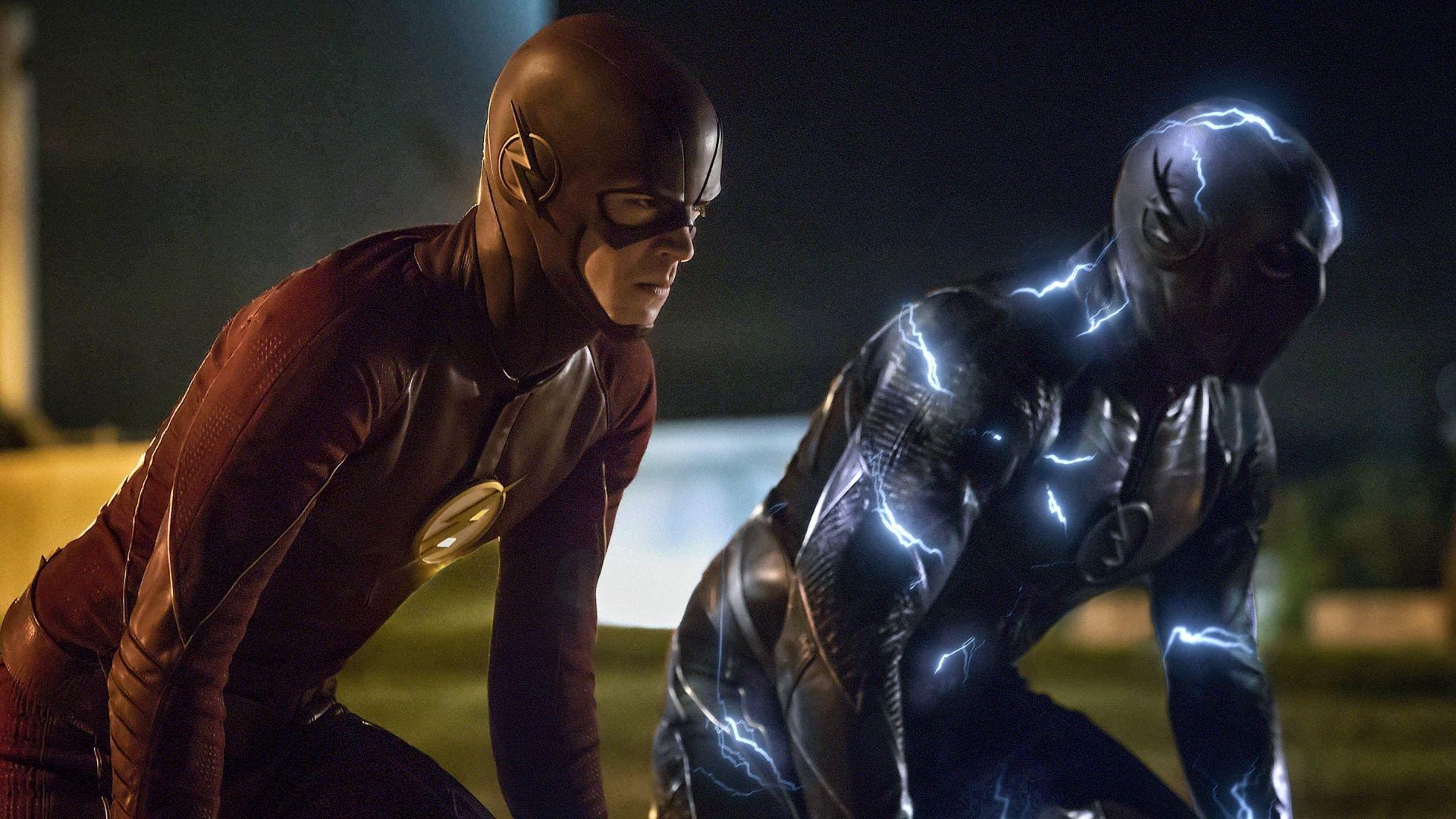
He was terrifying. Honestly, if you look back at the second season of The Flash, there was this palpable shift in energy when Zoom finally stepped onto the screen. It wasn't just the blue lightning or the nightmare-fuel mask. It was the way he moved.
Speedsters are usually graceful. Zoom was a predator.
Fans who grew up on the CW’s Arrowverse remember the mystery of "Who is Zoom?" as one of the peak moments in televised superhero history. It wasn't just a rerun of the Reverse-Flash reveal from Season 1. It felt deeper, darker, and significantly more personal for Barry Allen. When we talk about Zoom the Flash series fans usually point to that specific era as the show's high-water mark for villainy. He didn't just want to win; he wanted to break the very concept of hope.
The Man Behind the Mask: Who Was Hunter Zolomon?
Hunter Zolomon wasn't born a monster, but his backstory is basically a blueprint for one. In the show, we learn he witnessed his father murder his mother—a dark mirror to Barry’s own childhood trauma. But while Barry had Joe West and a support system, Hunter ended up in the foster system and eventually a psychiatric hospital. He became a serial killer on Earth-2 long before he ever got speed.
That’s the core difference. Eobard Thawne was obsessed. Hunter Zolomon was broken.
When the S.T.A.R. Labs particle accelerator exploded on Earth-2, Hunter was undergoing electroshock therapy. The combination of dark matter and high-voltage electricity turned a serial killer into the fastest man alive. Or, at least, he thought he was. He called himself Jay Garrick for a while, playing the hero to give people hope just so he could rip it away. It’s a sick, twisted psychological game that Teddy Sears played with eerie perfection. You’ve got to appreciate how he flipped from the "charming mentor" to the "soulless demon" the moment the mask came off.
Why Zoom Was More Than Just a "Reverse-Flash" Clone
A lot of people think speedster villains are all the same. They run fast, they vibrate their hands through hearts, and they talk about being "the future." But Zoom was a different animal entirely.
- The Visual Design: His suit looked like it was made of charred skin or shadows. Unlike Thawne’s bright yellow, Zoom was a void.
- The Voice: Bringing in Tony Todd—the legend from Candyman—to do the voice was a stroke of genius. It gave the character a supernatural, almost demonic weight that made the human reveal even more shocking.
- The Motivation: Thawne wanted to go home. Zoom wanted to be the only speedster left in the multiverse. He was a vacuum, consuming speed from others because his own cells were decaying from the Velocity-9 serum.
He wasn't trying to change the timeline for a specific goal. He was just hungry. That kind of primal hunger is way harder to negotiate with than a guy who just hates your future self.
The Fight That Changed Everything
Remember "Enter Zoom"? That episode in Season 2 changed the stakes of the entire show.
Usually, the hero gets beat up, learns a lesson, and wins in the third act. Not here. Zoom caught Barry’s lightning and threw it back at him. He caught Barry’s punches like they were nothing. Then, he did the unthinkable: he broke Barry’s back. He paraded Barry’s limp body around Central City, showing the citizens, the police, and the media that their "Flash" was a failure.
It was brutal. It was the first time viewers truly felt Barry might lose everything.
The Velocity-9 Problem and the Multiverse
The science of Zoom the Flash series lore gets a bit crunchy, but it’s worth understanding. Hunter wasn't naturally faster than Barry forever. He was dying. The Velocity-9 drug he used to boost his speed was literally tearing his DNA apart. This is why he needed Barry’s speed—he needed a "cure" for his own cellular degeneration.
This introduces the concept of the Speed Force as a sentient entity. The Speed Force doesn't like it when people cheat. By using drugs and stealing speed, Hunter had essentially put a target on his back. This eventually led to the creation of the Black Flash. When the Time Wraiths finally caught up to him in the Season 2 finale, they didn't just kill him. They transformed him into the Speed Force’s personal grim reaper.
Talk about a promotion from hell.
What Most People Get Wrong About the Earth-2 Reveal
There’s a common misconception that Zoom "became" Jay Garrick. He didn't. He found the real Jay Garrick (the Flash of Earth-3, played by John Wesley Shipp) and threw him in a cage with a metal mask on. Hunter then stole Jay's name and identity to play a "game" on Earth-2.
It’s a complicated layer of deception. He wasn't just hiding; he was performing. He played the hero for years on Earth-2 just to make his eventual betrayal more "delicious." That’s a level of sociopathy that even the most hardened villains in the Arrowverse rarely touched.
The Legacy of Zoom in the Later Seasons
Even after Hunter was hauled off by the Time Wraiths, his shadow loomed large. Every speedster that came after—Savitar, Godspeed, Red Death—was compared to him. Most of them fell short. Why? Because Zoom felt like a horror movie villain dropped into a CW soap opera.
He made the world feel small and dangerous. When he was on screen, you weren't looking at the background characters or thinking about the "ship" of the week. You were wondering if everyone was going to die. That tension is something The Flash struggled to maintain in its later years.
How to Revisit the Zoom Arc Today
If you’re looking to re-watch or dive into the Zoom the Flash series storyline for the first time, don't just binge the whole show. Focus on the core Hunter Zolomon arc.
- Start with Season 2, Episode 1 to see the "Jay Garrick" introduction.
- Pay close attention to "Enter Zoom" (Episode 6) for the physical dominance.
- "Versus Zoom" (Episode 18) is the deep dive into his origin story.
- The finale, "The Race of His Life," shows the final consequence of his arrogance.
Seeing the evolution of the character—from the mysterious blur in the woods to the "Black Flash" entity—is a masterclass in building a long-form antagonist.
Actionable Insights for Fans and Writers
To truly appreciate the depth of this character, look at the writing choices made during the 2015-2016 television season. The writers used Zoom to explore the "nature vs. nurture" argument. By giving Hunter and Barry similar backstories but different outcomes, the show challenged Barry's moral superiority.
If you're a writer, study how the show used a "mystery box" (the identity of the man in the iron mask) to keep the audience engaged even when the main villain's identity was revealed. If you're a fan, look for the subtle cues in Teddy Sears' early Season 2 performance—the way he looks at Barry’s speed with a mix of envy and hunger. It’s all there, hiding in plain sight.
The best way to experience the Zoom era is to watch for the parallels. Look at how Joe West acts as a tether for Barry, and how the absence of that tether turned Hunter into a monster. The speed was just a tool; the trauma was the engine. That’s why, even in a world of gods and aliens, a guy in a tattered black suit remains the most terrifying thing to ever run through Central City.