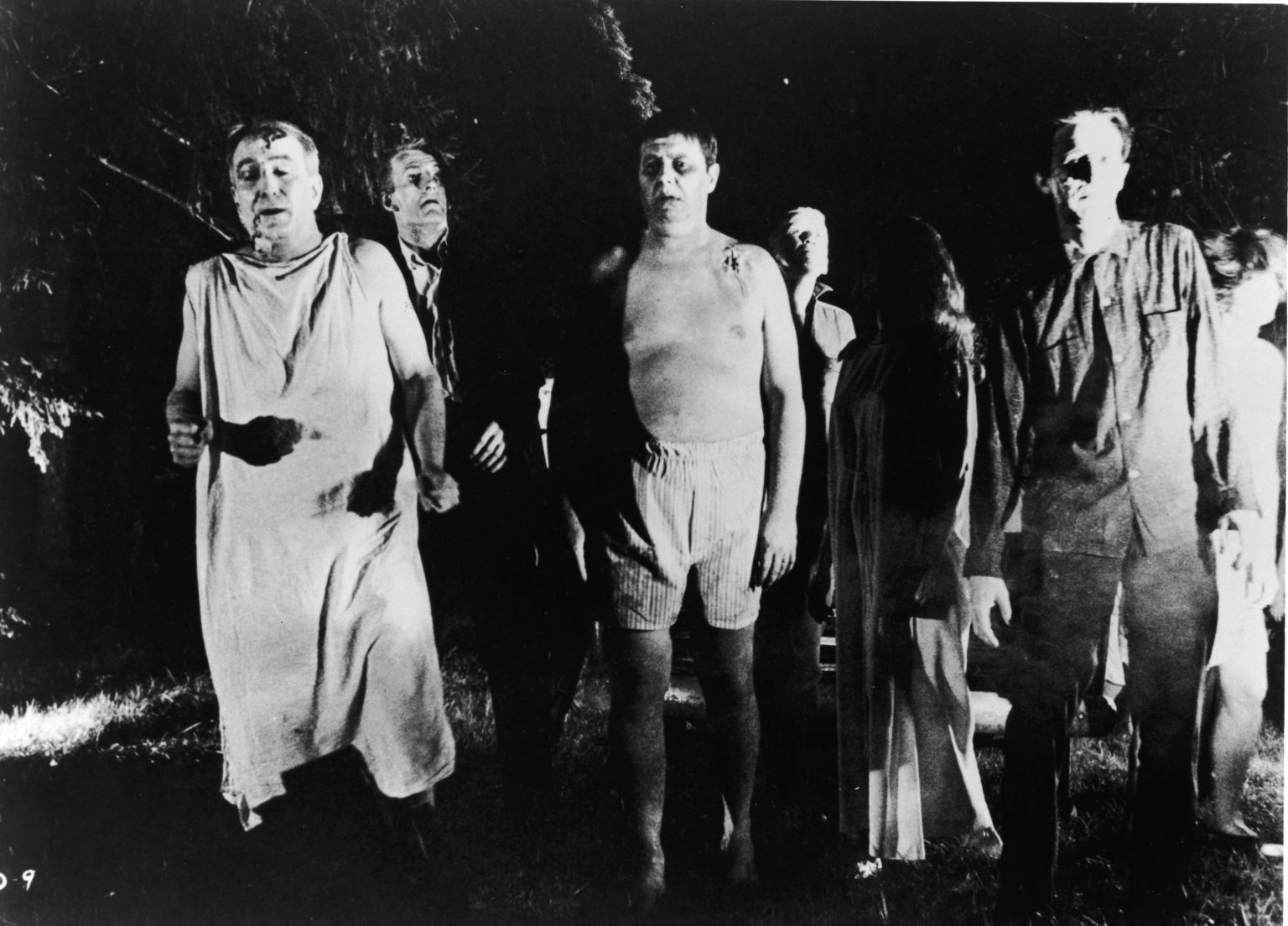
You’ve seen the headlines. Every few months, a story bubbles up about "zombie deer disease" or a fungus that turns ants into mindless puppets, and suddenly, the internet loses its mind. We're fascinated by it. Honestly, it’s kinda weird how much we love being terrified by the idea of the world ending not with a bang, but with a shuffle and a groan. But when you see zombies in the news today, it isn't usually about a Hollywood movie set. It’s about biology, neurology, and the very real ways nature can hijack a living brain.
Take Chronic Wasting Disease (CWD). It’s a real thing. It’s happening right now in deer populations across North America, including places like Yellowstone National Park and various forests in Canada. CWD is caused by prions—misfolded proteins that basically eat holes in the brain. The animals become emaciated, lose their fear of humans, and stumble around like something out of a George Romero flick. Researchers at the University of Minnesota and other institutions have been sounding the alarm because prions are notoriously hard to "kill." They aren't even alive to begin with. You can’t just bleach them away.
The Cordyceps craze and the reality of fungal takeovers
Most people got their latest dose of "zombie" anxiety from The Last of Us, but the fungus at the heart of that story, Ophiocordyceps unilateralis, is a very real inhabitant of our world. It's spectacular. It’s also horrifying. If you're an ant in a tropical rainforest, this is your worst nightmare.
The fungus doesn’t just kill the ant. That would be too simple. Instead, it grows through the ant's body, eventually taking control of its muscles. It forces the ant to climb to a specific height—usually about 25 centimeters above the ground—where the temperature and humidity are perfect for fungal growth. The ant bites down on a leaf in a "death grip," and then a stalk grows out of its head to shower spores on the colony below.
David Hughes, an entomologist who worked as a consultant on the game, has spent years studying this. He’s pointed out that while this fungus is highly specialized for insects, the concept of a parasite changing behavior is a cornerstone of evolutionary biology. It's called "extended phenotype." Basically, the parasite’s genes are expressing themselves through the host’s body. We see it in Toxoplasma gondii too. That’s the parasite found in cat litter that makes mice lose their fear of cats. Some studies even suggest it might subtly influence human behavior, though that's still a hotly debated topic in the halls of academia.
Why "zombies in the news" keeps trending every year
News cycles love a good scare. It's clicky. But there's a deeper reason why we keep seeing zombies in the news even when there isn't a pandemic. It's a metaphor. We use the "zombie" label to describe everything from "zombie fires" in the Arctic—peat fires that burn underground through the winter—to "zombie companies" that only exist because of cheap debt.
In 2024 and 2025, the term gained new life in the tech world. We started hearing about "zombie AI" accounts—dead users' profiles being reanimated by large language models to keep engagement high on social media platforms. It’s eerie. It’s also a legal minefield. When a person dies but their digital ghost keeps tweeting or posting "personal" updates, what do we call that? It's a different kind of undead, but it hits that same primal nerve of something being not quite right.
The "Zombie" Prion Threat: Is it a real risk to humans?
This is where things get serious. Epidemiologists at the CDC and researchers like Michael Osterholm have been tracking CWD for decades. The big question is "species jump." We saw it with Mad Cow Disease (BSE) in the UK during the 90s. People ate tainted beef and developed variant Creutzfeldt-Jakob Disease. It was devastating.
So far, there is no documented case of CWD jumping to humans. None. But laboratory studies have shown that CWD prions can infect human cells in a petri dish under certain conditions. That's enough to keep scientists awake at night. If you’re a hunter in Wisconsin or Wyoming, the advice is clear: get your meat tested. Don't eat the brain. Don't eat the spinal cord. It’s common sense, but in a world obsessed with survivalist tropes, these warnings take on a much darker tone.
Beyond the hype: The psychological appeal of the apocalypse
Why do we click on these stories? Dr. Steven Schlozman, a Harvard psychiatrist who actually wrote a "medical" book on zombie neurobiology for fun, suggests it's a way for us to process collective trauma. Life is complicated. Taxes are hard. Geopolitics is a mess. A zombie apocalypse? That’s simple. You run, you find supplies, you survive. It’s a weirdly comforting fantasy because the stakes are binary.
We also see this reflected in how news outlets frame medical breakthroughs. Sometimes, you'll see a headline about "reanimating" cells. In 2019, a team at Yale managed to restore some cellular function in pig brains hours after death. They called it BrainEx. The media, of course, called it the first step to a zombie pig. It wasn't. The brains weren't "conscious" or "alive" in any meaningful way, but the ability to restart cellular metabolism was a massive deal for stroke research.
Real-world "Zombie" scenarios you should actually know about
If you want to talk about real-life zombies, look at the "Zombie Drug" or "Tranq." This is the combination of fentanyl and xylazine (a veterinary sedative) that has hit cities like Philadelphia and San Francisco. It's heartbreaking. Users develop severe skin ulcers and can fall into a catatonic, hunched-over state for hours. This isn't a fun movie trope; it's a public health crisis.
The "zombie" label here is controversial. Some advocates say it dehumanizes people struggling with addiction. Others argue it accurately describes the terrifying physical toll the drug takes on the body. Regardless of the terminology, it’s a dominant fixture when you search for zombies in the news, representing a very grim reality of the modern opioid epidemic.
How to spot "Zombie" misinformation online
Not everything you read is true. Obviously. But "zombie" stories are magnets for "pink slime" news sites and AI-generated tabloids.
- Check the source. Is it a peer-reviewed journal like Nature or The Lancet, or a site called "TheDailyEndTimes.biz"?
- Look for the "jump." If the article says a virus will turn us into zombies, it's lying. If it says a virus has the potential to cause neurological shifts, it might be worth a read.
- Verify the imagery. AI-generated images of "zombie outbreaks" often have tell-tale signs: too many fingers, weird lighting, or text that looks like gibberish.
The truth is usually much more boring—and much more interesting—than the fiction. A "zombie" virus that kills 100% of its hosts would actually be an evolutionary failure. A successful virus wants its host to stay alive long enough to spread the seeds. Evolution doesn't want a "zombie"; it wants a carrier.
Practical steps for the "Zombie-Adjacent" world
Look, a Hollywood-style collapse isn't happening tomorrow. But the "zombie" trend in news teaches us a lot about preparedness and scientific literacy.
- Get your meat tested. If you hunt in CWD-active zones, use the state-provided testing kits. It’s free or cheap, and it’s the only way to be sure.
- Follow the "Zombie Preparedness" guide. Seriously, the CDC has one. They created it years ago as a tongue-in-cheek way to get people to prepare for actual disasters like hurricanes or power outages. If you have a kit that can get you through a zombie swarm, it can get you through a blizzard.
- Understand the difference between viruses and prions. Viruses are genetic material in a protein coat. Prions are just proteins. This matters because treatments for one won't work for the other.
- Support fungal research. With rising global temperatures, fungi are adapting to warmer environments. Some experts, like those at the Westerdijk Fungal Biodiversity Institute, worry this could make them more capable of surviving inside the warm human body.
The next time you see zombies in the news, take a second to look past the clickbait. Whether it's a deer in the woods, a fungus in the jungle, or a new tech trend, the "undead" are really just a mirror for our own fears about the things we can't control. Stay informed, stay skeptical, and maybe keep a flashlight and some extra water in your trunk just in case. It never hurts to be prepared for the unexpected, even if it doesn't have a taste for brains.