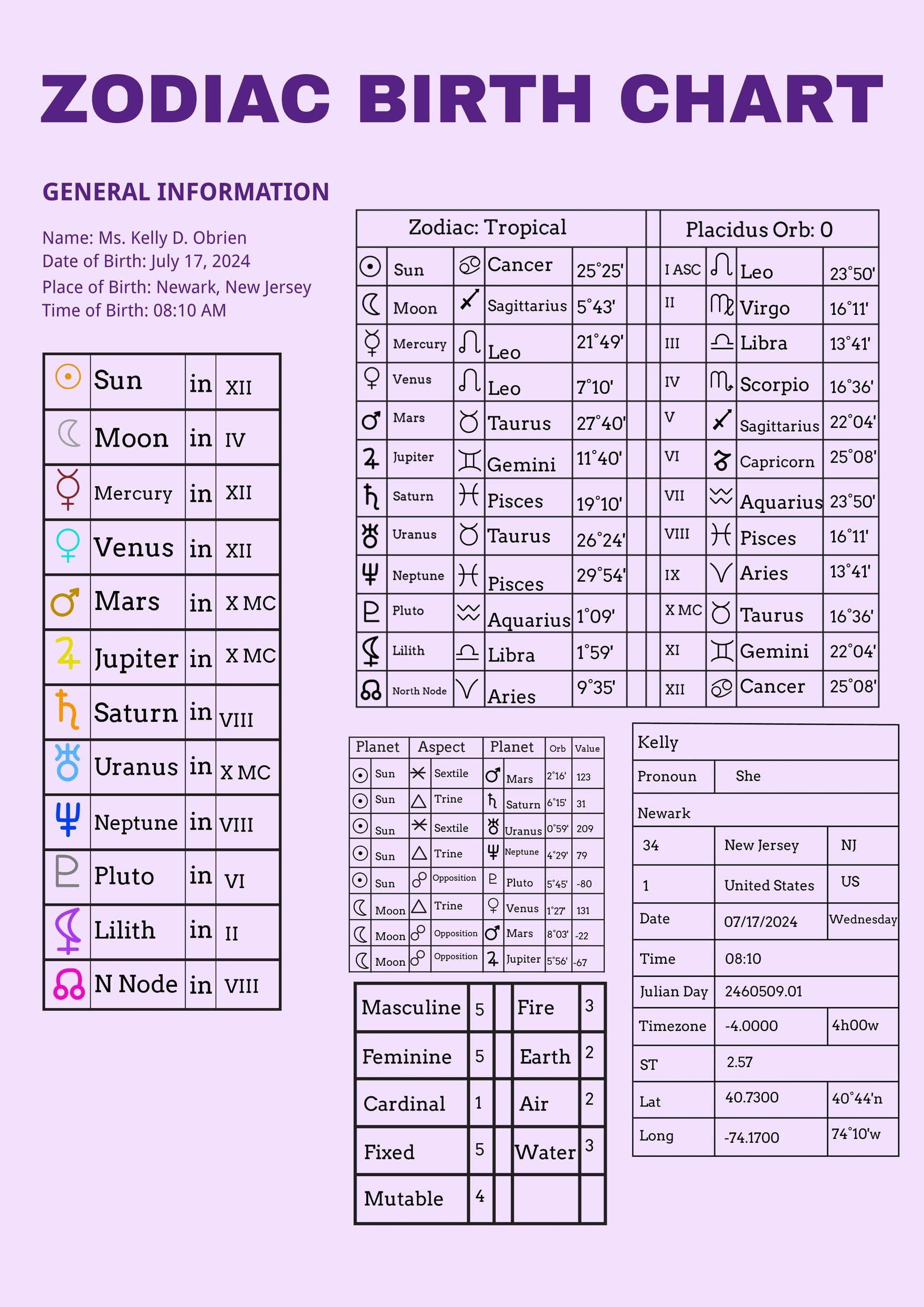
Most people think their "sign" is just that one symbol they check in the back of a magazine. It’s usually the Sun sign. You're a Leo. Or a Pisces. Cool. But have you ever met someone with your same birthday who acts absolutely nothing like you? That's because the zodiac time of birth is the missing piece of the puzzle. It's the difference between a rough sketch and a high-definition photograph.
Without the exact minute you took your first breath, you're basically looking at a map of a city without any street names.
The Rising Sign: The Real Filter of Your Life
If the Sun is your core ego, the Rising sign (or Ascendant) is the "lens" through which you see the world. It changes roughly every two hours. This is why the zodiac time of birth is so high-stakes. A baby born at 6:01 AM could have a completely different Ascendant—and therefore a completely different personality structure—than a baby born at 8:01 AM.
The Ascendant determines your "First House." In astrology, houses are the specific areas of life where planetary energies play out. If you don't have your birth time, you can't calculate your houses. You’re flying blind.
Astrologer Chris Brennan, author of Hellenistic Astrology, often emphasizes that the Ascendant is the most personal point in a chart. It represents the physical body and the immediate environment of your birth. Honestly, it’s often more "you" than your Sun sign is, at least in terms of how you show up in a room. Think of it as the avatar you've chosen for this specific video game called life.
Why 12:00 PM is a Total Lie
If you go to a free chart generator and you don't know your time, the site usually defaults to Noon. Don't do this. It’s better to be honest about the "unknown" than to build a personality profile on a guess.
Why?
Because the Moon moves fast. It covers about 13 degrees of the zodiac every single day. If you were born on a day when the Moon was transitioning from, say, Gemini into Cancer, being off by just four hours could give you an entirely different emotional landscape. You might think you're a detached, intellectual Gemini Moon when you’re actually a deeply sensitive, homebody Cancer Moon. This is the stuff that causes real identity crises for people trying to use astrology for self-growth.
Real-world check: Look at your birth certificate. Not the "short form" one that just lists your name and parents, but the "long form" or "vault copy." Hospital records are usually pretty precise, though even then, nurses sometimes round to the nearest five or ten minutes. Even a five-minute discrepancy can occasionally shift a planet into a different house. It's a game of inches.
The Houses: Where the Action Actually Happens
The zodiac time of birth dictates the house placements. This is where astrology gets practical.
Imagine your chart is a play. The planets are the actors. The signs are the costumes they wear. But the houses? The houses are the stage sets. They tell you where the drama is happening.
If you have Venus in your 10th House, your career and public image are going to be defined by charm, beauty, or artistic talent. But if your birth time moves that Venus into the 11th House, your focus shifts entirely toward social groups, networking, and activism. Same planet. Same sign. Completely different life story.
- The 1st House: Your physical appearance and first impressions.
- The 4th House: Your home, your roots, and your private life.
- The 7th House: Your partnerships and who you’re attracted to.
- The 10th House: Your legacy and professional reputation.
Without that timestamp, you have no idea where your "luck" (Jupiter) or your "challenges" (Saturn) are located. You’re just guessing.
Rectification: What to Do If Your Records Are Gone
Maybe you were born at home. Maybe the hospital burned down. Maybe your parents just... forgot. It happens.
In these cases, professional astrologers use a technique called "Rectification." It is a painstaking, forensic process. It’s basically reverse-engineering your life. An expert like Steven Forrest or Demetra George would look at the major "impact events" of your life—marriages, deaths, major career shifts, big moves—and work backward using planetary transits to find the exact zodiac time of birth that fits those events.
It’s not magic. It’s math.
If a major life event happened when Saturn crossed a specific degree, and that degree corresponds to the 4th House cusp, the astrologer can narrow down your birth time to a 15-minute window. It's fascinating. It's also expensive, but for someone serious about using astrology as a psychological tool, it’s the only way to get a clean signal.
Common Misconceptions About Birth Times
People often think daylight savings time ruins their chart. It doesn't. Modern software is incredibly good at cross-referencing historical time zone changes. When you enter your zodiac time of birth, the computer automatically adjusts for UTC/GMT.
Another myth? That "C-section babies" have "fake" charts. This is nonsense. Astrology is about the moment of the first breath—the moment you become an independent biological entity in the world. How you got out of the womb doesn't change the celestial alignment at that specific second.
The most important thing to remember is that astrology is a system of observation. It’s about cycles. When you pin down your birth time, you're pinning down your place in a cycle that's been observed for thousands of years.
How to Get Your Accurate Data
If you’re in the US, you can usually request a "Long Form Birth Certificate" from the Department of Vital Statistics in the state where you were born. Be specific. You want the one with the time.
Check baby books. Seriously. Parents often wrote the time down in those "First Year" albums, even if it never made it to the official state records.
If you’re still stuck, look at your "Midheaven" (MC). This is the highest point in the sky when you were born. If you know you were born "around sunset," your Sun will be near the 7th House cusp. If you were born "at dawn," your Sun will be near the Ascendant. These rough anchors can at least give you a starting point.
Actionable Steps for Your Chart
- Locate the Long-Form Certificate: Don't trust your mom's memory. Memories fade or get fuzzy after 20+ years of parenting. Get the paperwork.
- Use a High-Quality Calculator: Sites like Astro.com or Astro-Seek are the gold standard. They use the Swiss Ephemeris, which is what professional astronomers and astrologers use for maximum precision.
- Identify Your Ruling Planet: Once you have your zodiac time of birth, find your Ascendant sign. The planet that "rules" that sign is your Chart Ruler. If you’re a Virgo Rising, Mercury is your boss. Tracking that planet’s movements will give you way more insight than reading your daily Sun sign horoscope.
- Watch the Angles: Pay attention to the four main points: Ascendant, Descendant, Midheaven, and Imum Coeli. These are the pillars of your personality.
Getting your birth time right is like finally getting the correct prescription for your glasses. Suddenly, the blurry shapes of your life come into sharp, unmistakable focus. It’s the first step to actually owning your story instead of just reading about it.