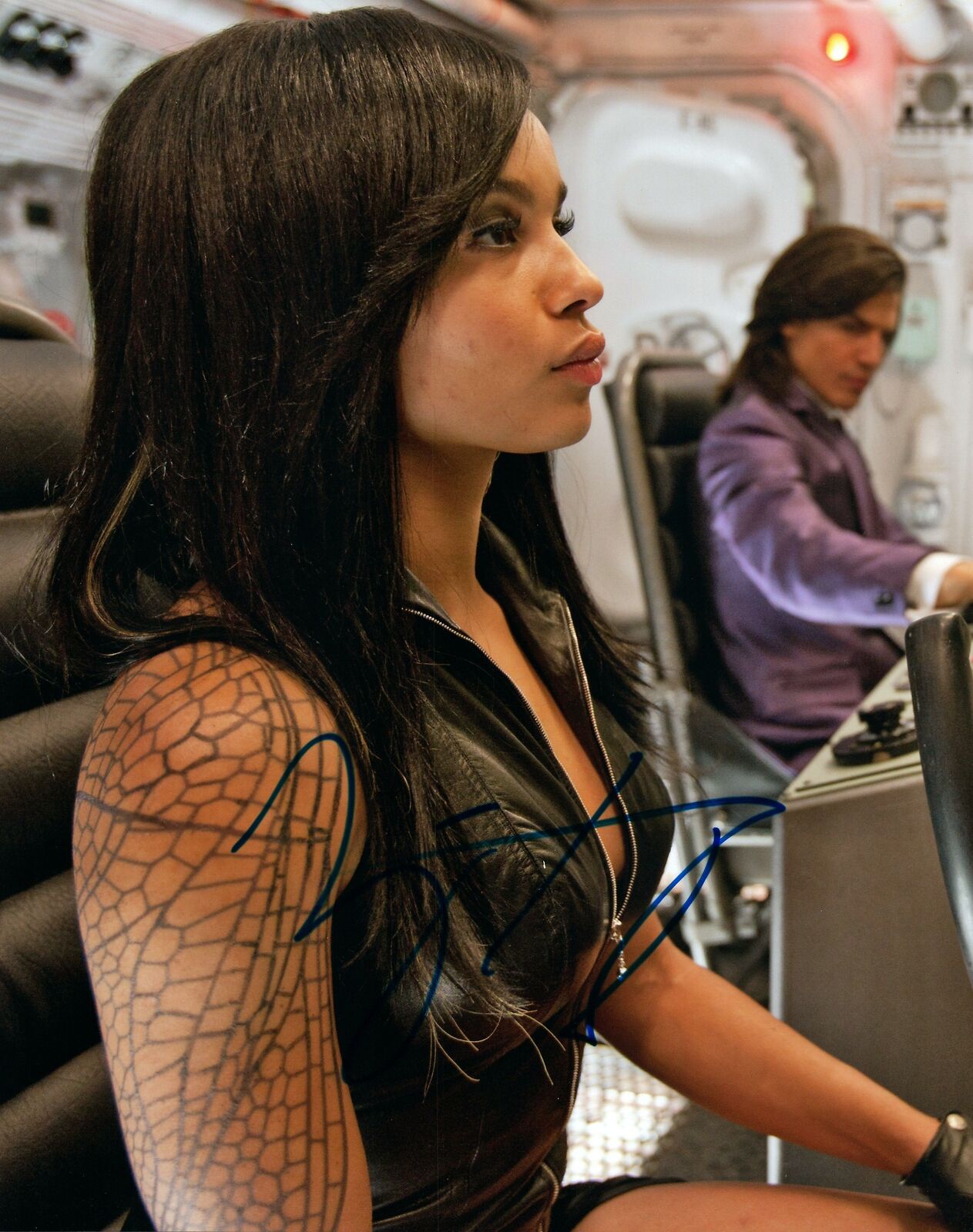
Before she was dodging bullets in Gotham as Catwoman or navigating the messy drama of Monterey in Big Little Lies, Zoë Kravitz was a mutant. Most people forget this. Long before the DC and blockbuster superstardom, she stepped into the leather-clad boots of Angel Salvadore in the 2011 prequel X-Men: First Class.
Honestly, it’s a weird role to look back on now. Kravitz was barely 22. She was basically the "new girl" in a cast that included future heavyweights like Jennifer Lawrence and Michael Fassbender. But her character wasn't just some background extra; she was a pivotal part of the rift that eventually split the X-Men and the Brotherhood of Mutants down the middle.
Why the Zoë Kravitz X-Men connection is so bizarre
If you rewatch First Class today, Angel Salvadore stands out because her powers are... well, kinda gross but also incredibly cool. She starts as a go-go dancer at a club where Charles Xavier and Erik Lehnsherr find her. She has these delicate butterfly-wing tattoos on her back. Except they aren't tattoos.
They’re actual, functional insect wings that sprout from her shoulder blades.
Oh, and she spits acid. Not just little drops, either. We’re talking projectile, corrosive "vomit" that can melt through metal and flesh. Kravitz famously joked in interviews at the time that while her co-stars got cool powers like magnetism or telepathy, she had to spend her days on set pretending to hurl on people.
The betrayal no one saw coming
The most significant thing about Angel Salvadore isn't her wings. It’s her choice. About halfway through the movie, the recruits are forced to pick a side. Sebastian Shaw, the villain played by Kevin Bacon, gives them a "join or die" ultimatum. While most of the kids stay with Xavier, Angel is the first to walk over to the dark side.
Why? It wasn't just because she was scared.
If you look at the subtext, Angel felt like an outsider even among the "gifted." She didn't buy into Xavier’s dream of peaceful coexistence. She saw Shaw’s vision of mutant supremacy as a form of survival. It was a cold, calculated move that gave the character a level of agency that many other supporting mutants lacked.
What really happened to her character?
If you’re a casual fan, you probably finished First Class and wondered why she never showed up again. The sequel, X-Men: Days of Future Past, provides a heartbreaking and blink-and-you'll-miss-it answer.
During a scene where Mystique is breaking into Bolivar Trask’s office, she finds a series of autopsy files. Among them is a photo of Angel Salvadore’s corpse. There is also a shot of one of her wings kept in a glass display case like a hunting trophy. It’s a grim confirmation: sometime between 1962 and 1973, Angel was hunted down and killed by Trask’s men for experimentation.
- Codename: Angel Salvadore (sometimes referred to as Tempest)
- Abilities: Fly with insectoid wings, projectile acid spit, core strength (essential for those wire stunts!)
- Affiliation: Started with X-Men, defected to the Hellfire Club/Brotherhood
- Status: Deceased (confirmed via autopsy files in Days of Future Past)
The "First Class" experience and the "Bent Bullet" mystery
For Kravitz, the role was a massive physical undertaking. She spent months working on her core strength just to handle the wire work required for the flying scenes. "It's the closest I'll ever get to flying," she told IGN back in 2011, though she admitted the harness "kinda hurts" after a few hours of zooming around Pinewood Studios.
There is also a bit of "lost lore" here. A viral marketing site for the franchise called The Bent Bullet claimed that Angel (under the name Tempest) was killed in July 1963 during a CIA raid called Project: Wideawake. Interestingly, the autopsy report in the actual film has a different date, marking her death in November 1962. It’s a classic Fox-era continuity error, but the takeaway remains the same: her story ended far too early.
Actionable Insights for Fans
If you want to fully appreciate the Zoë Kravitz X-Men era, don't just stop at the movie.
- Check the Autopsy Photos: In Days of Future Past, pause the movie at the 11:37 mark. You can see the files for Angel and Azazel. It’s a dark bit of world-building that explains why the original team was so depleted.
- Read the Source Material: The comic version of Angel Salvadore is very different. In Grant Morrison’s New X-Men run, she’s a 14-year-old girl who ends up having fly-human hybrid babies with a mutant named Beak. The movie version is much more "glamorized."
- Contrast the Tone: Compare Kravitz’s performance as Angel with her later role as Selina Kyle. You can see the seeds of that "rebel who doesn't quite fit in" energy even back in 2011.
While the role of Angel Salvadore was relatively brief, it served as the launchpad for Kravitz into the world of high-budget genre filmmaking. She wasn't just another mutant in the background; she was the face of the first major defection in the X-Men's cinematic history. Even if her character ended up as a photo in a folder, Kravitz’s impact on the prequel trilogy's stakes was undeniable.