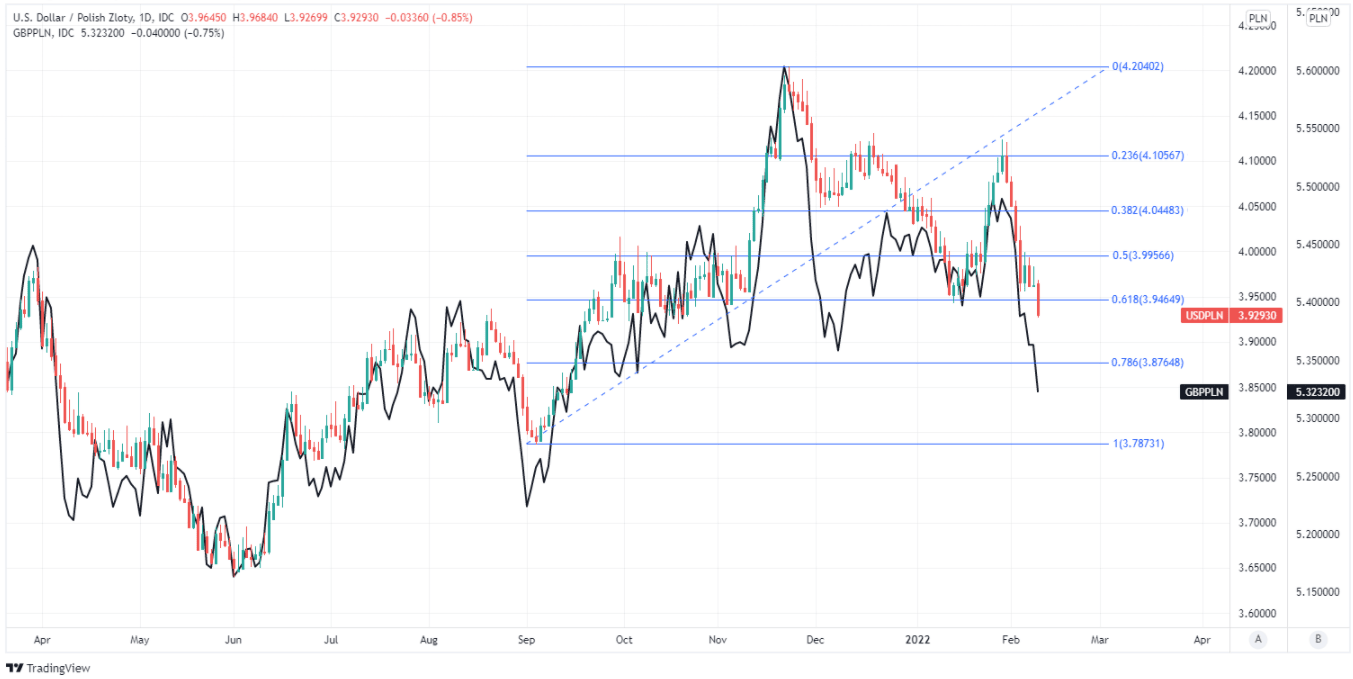
Money is weird. One day you're looking at your bank account feeling like a king in Warsaw, and the next, you're staring at a pint in London wondering why it costs as much as a three-course meal back home. If you've ever tried to time the zloty to pound sterling exchange, you know it’s basically like trying to catch a falling knife while blindfolded.
Most people think currency exchange is just about "the number" on Google. It isn't. It's about a messy tug-of-war between two very different central banks—the National Bank of Poland (NBP) and the Bank of England (BoE)—and a whole lot of geopolitical drama in between. Honestly, if you aren't watching the interest rate gaps, you're just guessing.
Why the Zloty to Pound Sterling Rate is Moving Right Now
As of mid-January 2026, the Polish Zloty (PLN) is sitting around 0.205 against the British Pound (GBP). To put that in human terms, you’re looking at roughly 4.86 PLN for every 1 GBP. But that’s just a snapshot.
The NBP, led by Adam Glapiński, recently hit the "pause" button on interest rates. After cutting rates six times in 2025—bringing the reference rate down to 4.00%—the Monetary Policy Council decided to wait and see. Why? Because even though Polish inflation dipped to a surprisingly low 2.4% in December 2025, there’s a lurking fear that it might bounce back once energy subsidies fully fade.
Meanwhile, across the North Sea, the Bank of England is playing a different game. They’ve been slightly more "hawkish," meaning they are keeping their rates a bit higher (around 3.75%) to squeeze the last bits of inflation out of the UK economy. When the UK keeps rates higher than Poland, the zloty to pound sterling rate usually feels the pressure. Investors like higher returns, so they move their cash to where the interest is better. It’s not personal; it’s just math.
The "Invisible" Factors Most People Miss
You've probably heard about "safe haven" currencies. The British Pound is often seen as more stable during global panics, while the Zloty is a "proxy" for Central and Eastern Europe. When things get spicy near the Ukrainian border or the EU starts bickering about budgets, the Zloty takes the hit first.
The China Connection
Believe it or not, what happens in Beijing affects your exchange rate in Wroclaw. Poland has been importing a massive amount of cheap goods from China lately. This is great for keeping inflation down, but it’s been pushing Poland’s current account back into a deficit. If Poland is spending more abroad than it’s bringing in, the Zloty loses some of its muscle.
The Wage Growth Trap
In the UK, service inflation—think the cost of haircuts, legal fees, and dining out—has been stubborn. Wage growth in Britain stayed high through 2025. In Poland, however, we’re seeing a cooling of the labor market. This divergence is huge. If UK wages keep rising, the BoE won't be able to cut rates as fast as the NBP, which keeps the Pound relatively expensive for anyone holding Zloty.
Historical Perspective: It’s Not Just About 2026
If we look back, the zloty to pound sterling relationship has been a rollercoaster. Remember the post-Brexit chaos? Or the 2022 energy crisis? There were times when 1 GBP would cost you over 5.50 PLN. Seeing it under 5.00 PLN feels like a win for many, but for Polish exporters selling to London, it’s a bit of a nightmare.
- Volatility is the norm: Since 2004, when Poland joined the EU, the rate has swung wildly.
- The 4.50 floor: Historically, whenever the rate gets close to 4.50 PLN, the Polish central bank starts getting nervous because it makes Polish exports too expensive.
- The 6.00 ceiling: We haven't seen 6.00 in a long time, but during major global meltdowns, the Pound can spike fast.
Reality Check: Should You Exchange Money Now?
If you're an expat sending money home or a business owner managing a supply chain, timing is everything. Most analysts, including those at ING and Fitch Solutions, expect the NBP to start cutting rates again in March 2026. If Poland cuts rates while the UK holds steady, the Zloty will likely weaken.
Basically, the zloty to pound sterling rate might get worse for PLN holders by the spring.
The Bank of England is also expected to ease, but they are notorious for being slow. They hate "surprising" the market. The NBP, on the other hand, is a bit more unpredictable. Governor Glapiński’s press conferences are legendary for their length and sometimes surprising shifts in tone.
Practical Steps for Your Wallet
- Watch the March Projections: The NBP releases new inflation and GDP reports in March. This is the biggest data drop of the quarter. If the "March Projection" shows inflation staying low, expect a rate cut and a weaker Zloty.
- Use Limit Orders: Don't just accept the "live" rate if you don't have to. Most fintech apps let you set a target rate. If you want 4.80 PLN to 1 GBP, set a notification. Don't stare at the screen all day.
- Hedge for Business: If you’re a business owner, talk to a specialist about forward contracts. Locking in a rate for 6 months might cost a small fee, but it prevents a 10% swing from eating your entire profit margin.
- Ignore the "No Fee" LIES: No one exchanges money for free. If they say "zero commission," they are just hiding their profit in a terrible exchange rate (the "spread"). Always compare the rate you’re being offered to the mid-market rate on Reuters or Bloomberg.
The zloty to pound sterling pair is a story of two economies trying to find their footing after years of shocks. Poland is growing faster—projected at nearly 3.5% GDP growth for 2026—but the UK has the "big currency" advantage.
Keep an eye on the interest rate gap. That's the real signal. Everything else is just noise.
To manage your exposure effectively, monitor the Bank of England's February meeting minutes and the Polish NBP's March inflation report. These two dates will define the trend for the first half of the year. If you are holding Zloty and need Pounds for a summer trip or a property payment, consider locking in a portion of your needs now while the rate is still hovering around the 4.85 mark, as further Polish rate cuts in the spring could push the cost of Sterling higher.