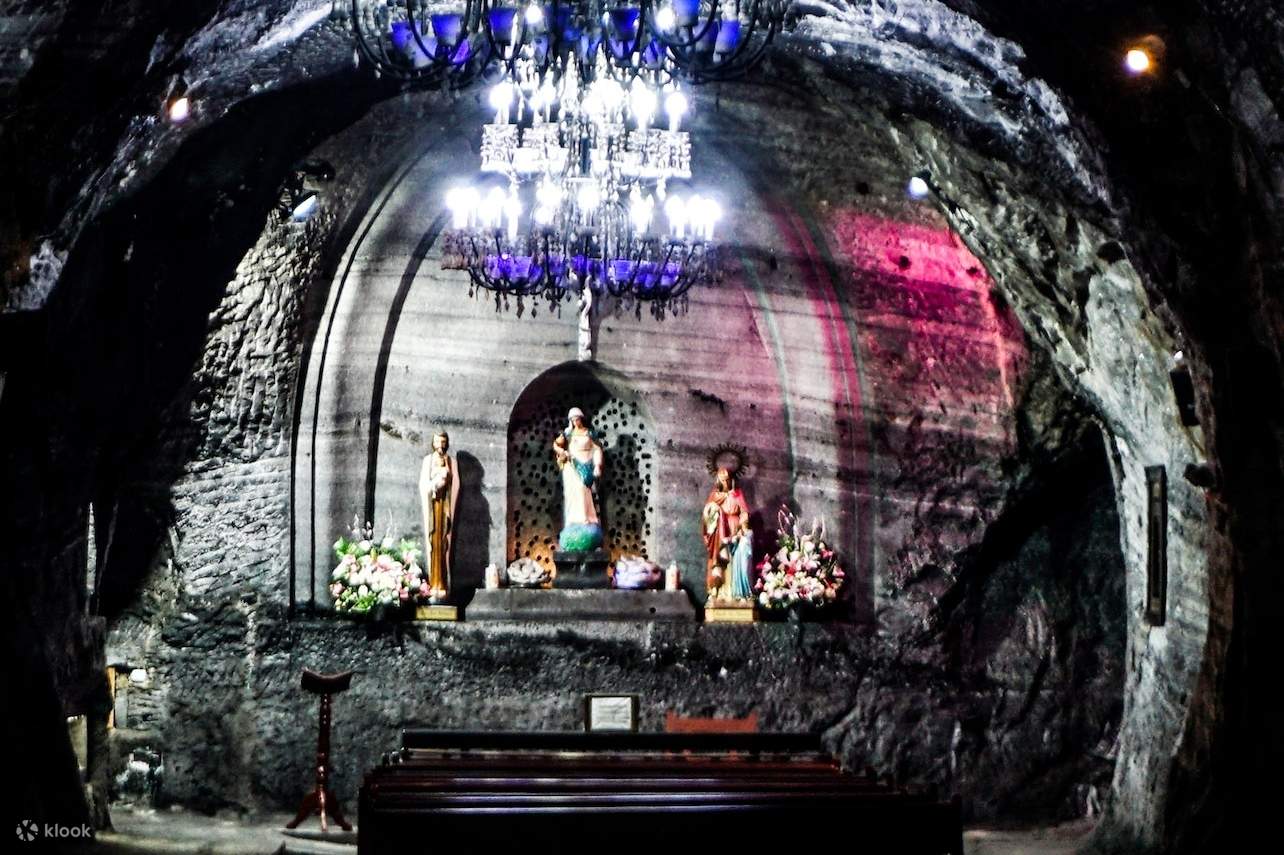
You’re standing 180 meters underground. It is freezing, the air tastes faintly of brine, and the only light comes from a neon-blue glow reflecting off jagged, crystalline walls. This isn't a cave. It’s a cathedral. Honestly, the first time you step into the main nave of the Salt Cathedral Zipaquira Bogota, it feels less like a church and more like a set from a sci-fi movie.
Most travelers in Bogota treat Zipaquirá as a "check-the-box" excursion. They hop on a bus, take a few selfies with the glowing crosses, and head back to the city for ajiaco. They’re missing the point. This place isn't just a gimmick or a pretty basement. It’s a staggering feat of engineering carved into a salt deposit formed 250 million years ago when the Andes were still under the sea.
People call it the "First Wonder of Colombia." That's a heavy title. But when you realize you are walking through a mountain of salt that supported the entire economy of the Muisca people long before the Spanish arrived, the weight of the place starts to sink in.
Why the "Cathedral" Isn't Actually a Cathedral
Let's clear something up right away. If you’re looking for a traditional consecrated cathedral where a bishop sits in a fancy chair, you’re in the wrong place. Technically, the Salt Cathedral Zipaquira Bogota has no official status within the Catholic Church hierarchy. It’s a monumental piece of religious architecture, sure, but it’s more of a cultural and spiritual site than a functioning seat of a diocese.
The history is grit and sweat. Long before the neon lights, miners carved small niches into the rock to pray for safety before their shifts. Mining salt is dangerous. The ceiling can collapse, or pockets of gas can ignite. By the 1950s, those small shrines grew into the first official Salt Cathedral. But there was a problem: it was structurally unsound. By the early 90s, the original site was shut down because it was literally crushing itself.
The version you visit today? That’s the "new" one, opened in 1995. It was designed by architect Roswell Garavito Pearl. He didn't just dig a hole; he created a symbolic journey through the Stations of the Cross. Each station is a cavernous room where the proportions and lighting are meant to make you feel... small.
The Walk Through the Mountain
The entrance is a bit deceptive. You walk into a tunnel that feels like a standard mine. Then, the temperature drops.
You start the descent through 14 small chapels representing the Stations of the Cross. This is where most people get bored if they don't have a guide. Without context, it’s just 14 dark rooms with rock carvings. But look closer at the textures. The miners didn't use marble or wood; everything is carved directly into the halite.
The Narthex and the Great Dome
Eventually, the tunnels open up. You hit the Dome. It’s massive. From here, you can look down into the main chambers. The scale is hard to communicate in photos. We’re talking about a space that can hold 10,000 people.
The centerpiece is the Great Cross. It’s 16 meters high. Here’s the kicker: it’s not a solid object. It’s a hollow carving in the back wall, lit from within to create the illusion of a solid structure. It's a clever bit of visual trickery that works incredibly well in the gloom.
More Than Just Prayers
If you think this is only for the devout, you're wrong. The complex has expanded into a full-blown subterranean mall. There’s a "Water Mirror"—a shallow pool of highly saturated salt water that acts like a perfect glass reflection. It’s arguably the most photographed spot in the mine.
Then there’s the 3D movie theater and the "Route of the Miner" tour. If you’re claustrophobic, maybe skip the miner route. They give you a helmet and a pickaxe and take you into the actual unrefined tunnels. It’s dark. It’s cramped. It makes you realize how brutal life was for the people who built this place.
Getting There Without Losing Your Mind
Bogota traffic is legendary. And not in a good way.
Zipaquirá is about 49 kilometers north of Bogota. On a Sunday, that might take you an hour. On a Tuesday morning? Good luck. You’re looking at two hours of stop-and-go diesel fumes.
- The Tren Turístico de la Sabana: This is the "classic" way. It’s an old steam train (well, mostly diesel-powered now) that leaves from Estación de la Sabana or Usaquén. It’s slow. It’s noisy. It’s also charming as hell. You get live music and snacks. It’s a full-day commitment, though.
- The TransMilenio + Inter-municipal Bus: This is for the budget-conscious. Take the TransMilenio to Portal Norte. From there, look for the small buses marked "Zipa." It’s cheap—usually less than 10,000 COP.
- Private Driver: Honestly, if you have a group of three or four, just hire a driver for the day. It’s worth the extra money to not be beholden to a bus schedule.
The Altitude Factor
Bogota is high (2,640 meters). Zipaquirá is slightly higher. Then you go deep underground where the air circulation, while good, is still different.
Drink water. Lots of it.
If you just flew into Bogota yesterday, maybe wait a day or two before hitting the Salt Cathedral Zipaquira Bogota. Altitude sickness plus a deep underground trek is a recipe for a massive headache. Also, wear layers. It’s surprisingly chilly inside the mine, even if it’s a scorching day in the plaza outside.
What Most Guides Forget to Tell You
Zipaquirá itself is a beautiful colonial town. Don't just run back to Bogota as soon as you exit the mine. The main square, Plaza de los Comuneros, is gorgeous. The buildings are white-washed with green trim, very traditional.
Eat at a local spot. Look for "Pan de Azuca." It’s a local sweet bread. Or try the cuajada con melao (cheese with sugar syrup).
There’s also a frequent misconception that the cathedral is the only thing to see. Just outside the salt mine entrance is the "Parque de la Sal," which has a museum of mining and some great viewpoints of the valley. If you have the energy, the hike up the hills surrounding the mine offers a perspective of the landscape that puts the geological scale of the salt deposit into context.
The Sustainability and Ethics of Salt Tourism
Salt mining in Zipaquirá isn't just a relic of the past. It’s an ongoing industry. The "Cathedral" is actually carved into a level of the mine that is no longer being actively exploited for commercial salt, but the mountain is still a working site.
This creates a weird tension. You have thousands of tourists wandering through neon-lit halls while, elsewhere in the mountain, the industrial process continues. The Brine Museum (Museo de la Salmuera) located in the old processing plant explains how they turn rock into the table salt you use every day. It’s less "magical" than the cathedral, but it’s the reality of the region’s economy.
Real Talk: Is It Worth the Price?
The entrance fee for foreigners has climbed significantly over the last few years. As of 2025/2026, you're looking at a price tag that feels "steep" by Colombian standards.
Is it a tourist trap? A little bit. The gift shops are aggressive. The "Light and Sound" show is a bit cheesy.
But is it unique? Absolutely. There are only a handful of salt cathedrals in the world—the most famous other one being Wieliczka in Poland. The Colombian version is much more focused on modern architectural drama and light. It feels like a living monument.
Practical Steps for Your Visit
If you're planning to visit the Salt Cathedral Zipaquira Bogota, do these things to actually enjoy it:
- Book the early slot. The tour groups from Bogota usually arrive between 10:30 AM and 12:00 PM. If you can get there when they open at 9:00 AM, you’ll have the Stations of the Cross almost to yourself. The silence underground is haunting in a good way.
- Wear shoes with grip. The floor is salt. It can be slippery, especially in areas where condensation or "salt sweat" pools.
- Bring a tripod (if you're a pro). Taking photos in low light is a nightmare. Most people end up with blurry orange blobs. If you're serious about your shots, you'll need a steady hand or a small travel tripod.
- Download the audio guide beforehand. The physical devices they hand out are sometimes hit-or-miss. Having the app on your phone (if available) or a pre-downloaded guide makes the walk through the tunnels far more meaningful.
- Check the schedule for Sunday Mass. If you want to see the place "in action," there is usually a mass held in the main chamber on Sundays at noon. It’s a powerful experience, even if you aren’t religious, simply because of the acoustics.
The Salt Cathedral is a reminder of what humans do when they are stuck in the dark. We build. We carve. We find a way to make the oppressive weight of a mountain look like art. It's a weird, salty, neon-lit pilgrimage that everyone should do at least once.
Once you finish the underground tour, walk down the hill into the town of Zipaquirá. Find a small cafe, order a tinto, and watch the world go by in the plaza. It’s the perfect palate cleanser after the intensity of the mine.