You probably think your ZIP code is just a fancy way to say what town you live in. Honestly, it’s not. Most people assume these five numbers are just digital shorthand for a city name or a specific neighborhood boundary, but that’s a total misconception that has caused countless headaches for homeowners, insurance agents, and even the census bureau.
The truth? A ZIP code is a route. It's a delivery path for a mail truck.
In the early 1960s, the United States Post Office Department was drowning in paper. The volume of mail tripled in twenty years. They needed a way to move envelopes faster than a human could read a handwritten address. So, in 1963, they dropped the Zone Improvement Plan. That’s the literal ZIP code meaning: a plan to improve the "zones" of mail transit. It was never intended to define where a town starts or ends.
How the Numbers Actually Work
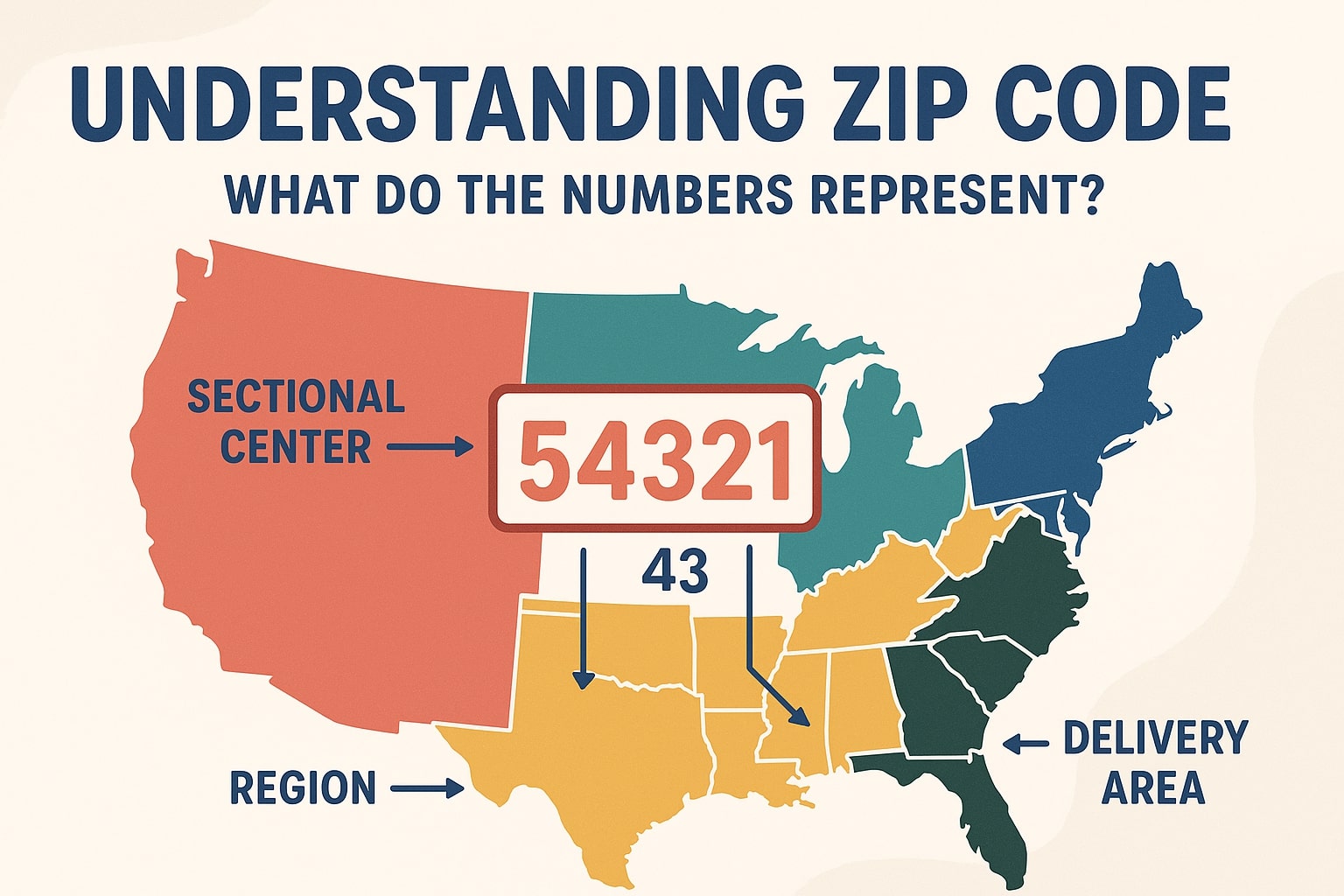
Let's break down the anatomy of the code because the sequence isn't random. The first digit represents a broad group of U.S. states. If your code starts with a 0, you’re likely in the Northeast—think New England, New Jersey, or Puerto Rico. If it starts with a 9, you’re on the West Coast, maybe catching a sunset in California or Oregon.
The next two digits pinpoint a central post office facility, known as a Sectional Center Facility (SCF). This is the big hub where your Amazon packages and birthday cards from Grandma get sorted before heading to smaller local branches.
The final two digits? Those are the specific delivery area.
But here’s where it gets weird. A ZIP code can cross city lines. It can span across multiple counties. In some rural areas, a single ZIP code might cover hundreds of square miles of empty desert. In Manhattan, a single skyscraper—like the Empire State Building (10118)—has its own dedicated code because it receives so much mail. It’s essentially a vertical city.
The Myth of the Boundary
We use ZIP codes for everything now. We use them for Tinder swipes, car insurance quotes, and checking the weather. But using a ZIP code to define a "community" is fundamentally flawed.
Because ZIP codes are designed for the efficiency of a mail carrier’s truck, the boundaries can change whenever the USPS feels like it. If a new subdivision goes up and the mail carrier can't finish their route in eight hours, the Post Office might just slice that ZIP code in half. Suddenly, your "identity" as a resident of 90210 might vanish because a bureaucrat in D.C. needed to balance a spreadsheet.
This causes real-world friction. You might live in the physical, legal city limits of City A, but your ZIP code says City B because that’s where the mail truck starts its engine. This "postal address" versus "physical location" discrepancy leads to people paying the wrong sales tax or, in some tragic cases, emergency services being dispatched to the wrong jurisdiction.
The ZIP+4 Revolution
In 1983, the USPS realized five digits weren't enough. They introduced the ZIP+4. Most of us ignore those extra four numbers after the hyphen, but they are incredibly precise.
The first two digits of the +4 represent a "sector," which could be a specific block of houses or a large office building. The last two digits represent a "segment," which might be a specific floor of an office or even one side of a street.
Why don't we use them more? Because they are hard to remember. Businesses love them, though. Using the full nine digits can actually save companies money on bulk mailing because it does the sorting work for the Post Office ahead of time. It’s the difference between a mail carrier looking at a map and a machine knowing exactly which shelf a letter belongs on.
Why Your ZIP Code Dictates Your Life
It’s kind of scary how much power these numbers hold. Beyond the ZIP code meaning of mail delivery, these digits have become a proxy for socioeconomic status.
Insurance companies use them to calculate your risk. If your ZIP code has a high rate of car thefts, your premiums go up, even if your car is locked in a private garage. Marketers use "Prizm clusters" to categorize you based on your code. They see a ZIP and immediately think "Urban Achievers" or "Rural Crossroads."
- Credit Scores: While the code itself isn't a factor in your FICO score, it influences which offers you see.
- Health Outcomes: Researchers often say your ZIP code is a better predictor of your health than your genetic code. It tells them if you have access to fresh groceries or if you live in a "food desert."
- Political Gerrymandering: While districts are supposed to be based on census data, ZIP codes are often used by campaigners to target specific demographics with uncanny precision.
The "Floating" ZIP Codes
Did you know some ZIP codes don't even have a physical location? These are called "Unique" or "Military" ZIP codes.
The Navy has them for ships at sea. The IRS has them for processing centers. If you send a letter to Santa at the North Pole, it often gets routed through specific codes set up just for the holidays. These aren't dots on a map; they are digital buckets.
Dealing with ZIP Code Errors
If you’re moving or trying to get a package delivered to a new build, you’ll likely run into "address not found" errors. This usually happens because the USPS Address Management System (AMS) hasn't updated its database yet.
Don't just assume Google Maps is right. Google is great, but the USPS is the source of truth for delivery. You can go to the official USPS website and use their "ZIP Code Lookup" tool. It will give you the standardized version of your address. Using the "Standardized" version—all caps, no punctuation, correct directional (like N or SE)—is the best way to ensure your mail doesn't end up in a dead-letter office in Utah.
How to Optimize Your Use of ZIP Codes
If you're a business owner or just someone tired of packages getting lost, there are a few things you should do immediately.
First, stop relying on city names for accuracy. Always prioritize the ZIP code. If there is a conflict between the city name and the ZIP, the sorting machines will almost always follow the ZIP.
Second, if you're shipping something valuable, use the ZIP+4. You can find it on the USPS website by entering your address. It adds a layer of "geographic certainty" that prevents your package from sitting in a sorting facility while a human tries to figure out if "Springfield" means the one in Illinois or the one in Missouri.
Finally, be aware of "Boundary Districts." If you are buying a home, never trust a real estate listing's "City" field based solely on the ZIP code. Check the tax maps. You might find yourself paying taxes for a school district you don't actually live in because the ZIP code misled you.
Essential Steps for Accuracy
- Verify via USPS.com: Use the official lookup tool to find your standardized address format.
- Check Tax Jurisdictions: If you're a homeowner, verify your municipality through your county assessor, not your mailing address.
- Use ZIP+4 for Business: If you are running a direct mail campaign, the +4 code is the only way to ensure you aren't wasting money on "undeliverable" addresses.
- Update Your Bank: Financial institutions use ZIP codes as a primary security layer (AVS - Address Verification System). If your ZIP doesn't match your billing address exactly, your card will be declined at the gas pump or online.
Understanding the true ZIP code meaning is basically about realizing that the USPS doesn't care about your town's history or your neighborhood's vibes. They care about the most efficient path for a truck. When you start treating your address like a coordinate in a logistics network rather than a piece of your identity, things suddenly start arriving on time.