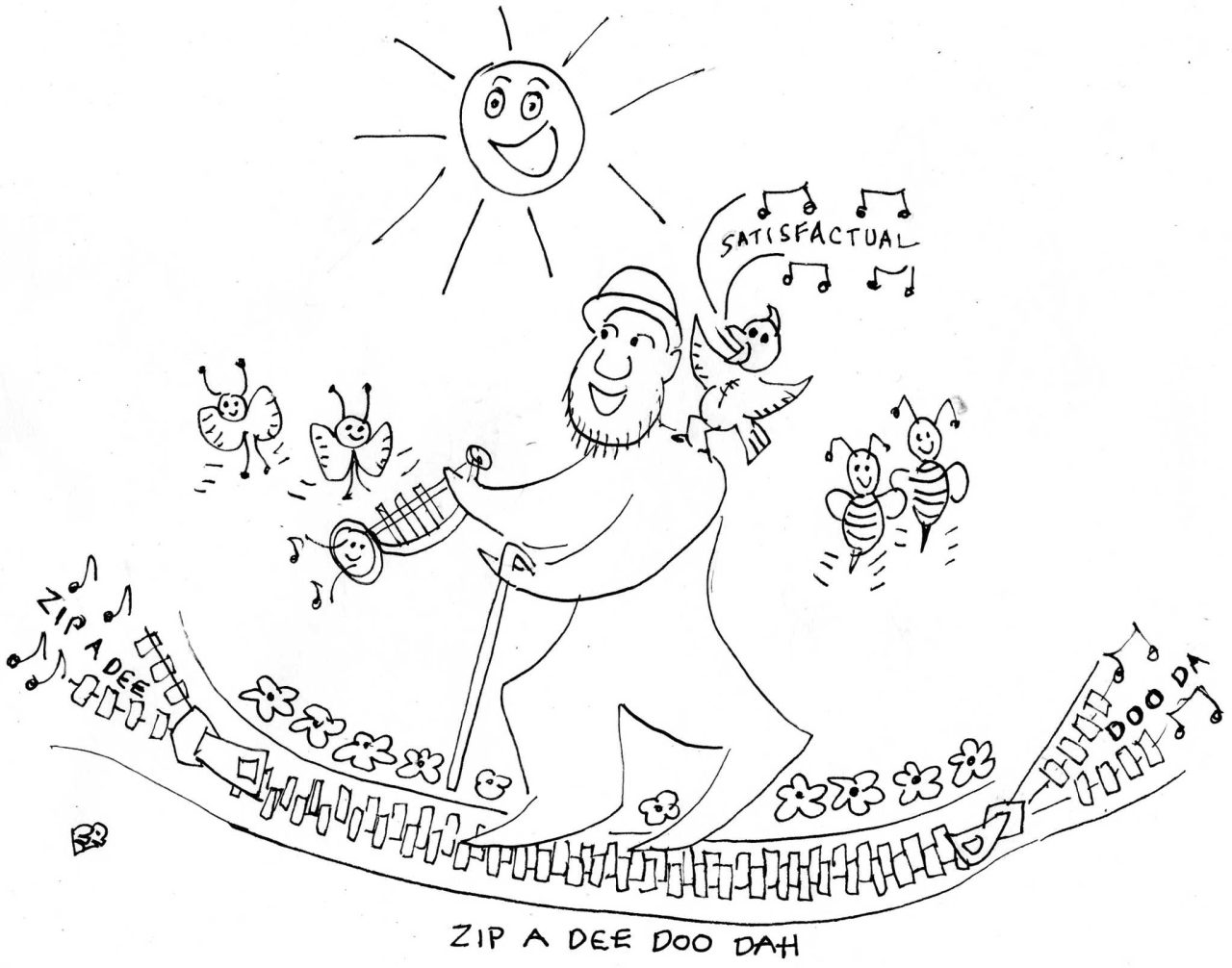
It’s a earworm. You know the one. That bouncy, major-key melody that feels like sunshine and bluebirds. If you grew up anywhere near a Disney park or a VHS player in the 90s, the lyrics for zip a dee doo dah are probably hard-coded into your brain. It’s the ultimate "feel-good" anthem. Or at least, it was meant to be.
But things are different now.
If you go looking for the song on Disney+, you won't find the movie it came from. If you head to Disneyland, the ride it inspired—the iconic Splash Mountain—is gone, replaced by Tiana’s Bayou Adventure. The song has effectively been scrubbed from the corporate spotlight. Why? Because while the lyrics talk about a "wonderful day," the history behind them is incredibly messy.
The Lyrics for Zip a Dee Doo Dah: What’s Actually Being Said?
Let's look at the words first. They’re simple. Honestly, they’re almost nursery-rhyme simple. Written by Allie Wrubel with lyrics by Ray Gilbert for the 1946 film Song of the South, the song is built on a foundation of scat-singing and folk optimism.
The core refrain is: "Zip-a-dee-doo-dah, zip-a-dee-ay! My, oh, my, what a wonderful day! Plenty of sunshine headin' my way, zip-a-dee-doo-dah, zip-a-dee-ay!"
It’s pure escapism. It’s about a "Mr. Bluebird on my shoulder" and the idea that everything is "satisfactual." That last word—satisfactual—isn't a real word, of course. It was a bit of wordplay designed to sound like Southern colloquialism, specifically the dialect James Baskett used in his portrayal of Uncle Remus.
The song won the Academy Award for Best Original Song in 1947. It was a massive hit. But to understand the lyrics for zip a dee doo dah, you have to look at who is singing them and where they are standing. Uncle Remus is a Black man living on a Reconstruction-era plantation. He’s singing about how wonderful life is in a setting that, historically, was anything but wonderful for people who looked like him.
That’s the rub.
Why the Context Changes Everything
You can’t separate the lyrics from the visuals of the 1946 film. Song of the South has been criticized for decades for its "Idyllic" portrayal of the post-Civil War South. Critics like Walter White of the NAACP pointed out as early as 1946 that the film helped to perpetuate a "dangerously glorified picture of slavery."
Now, technically, the film is set after the Civil War. Uncle Remus is a free man. But the movie presents a world where the racial hierarchy is still comfortably in place, and everyone is happy about it. The lyrics for zip a dee doo dah serve as the musical heartbeat of that sentiment. When Remus sings about "plenty of sunshine," he’s reinforcing a version of history that many find revisionist and offensive.
It’s weird, right? A song about a bluebird becoming a flashpoint for cultural debate.
But it’s not just about the movie anymore. For decades, Disney used this song as its secondary anthem, right behind "When You Wish Upon a Star." It played on the monorails. It was the climax of the Main Street Electrical Parade. It was everywhere. Because it's catchy. It’s a "happy" song. But "happy" is subjective when the source material is rooted in a romanticized view of a period of intense racial trauma.
The Linguistic Roots and the "Zip Coon" Connection
Here is where it gets even more uncomfortable. Some historians and musicologists have pointed out the phonetic similarity between "Zip-a-dee-doo-dah" and the "Zip Coon" song from 1830s minstrel shows.
"Zip Coon" was a character used in blackface performances to mock free Black people in the North. It’s a ugly piece of American history. While Ray Gilbert never explicitly cited "Zip Coon" as an influence for the lyrics for zip a dee doo dah, the linguistic pattern—the "Zip-a-dee" rhythm—is uncomfortably close to that minstrel tradition.
Even if it was an accidental echo, the resonance is there. For a long time, the public didn't really think about this. We just hummed along. But as our collective understanding of minstrelsy and its impact on American pop culture grew, the song started to feel less like a sunny afternoon and more like a relic of a past we’re trying to move beyond.
The Great Disney Erasure
If you’ve been to the parks lately, you’ve noticed the silence. Around 2020, Disney began quietly removing the song from background music loops. By 2023, Splash Mountain was closed for good in both California and Florida.
The company's decision wasn't just about one song. It was a brand-wide realization that "Zip-a-dee-doo-dah" carried too much baggage. You can’t tell a guest "Magic Happens Here" while playing a song that reminds a significant portion of your audience of a film that marginalized their ancestors.
It's a business move. It's a social move. It's a "reading the room" move.
Interestingly, you can still find the song on YouTube. You can find covers by everyone from Louis Armstrong to Miley Cyrus. Paula Abdul did a version. The Jacksons did a version. The song has lived many lives. Armstrong’s version is particularly fascinating because he brings a genuine jazz sensibility to it, almost stripping away the Disney gloss and turning it into a legitimate piece of the Great American Songbook.
Is It Okay to Still Like the Song?
This is the question people struggle with. Can you enjoy the lyrics for zip a dee doo dah without endorsing the politics of Song of the South?
Most people would say yes, but with an asterisk.
Music is evocative. It triggers memories of childhood trips or Sunday nights watching the Wonderful World of Disney. Those feelings are real. You aren't a bad person because a melody makes you feel nostalgic. However, being an "expert" listener in 2026 means acknowledging that your nostalgia might not be universal.
The song is a masterclass in songwriting efficiency. It uses simple vowels—"Zip," "Doo," "Day"—that are easy for children to pronounce. It uses a 4/4 time signature that invites marching or skipping. It’s designed to be a "happy" pill.
But the lyrics also represent a specific era of Hollywood storytelling where "charm" was often used to mask systemic inequality. When you listen to it now, you're hearing two things at once: a catchy tune and the echoes of a complicated history.
What the Lyrics Actually Say (The Full Breakdown)
If you look at the verses, they’re almost entirely about nature.
"Mr. Bluebird's on my shoulder, it's the truth, it's 'actual, everything is 'satisfactual."
The play on "actual" and "satisfactual" is clever. It anchors the song in a sense of reality—even if that reality is a fantasy. The second verse moves into:
"Well, I see a bit of 'ol Mister Sun, and he's a-shinin' on everyone!"
This is the "universal" appeal. The sun shines on everyone. It’s a message of equality that the movie itself didn't quite live up to. That’s the irony of the lyrics for zip a dee doo dah. The words themselves are inclusive and joyful. The context is what makes them exclusive.
Notable Covers and Variations
- Louis Armstrong (1968): A gravelly, soulful take that feels more like a celebration of life than a corporate jingle.
- The Jackson 5 (1969): High energy, bubblegum pop at its finest.
- Paula Abdul (1991): Part of the Simply Mad About the Mouse project, this version gave it a 90s dance-pop beat.
- Sly & The Family Stone: Yes, even the pioneers of funk tackled this one, proving just how deeply embedded the melody was in the culture.
Moving Forward: The Actionable Takeaway
So, what do we do with this song? We don't have to burn the records, but we shouldn't ignore the "why" behind its disappearance.
If you're a parent or a teacher, use the lyrics for zip a dee doo dah as a teaching moment. It’s a perfect example of how art doesn't exist in a vacuum. You can appreciate the melody while discussing why the movie it came from is no longer shown.
Here are a few ways to engage with the song's legacy today:
- Listen to the Covers: Check out Louis Armstrong’s version. It’s a great way to hear the song outside the "Disney" filter.
- Research the History: Look into the work of James Baskett. He was the first Black man to win an Oscar (an Honorary Award), and his performance as Uncle Remus was groundbreaking at the time, even if the film around him was flawed.
- Understand the Transition: If you miss Splash Mountain, look into the story of The Princess and the Frog. Tiana’s Bayou Adventure is a direct response to the need for more inclusive representation in the parks.
- Analyze the Language: Look at the "folk" style of the lyrics. It’s a specific type of American songwriting that tried to capture a "vernacular" that often bordered on caricature.
The song isn't going anywhere—it's too catchy for that. But its role in our culture has changed. It’s no longer the "official" song of a magical kingdom. It’s a piece of history. It’s a reminder that even the sunniest days have shadows.
When you hear those first few notes of the lyrics for zip a dee doo dah, you aren't just hearing a song about a bluebird. You're hearing 80 years of American cultural evolution. And that, honestly, is a lot more interesting than a "satisfactual" day on the plantation.
By understanding the roots, the controversy, and the eventual retirement of the song, you get a clearer picture of how media shapes our view of the world. It’s not about "canceling" a song; it’s about growing up. We can recognize the craft of the music while acknowledging that we’ve learned a lot more about history since 1946.
Keep the melody if you want. But keep the context too. That’s the only way to truly understand what you’re singing.