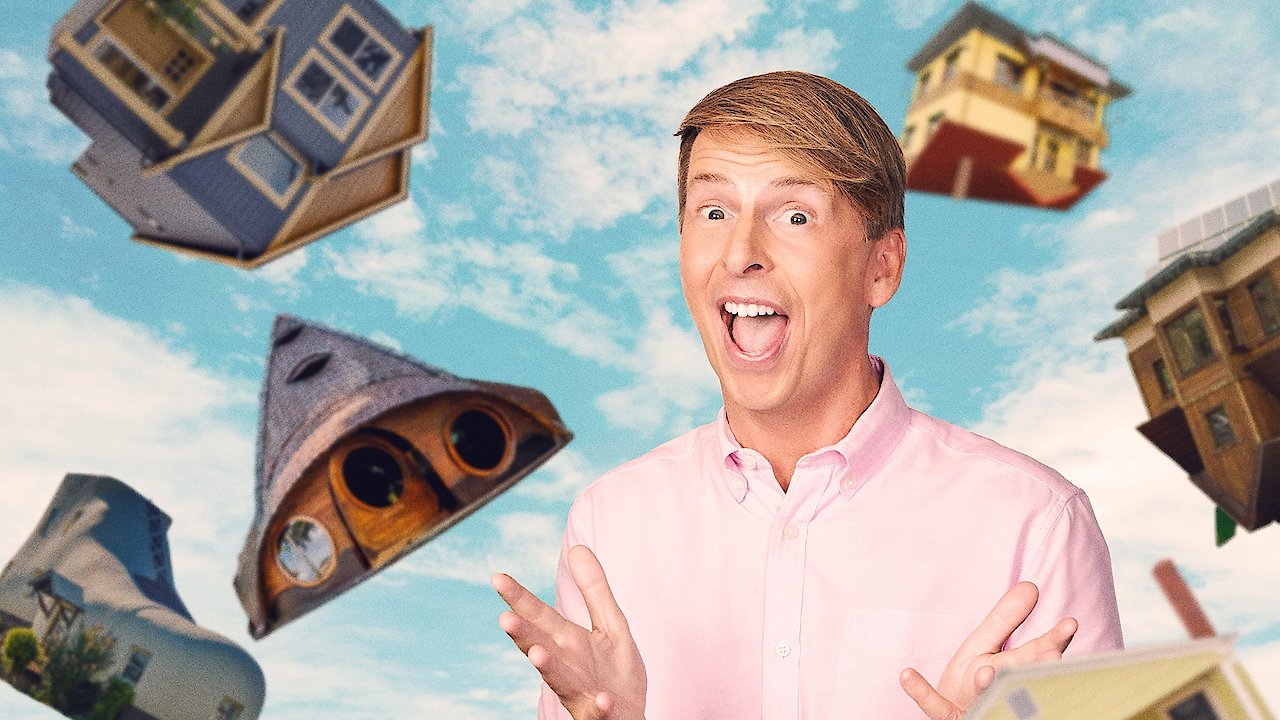
You know the feeling. It’s 11:30 PM, you’re scrolling through your phone, and suddenly you see a house that looks like a giant mushroom. Or maybe it’s a basement that contains a full-sized, non-ironic jail cell. That’s the magic of Zillow Gone Wild. What started as a viral social media account grew into a full-blown HGTV series, and honestly, Zillow Gone Wild episodes are some of the weirdest television you'll ever see. It’s not just about "ugly" houses. It’s about the bizarre, the obsessive, and the deeply personal ways people choose to live.
Most real estate shows are boring. They’re about "neutral tones" and "open floor plans." This show is the exact opposite. Hosted by Jack McBrayer—who you probably recognize as Kenneth the Page from 30 Rock—the series takes us inside the homes that made the internet lose its collective mind.
The Jump From Instagram to HGTV
Back in 2020, Samir Mezrahi started an Instagram account. He just wanted to share the weird listings he found while procrastinating. It blew up. Fast forward to 2024, and HGTV realized that people don't just want to see beautiful kitchen islands; they want to see a house in Nebraska that’s built entirely underground in a former missile silo.
The structure of the show is pretty straightforward but effective. Each of the Zillow Gone Wild episodes usually features three or four distinct properties. McBrayer travels across the country to meet the owners, and let me tell you, the owners are often just as interesting as the buildings. You have to be a specific type of person to live in a house shaped like a shoe.
The show isn't just mocking these places. It actually celebrates the "wildness." While the internet might roast a bathroom covered in lime-green shag carpeting, the show tries to understand the why behind it. It’s about people who refused to live in a cookie-cutter suburban box.
What Actually Happens in These Episodes?
Take the premiere, for instance. We’re introduced to a "castle" in the middle of a regular neighborhood. It’s jarring. You see these homes and your first thought is usually, "How did the neighbors let this happen?"
One of the most memorable segments involves a home in Berkeley, California, known as the "Fish House." It’s officially the Tsui House, designed by architect Eugene Tsui for his parents. It’s meant to be the safest house in the world, based on the anatomy of a tardigrade (those tiny water bears that can survive in space). It’s made of recycled Styrofoam and concrete. It has no right angles. It looks like a creature from a 1950s sci-fi flick. Seeing it on a tiny phone screen is one thing, but seeing McBrayer walk through those oval doors makes the scale of the eccentricity really hit home.
The "Wildest" Winners
The show builds toward a season finale where one home is crowned the "Wildest House." Throughout the season, we see:
- A house that looks like a literal bridge over a creek.
- A "Jungle House" where the interior is so dense with plants you'd need a machete to find the toaster.
- A mid-century modern masterpiece that looks like a spaceship landed in the desert.
There’s a specific kind of voyeurism here. We’re looking for the limits of personal taste. Most people spend their lives trying to make their homes "salable." We paint walls "Agreeable Gray" so the next person won't hate it. The people featured in Zillow Gone Wild episodes do not care about your resale value. They built a shrine to their own weirdness. It’s kind of inspiring, in a chaotic sort of way.
Why Some Fans Were Skeptical
Not everyone loved the transition to TV. Some purists felt the Instagram account was better because it was raw. On the internet, you can see 50 photos of a weird house in ten seconds. On TV, you have to sit through commercials and host segments.
There’s also the "Jack McBrayer factor." He’s incredibly wholesome. Some viewers wanted the snarky, biting commentary found in the Instagram comments section. Instead, they got a show that is genuinely nice. It’s "lifestyle" TV, not a roast session. If you go in expecting a mean-spirited takedown of bad architecture, you’ll be disappointed. If you want to see a guy in a blazer be genuinely baffled by a living room full of taxidermy, you’re in the right place.
The Reality of Owning a "Wild" Home
One thing the show touches on—but perhaps could go deeper into—is the nightmare of maintaining these places. Custom architecture is a trap. When your roof is shaped like a giant hat, who do you call when it leaks? A standard roofer is going to look at that and drive away.
We see this in the episode featuring the "Bubble House." These monolithic dome homes are energy efficient, sure, but try hanging a picture on a curved wall. It’s a logistical disaster. The owners usually laugh it off, but you can see the exhaustion in their eyes when they talk about the "specialized" repairs.
The Real Estate Reality Check
Let’s talk money. A lot of these homes sit on the market for years. The show is titled after Zillow, after all. A house is only worth what someone will pay for it. If you spend $2 million building a house that looks like a dragon, you better hope there’s another dragon-lover with $2 million out there.
Often, these houses are sold at a massive loss. The "Fish House" in Berkeley, despite its fame, faced plenty of hurdles. These aren't just homes; they are art installations. And art is subjective.
How to Spot a "Wild" Listing Yourself
If you’ve watched enough Zillow Gone Wild episodes, you start to see the patterns. You become a bit of a scout. You start looking for the red flags in listings:
- The "Labyrinth" layout: When the floor plan makes no sense and you have to walk through a bathroom to get to the kitchen.
- The "Over-Commitment": When a theme isn't just a room, but a lifestyle. If there’s a medieval suit of armor in the entryway, the rest of the house is going to be a ride.
- The "DIY Disaster": Owners who clearly did their own electrical work or tiling after watching three minutes of a YouTube tutorial.
The show teaches us that "luxury" is a very loose term. To one person, luxury is a marble entryway. To another, it’s a built-in indoor slide that goes from the bedroom to the pool.
The Cultural Impact of Viral Real Estate
We are living in an era of "Doomscrolling" and "Zillow Surfing." During the pandemic, Zillow became a form of escape. We weren't just looking for houses to buy; we were looking for alternate lives. Zillow Gone Wild episodes tapped into that specific zeitgeist.
It’s a form of digital tourism. Most of us will never step foot in a 10,000-square-foot mansion in the Florida panhandle that’s decorated entirely in 1980s neon. But we can spend thirty minutes there on HGTV.
The show also highlights the "flattening" of American architecture. As every new apartment building starts to look like a gray box, these weird houses become more valuable as cultural artifacts. They represent a time when people had "too much" personality and the budget to back it up.
Is There a Season 2?
As of early 2026, the buzz around the show remains strong. The format is cheap to produce compared to big-budget dramas, and the source material—the internet—is infinite. People will never stop building weird houses.
The key for the show moving forward will be finding homes that haven't already been seen by everyone on TikTok. There’s a certain "spoiler" effect when you’ve already seen the viral thread about the "clown house" six months before the episode airs. To stay relevant, the producers have to find the hidden gems—the houses that aren't for sale yet, or the ones tucked away in rural areas that haven't hit the viral algorithm.
What We Can Learn From the Chaos
There’s actually a practical takeaway here. Watching these episodes makes you realize that your own "boring" house is actually a sanctuary. You might hate your outdated kitchen, but at least your kitchen isn't shaped like a giant toilet (yes, that’s a real house).
It also encourages a bit of bravery. Maybe you should paint that accent wall a bold color. Maybe you should install that weird light fixture you liked. Life is short, and as the stars of Zillow Gone Wild prove, you might as well live in a space that makes you happy, even if the rest of the world thinks you’re crazy.
Actionable Steps for Zillow Fans
If you're obsessed with the show and want to dive deeper into the world of eccentric real estate, here is how you can actually engage with it beyond just watching:
- Set up Zillow Filters: Use keywords like "unique," "custom," or "one-of-a-kind" in your search filters. Set the "year built" to pre-1970 to find the really funky mid-century experiments.
- Follow the Source: If you haven't already, follow the original Zillow Gone Wild accounts on social media. The "episodes" there happen daily in real-time.
- Check the History: When you see a weird house on the show, look up the address on public records. You can often see the sales history—it's fascinating to see how many times these "wild" homes change hands.
- Visit in Person: Many of these homes, like the "Mushroom House" in New York or certain "Earthships" in New Mexico, are actually available as short-term rentals. You can literally live in a Zillow Gone Wild episode for a weekend.
- Audit Your Own Space: Look at your home. If you were to be featured on the show, what would your "wild" feature be? If you don't have one, maybe it's time to add a little bit of weirdness to your life.
The phenomenon of viral real estate isn't going anywhere. Whether it's through a screen or a guided tour by Jack McBrayer, we will always be fascinated by the places where people choose to lay their heads—especially if those places happen to look like a giant UFO.
Expert Insight: When viewing these properties, remember that "wild" architecture often faces significant insurance hurdles. Standard homeowners' insurance policies are built for standard homes. If you ever decide to buy a "wild" house, your first call shouldn't be to a decorator, but to a specialized insurance broker who understands non-traditional construction.
Next Steps: Research the "Earthship" community in Taos, New Mexico. It is one of the densest areas for "wild" architecture in the world and frequently appears in real estate deep-dives. Most of these homes are built from recycled tires and bottles, providing a fascinating look at how sustainable living can also be incredibly bizarre.