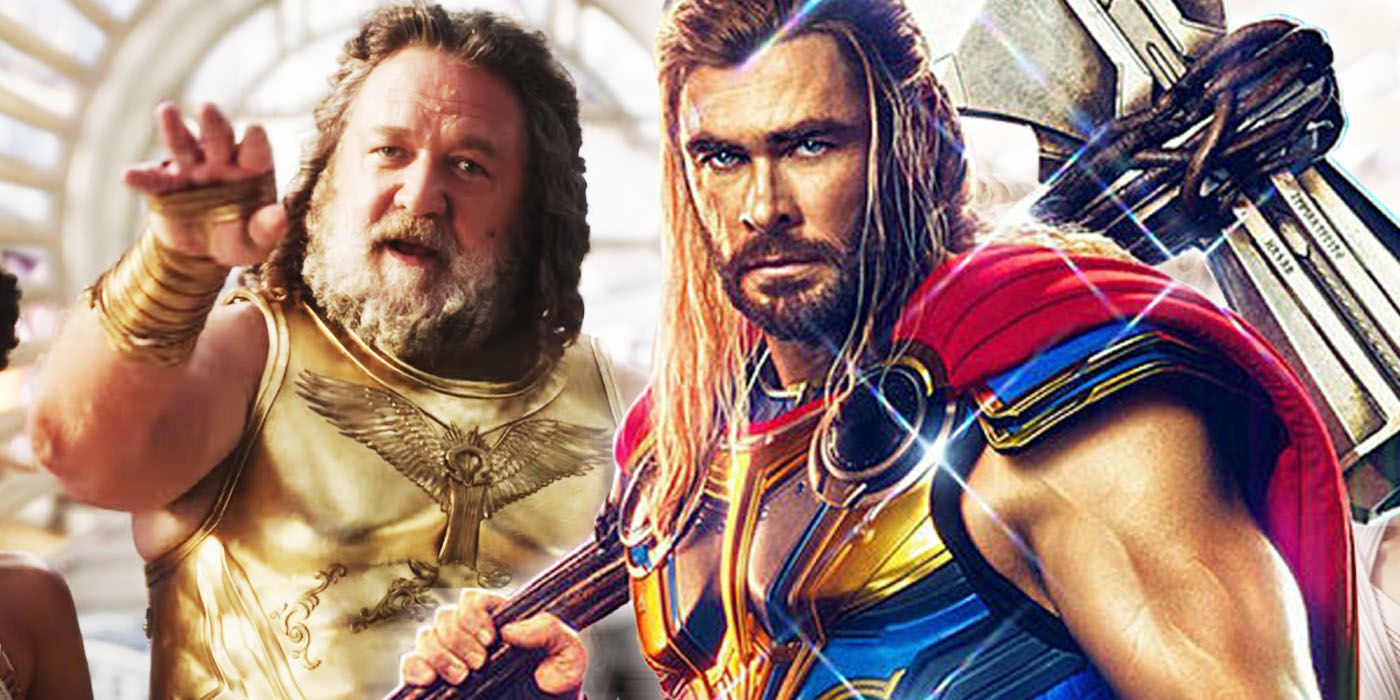
He’s not exactly the dignified, marble-statue version of a god you'd expect. When Russell Crowe strutted onto the screen in Thor Love and Thunder, playing the legendary Zeus, the audience didn't get a stoic leader of the heavens. Instead, we got a tutu-wearing, flicking-too-hard, ego-driven showman who seemed more interested in the quality of the upcoming orgy than the literal "God Butcher" murdering his peers. It was polarizing. Some fans loved the campy, Greek-accented absurdity, while others felt it stripped the stakes away from the Marvel Cinematic Universe (MCU) at a time when things should have been getting darker.
The introduction of Zeus in Thor Love and Thunder wasn't just a random cameo. It was a pivotal world-building moment for Omnipotence City. This is where the gods of the MCU hang out, hiding from the problems of mortals. It’s a gilded cage. Director Taika Waititi leaned heavily into the idea that gods are basically just celebrities who have lost their way. They’ve become influencers with superpowers.
The Problem With Zeus in Thor Love and Thunder
Why did people struggle with this version? Honestly, it’s because Marvel has a history of making its "Skyfathers" feel weighty. Think back to Anthony Hopkins as Odin. When Odin spoke, the room went quiet. He felt like ancient history and heavy responsibility. In contrast, Zeus in Thor Love and Thunder feels like a parody of power. He’s fearful. He’s hiding behind his golden gates while Gorr the God Butcher, played by a terrifyingly committed Christian Bale, is out there literally decapitating deities.
Crowe’s performance is actually quite nuanced if you look past the accent. He’s playing a man—a god—who knows his era is ending. He’s terrified. He uses humor and cruelty to mask the fact that he’s no longer the warrior he used to be. When Thor asks for help, Zeus doesn't just say no. He mocks him. He tries to humiliate him. It’s a classic defense mechanism.
The "flick" scene is the perfect example of the film’s tone. It’s funny, sure. Seeing Chris Hemsworth stripped bare by a literal flick of a finger is a gag that fits Waititi’s style. But it also shows Zeus’s casual disregard for his "lesser" peers. To Zeus, Thor is just a "lower-tier" god making a scene in his pristine city.
Breaking Down the Thunderbolt
The Thunderbolt isn't just a prop. In the comics and Greek myth, it's the ultimate weapon. In the movie, it’s depicted as a physical object made of solid gold energy. It’s chaotic. It’s fast. And interestingly, it’s the only thing that actually hurts Zeus.
When Thor grabs that bolt and puts a hole through Zeus’s chest, it’s a massive turning point. It proves that the "Old Guard" of gods can be bled. They aren't invincible. They’re just well-guarded. This moment serves two purposes:
- It gives Team Thor a weapon capable of fighting Gorr.
- It sets up a future conflict between the Asgardians and the Olympians.
Is Zeus Dead? The Post-Credits Reality
If you walked out of the theater the moment the credits rolled, you missed the real Zeus. The post-credits scene changes everything about how we should view his character in Thor Love and Thunder. He’s alive. He’s scarred. And he’s incredibly angry.
"Being a god used to mean something," he grumbles while being tended to by his handmaidens. This is the most honest line in the whole movie. He’s acknowledging that superheroes have replaced gods in the hearts of mortals. People don't pray to Zeus anymore; they look to the sky for Iron Man or Thor. He’s bitter.
This bitterness leads to the introduction of Hercules, played by Brett Goldstein. This tells us that Zeus isn't just a one-off joke. He’s the catalyst for the next chapter of Thor’s life. He wants his status back. He wants people to fear the lightning again.
The Contrast Between Zeus and Gorr
The brilliance—or the frustration, depending on who you ask—of Thor Love and Thunder is the juxtaposition between the two antagonists. You have Gorr, who is suffering, grieving, and fueled by a very real, very dark purpose. Then you have Zeus, who represents why Gorr is right.
Gorr wants to kill all gods because they are selfish. Zeus is the living proof of that selfishness. He sits in a literal ivory tower while children are being kidnapped and worlds are being razed. He’s the "bad" god that justifies the villain's crusade. It’s a bit of a meta-commentary on power. When those in charge stop caring about the people they serve, they become the villains of someone else's story.
What Most People Get Wrong About the Accent
There was a lot of chatter about Russell Crowe’s Greek accent. It sounds... thick. Almost like a caricature. But there’s a reason for it. Crowe actually recorded his scenes twice: once with a British "posh" accent (like Odin) and once with the Greek accent. Waititi ultimately chose the Greek version because it felt more "authentic" to the character's origins, even if it felt sillier in a blockbuster context.
It’s a choice that strips away the Shakespearean layer Marvel usually wraps its gods in. It makes Zeus feel like a specific person rather than a generic "wise old man." He’s a Mediterranean uncle who has had too much wine and thinks he’s still the hottest guy at the party. It’s a bold choice. It didn't land for everyone, but it was intentional.
The Power Scale: Zeus vs. Thor
Is Zeus stronger than Thor? In the comics, absolutely. Zeus is an Elder God level threat, usually on par with Odin. In Thor Love and Thunder, the power dynamic is a bit more skewed. Thor is in his prime. Zeus is past his.
- Zeus's Strength: He can manipulate lightning with more precision than Thor. He can "flick" clothes off or strike someone with a thought.
- Thor's Edge: Thor has the "warrior's spirit." He’s actually out there doing the work, while Zeus has grown soft in Omnipotence City.
When they clash, Thor wins not because he is inherently "stronger" in a magical sense, but because he is more determined. He has something to fight for—Love, and the children of Asgard. Zeus is just fighting for his ego.
Actionable Takeaways for Marvel Fans
If you're revisiting Thor Love and Thunder or trying to make sense of where the franchise is going, keep these points in mind:
- Watch the background in Omnipotence City. You can see gods from various mythologies, including Bast from Black Panther. It proves Zeus is the head of a massive, albeit lazy, divine collective.
- Don't take the tutu literally. The costuming is a nod to historical Greek "pteryges" but exaggerated for the "theatrical" nature of the character.
- The Thunderbolt is the key. Pay attention to how the weapon is used by Valkyrie and Thor. It's much more versatile than Mjolnir or Stormbreaker because it doesn't have a "weight." It’s pure energy.
- Hercules is coming. The rivalry between Thor and the Olympians is now officially MCU canon. Expect a much more "serious" version of the Greek gods in the next installment.
The portrayal of Zeus in Thor Love and Thunder remains one of the most debated parts of Phase 4. Whether you think he was a clown or a clever deconstruction of divinity, he’s changed the landscape of the cosmic MCU forever. He turned the "heavens" into a place of bureaucracy and vanity, making Thor’s journey to becoming a true protector even more significant.
The next time you watch, look past the jokes. Look at the fear in Zeus's eyes when Thor mentions Gorr. The god of lightning isn't a comedian; he's a relic trying to stay relevant in a universe that has moved on without him. That makes him a lot more dangerous than a simple punchline.
To get the full picture of the Greek gods' future, re-watch the post-credits scene and look at the "shrine" Zeus is sitting in. It’s not a palace; it’s a war room. The "nice" version of the gods is gone. The vengeful ones are waking up.