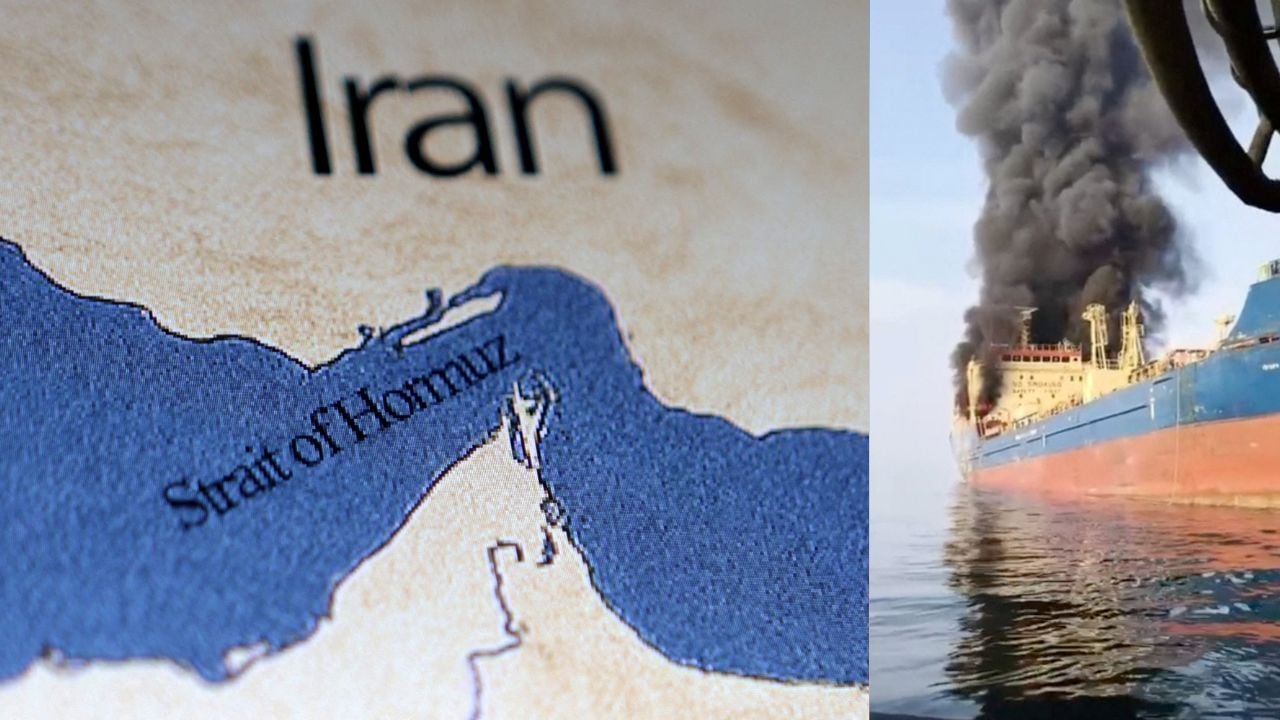
The headlines are screaming about three damaged tankers in the Gulf. The pundits are dusting off their "End of the World" scripts. They want you to believe that a few holes in a steel hull signify a global catastrophe. They are wrong.
Most analysts look at a burning tanker and see a supply chain failure. I look at it and see a long-overdue stress test. For decades, the global economy has been a glutton for cheap, subsidized security provided by the U.S. Navy. We have built a world that relies on the "miracle" of frictionless transit through some of the most volatile bottlenecks on the planet.
That era is over. And frankly, we should be glad.
The Myth of the Strategic Bottleneck
Every time a shadow-war skirmish between the U.S. and Iran escalates, the "Strait of Hormuz" becomes the most overused phrase in financial news. We are told that 20% of the world’s oil flows through there and that any disruption is an existential threat to Western civilization.
This is the "lazy consensus." It assumes that the global energy market is a fragile glass ornament. In reality, it is a self-healing organism. When insurance premiums for Gulf transit spike, the market does something beautiful: it starts to care about efficiency again.
I’ve spent twenty years watching traders hedge against "geopolitical risk." Most of them are just gambling on volatility. But the real players—the ones moving the physical molecules—know that these skirmishes are the only thing forcing the industry to diversify. Without a burning tanker every few years, the world would still be 100% dependent on the cheapest, dirtiest, and most politically compromised barrels on the map.
The Subsidy Nobody Talks About
Let’s be brutally honest about what the "stability" of the Gulf actually costs. The U.S. spends billions annually to patrol these waters. This is a massive, hidden subsidy for fossil fuel consumption. When you fill up your tank, you aren't paying the true cost of that gasoline. You aren't paying for the carrier strike groups required to make sure that tanker from Ras Tanura doesn't get hit by a drone.
By "escalating" the conflict, Iran isn't just threatening oil flow; they are inadvertently calling the bluff on the fossil fuel economy. They are making the hidden costs visible.
If you want to know why renewable energy and localized nuclear power aren't scaling faster, look no further than the artificially suppressed price of Gulf crude. A permanent state of low-level conflict in the Gulf is the most effective "carbon tax" ever devised. It forces the C-suite to look at the map and realize that "cheap" oil is actually the most expensive asset on their balance sheet when you factor in the risk of it never arriving.
Why "Freedom of Navigation" is a Relic
The competitor articles will tell you that the U.S. must "restore order" to protect the principle of freedom of navigation. This is a 20th-century solution to a 21st-century reality.
In a world of $50,000 suicide drones and smart mines, "protecting" a 300-meter-long slow-moving target is a mathematical nightmare. The physics favor the disruptor.
$$\text{Cost of Attack} \ll \text{Cost of Defense}$$
We are reaching a point where the cost of securing a single barrel of oil through the Strait may soon exceed the value of the oil itself. The contrarian take isn't that we need more destroyers; it's that we need to stop caring if the tankers get through.
The Resilience of the "Shadow Fleet"
You’ll hear "experts" talk about the "Three Tankers" as if they were part of a unified, regulated global fleet. They aren't. We are seeing the rise of the "Shadow Fleet"—vessels with obscured ownership, fake transponders, and questionable insurance.
These aren't "victims" of a conflict; they are the frontline of a new, decentralized energy trade that ignores sanctions and borders alike. If Iran hits a tanker, they aren't just hitting "The West." They are often hitting the very mechanisms that allow their own neighbors (and sometimes themselves) to move product.
The disruption doesn't stop the flow; it just changes the plumbing. It forces oil into pipelines that bypass the Strait, like the East-West Pipeline in Saudi Arabia or the Habshan-Fujairah line in the UAE. This is called geographic arbitrage. The more tankers burn, the faster these alternatives get funded.
The People Also Ask (And Are Wrong)
People often ask: "Will gas prices hit $10 a gallon if the Gulf closes?"
The answer is no, because the "closing" of the Strait is a physical impossibility. You can sink a dozen ships, and you still wouldn't block a waterway that is 21 miles wide at its narrowest point. The "closure" is a psychological event, not a physical one.
The real question you should be asking is: "Why am I still invested in companies whose entire supply chain depends on the mood of a regime in Tehran or the political will of a polarized Washington?"
If you are looking for "safety" in the traditional energy sector, you are looking for a ghost. The conflict isn't an "interruption" of the status quo; it is the status quo.
Stop Fixing the Conflict, Start Exploiting the Shift
If you are a business leader or an investor, quit waiting for "stability" to return to the Gulf. Stability was a historical anomaly fueled by an overextended superpower.
The smart move isn't to lobby for more naval protection. It’s to:
- Accelerate Decoupling: Any process that requires a 10,000-mile supply line through a war zone is a failed process.
- Short the "Security" Narrative: Companies that sell "maritime security" are selling a band-aid for a sucking chest wound.
- Bet on Friction: Profits are found in the friction. The higher the risk in the Gulf, the higher the value of every drop of oil produced in the Permian Basin, the North Sea, or Guyana.
The three damaged tankers aren't a tragedy for the global economy. They are a signal. The noise you hear is the sound of the old world cracking under the weight of its own inefficiency.
Stop mourning the end of cheap security. The era of the "unprotected" sea is here, and it’s the only thing that will finally force the world to grow up and build a resilient energy infrastructure that doesn't rely on a single, narrow strip of water.
Move your capital. Change your supply chain. Let the tankers burn.