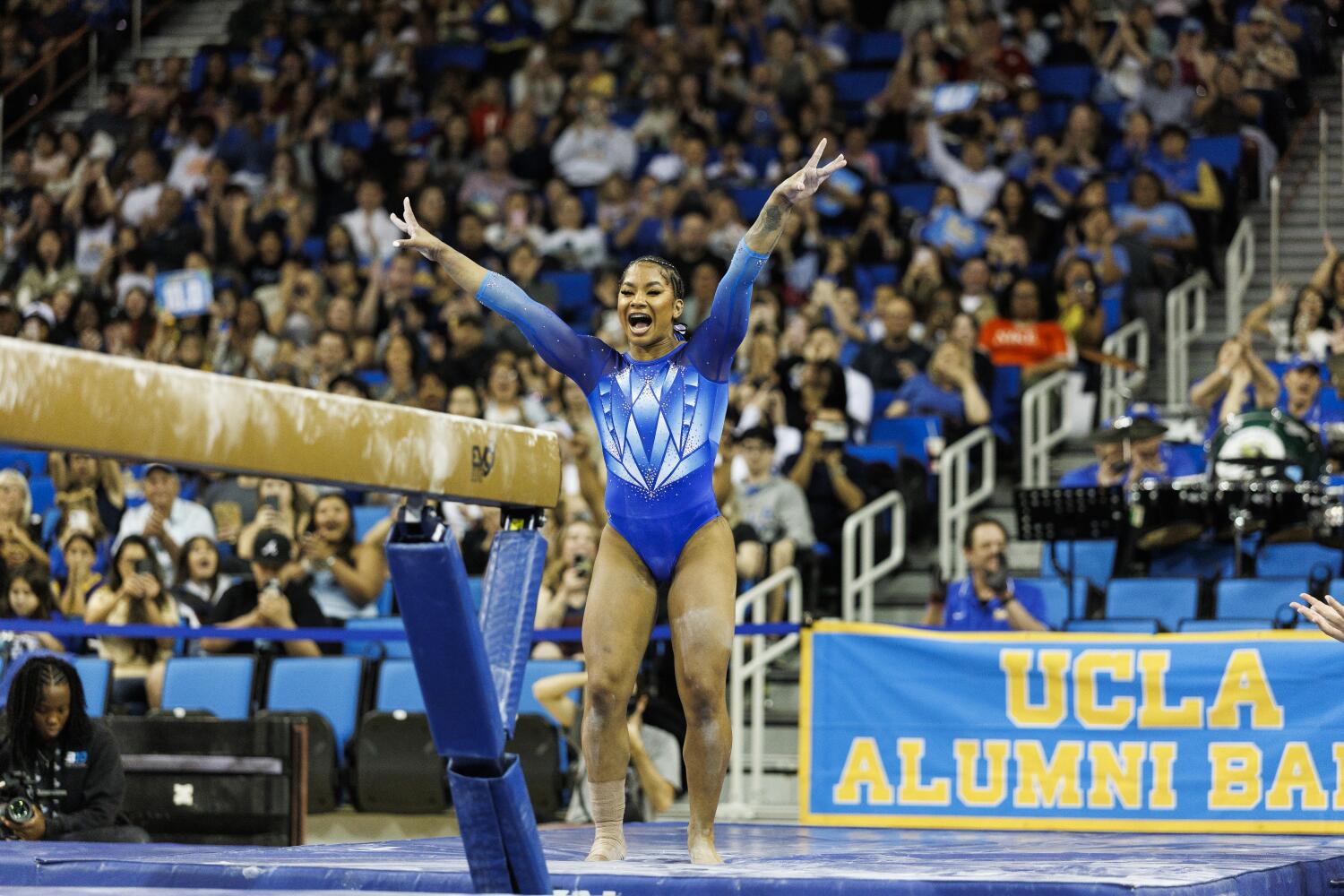
Jordan Chiles did more than just anchor a rotation or secure a trophy during the Big Ten gymnastics championships. She effectively redrew the map of collegiate power. By the time the final scores flashed across the board, UCLA had not only swept the titles but had also sent a clear message to the traditional elite programs in the Southeast. The Bruins are no longer just a "vibes" program known for viral floor routines; they are a clinical, high-execution machine that has mastered the technical demands of the Big Ten's increasingly rigid scoring environment.
The narrative surrounding Chiles often focuses on her Olympic pedigree, yet the real story lies in her transition from a world-class individual performer to the gravitational center of a rebuilding collegiate dynasty. Her performance—highlighted by another perfect 10—was the catalyst for a team effort that silenced critics who wondered if UCLA could maintain its identity while migrating to a new, more physically demanding conference.
The Big Ten Scoring Trap
When UCLA joined the Big Ten, skeptics pointed toward the conference's reputation for tight officiating and a preference for "traditional" form over the West Coast flair that defined the Bruins for decades. There was a legitimate fear that the flashier elements of the UCLA style would be penalized by judges accustomed to the more conservative Midwestern standard.
That fear proved unfounded.
What we saw at the championships was a team that had fundamentally adjusted its technical training. Instead of relying on raw athleticism to power through landings, the Bruins showed a discipline on the balance beam and uneven bars that matched the precision of their floor exercise. This wasn't a fluke. It was the result of a deliberate shift in coaching philosophy that prioritized "stuck" landings over the ambitious, high-difficulty transitions that previously led to inconsistency.
The Mechanics of Perfection
A "Perfect 10" in the modern era is rarely about the difficulty of the skills themselves. Most gymnasts at this level are performing the same core requirements. The distinction comes down to the micro-adjustments made in the air.
During Chiles' bars routine, every handstand was exactly 180 degrees. There was no "piking" in the giant swings, and her release moves were caught with arms fully extended, eliminating the small deductions that usually plague even the best athletes. When Chiles hits a perfect score, she isn't just winning a point for her team; she is providing a psychological cushion for the gymnasts following her. It creates a "halo effect" where judges, having seen perfection, are more likely to reward the high-level execution of her teammates.
Building Around a Centrifuge
Chiles operates as the centrifuge of this team. While most programs try to spread their talent thin to cover all four events, UCLA has leaned into the "star-power" model, allowing Chiles’ intensity to dictate the pace of practice.
The investigative reality of college sports is that a single elite athlete can change a culture more effectively than a decade of administrative planning. Before Chiles arrived, UCLA was a program in flux, searching for a post-Valorie Kondos Field identity. The transition was rocky. There were internal disagreements and a noticeable dip in the technical quality of the lower-lineup gymnasts.
Chiles changed that by demanding a professional-grade atmosphere. She treats the college gym like a national team camp. This forced the sophomores and juniors to elevate their own preparation. You could see the difference on the vault runway. In previous seasons, UCLA struggled with direction and height. This year, they attacked the table. The landings were aggressive. They weren't just trying to stay on their feet; they were trying to drill their heels into the mat.
The Hidden Depth Factor
While Chiles captures the headlines, the sweep was made possible by the "middle-order" gymnasts who have stopped making the unforced errors that defined the last three years of UCLA gymnastics.
- Reliability on Beam: The Bruins managed to navigate the beam rotation without a single major break. In a conference like the Big Ten, where the beam is often where dreams go to die under the pressure of a loud, hostile crowd, this stability was the true differentiator.
- The Freshman Integration: Newcomers didn't look like freshmen. They performed like seasoned veterans, a sign that the upperclassmen—led by Chiles—have successfully insulated the younger athletes from the pressure of the big stage.
Why the Big Ten Sweep Matters for the National Title
The Big Ten is no longer the "second-tier" gymnastics conference. With the inclusion of West Coast powerhouses, it has become a gauntlet that prepares teams for the brutality of the NCAA Regionals and Finals. By sweeping the titles, UCLA hasn't just won a conference; they have established a blueprint for how to beat the SEC giants.
The SEC relies on "power gymnastics"—massive vaults and explosive floor passes. The Big Ten, as evidenced by this championship, is shifting toward "efficiency gymnastics." UCLA has combined both. They have the SEC-level power thanks to athletes like Chiles, but they have adopted the Big Ten’s obsession with the "little things."
The Judging Paradox
There is an ongoing debate in the gymnastics community about "home-score inflation." Many argued that UCLA's high scores at Pauley Pavilion wouldn't travel well to the neutral or away sites of the Big Ten tournament. This weekend debunked that theory. The scores were earned in a high-pressure environment against judges who had no inherent bias toward the Bruin brand.
If UCLA can score 198+ in a conference championship setting, they are a lock for the Final Four. The question is no longer whether they can compete with the likes of Oklahoma or LSU, but whether those teams can match the momentum that UCLA has built over the last six weeks.
The Sustainability of the Chiles Era
We have to look at what happens when Chiles eventually moves on. The mark of a truly successful program isn't just winning while the superstar is on the roster, but using that superstar to build a foundation that lasts.
The "Chiles Standard" is now the baseline at UCLA. The recruiting classes for the next two years are already reflecting this. Top-tier recruits who previously looked at UCLA as a place to become a social media star are now looking at it as a place to become a technical master. The program has successfully pivoted back to being a championship contender first and an entertainment product second.
This sweep was the final piece of evidence needed to prove that the transition is complete. The Bruins didn't just win a title; they reclaimed their spot at the top of the food chain. Every other program in the country should be looking at the tape of this meet, specifically the way the Bruins moved between events. There was no fatigue. There was no loss of focus. There was only a relentless pursuit of the next ten.
Watch the way Chiles prepares for her vault. She isn't looking at the crowd or the scoreboard. She is visualizing the exact millimeter where her hands will hit the horse. That level of focus has become infectious, and it is the primary reason why UCLA walked away with every piece of hardware available. The rest of the field was playing for second place before the first rotation even ended.
Go back and watch the transition from the third to the fourth rotation. While other teams were huddling and trying to manage nerves, the UCLA sideline was calm. They knew the math. They knew that as long as they stayed within their training, the result was inevitable. That is the hallmark of a team that has moved past the "hope to win" phase and into the "expect to win" phase. For the rest of the NCAA, that is a terrifying development.
Check the technical replay of the bars rotation and pay attention to the distance on the dismounts. Most teams are happy to land within the "safe zone." UCLA gymnasts were landing so deep into the mat that it looked like they were trying to punch a hole through the floor. That is the aggression required to win in the modern era, and it is exactly what Chiles has brought to the program. Use this performance as the benchmark for the upcoming regional qualifiers.