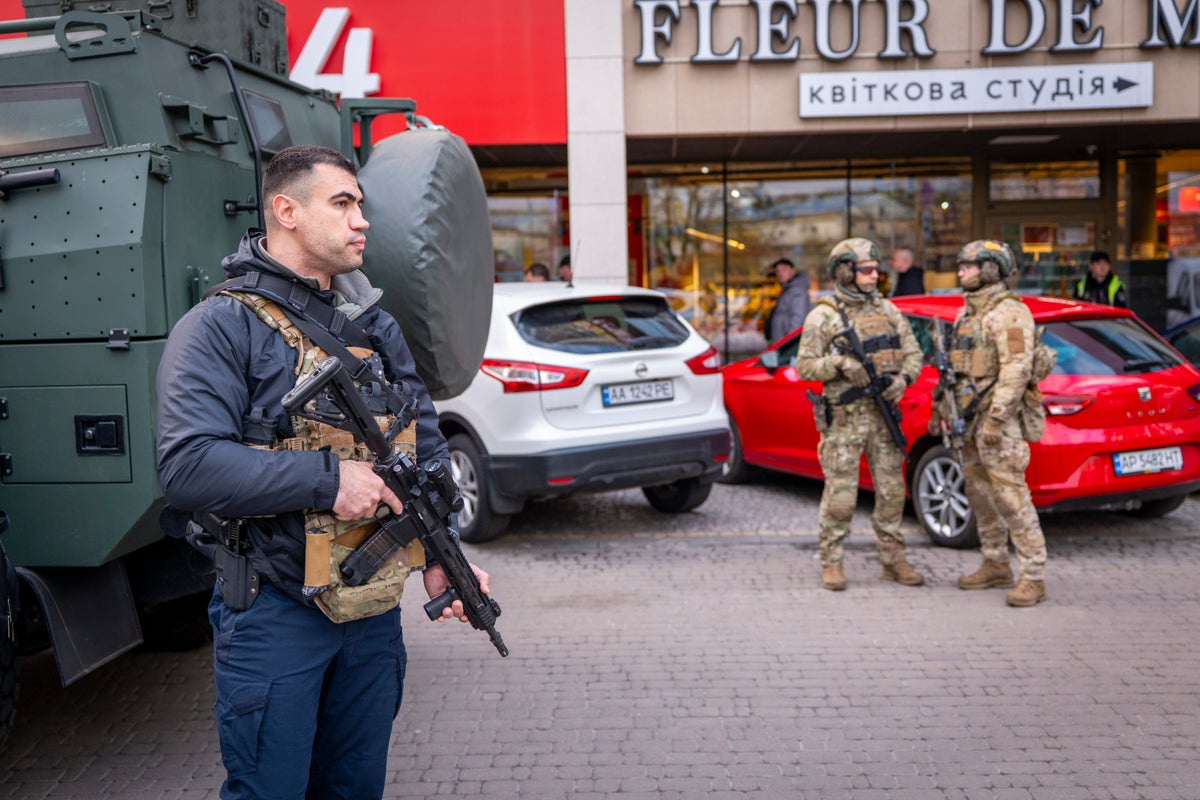
The tragic shooting in Kyiv serves as more than an isolated criminal event; it functions as a stress test for the Ukrainian social contract regarding the state’s monopoly on violence. In a nation where the frontline is fluid and the domestic security apparatus is strained by the exigencies of total war, the debate over legalizing handguns for self-defense has shifted from a civil rights discussion to a structural necessity of national resilience. The core friction lies in the mismatch between the high availability of military-grade long arms and the rigid, often prohibitive restrictions on civilian handgun ownership.
The Triad of Defensive Deterrence
To analyze the efficacy of liberalizing handgun laws in a high-threat environment, we must evaluate the proposal through three distinct lenses: the Response Time Variable, the Asymmetry of Lethality, and the Psychological Deterrence Quotient. You might also find this related coverage interesting: Why the Ofcom investigation into Telegram is a massive deal for privacy and safety.
- The Response Time Variable: In a conventional security model, the state guarantees protection through professional law enforcement. However, during active hostilities or high-density urban unrest, the mean response time often exceeds the duration of a violent encounter. By legalizing handguns, the state decentralizes the first-response capability, effectively moving the "point of intervention" from the arrival of police to the onset of the threat.
- The Asymmetry of Lethality: Currently, the Ukrainian black market and the influx of battlefield weapons have created an environment where criminals possess high-capacity tools while law-abiding civilians are restricted to hunting rifles or smoothbore shotguns. These long guns are suboptimal for concealable self-defense in urban settings, creating a tactical disadvantage for the victim.
- The Psychological Deterrence Quotient: A standardized legal framework for concealed carry introduces an element of "unknown risk" for potential aggressors. When the probability of encountering an armed citizen reaches a specific threshold, the cost-benefit analysis for opportunistic crime shifts toward avoidance.
The Regulatory Bottleneck and the Long-Gun Paradox
Ukraine maintains a counter-intuitive regulatory environment. It is relatively straightforward for a citizen without a criminal record to acquire a semi-automatic rifle (carbine), yet nearly impossible to legally obtain a handgun for personal protection. This creates the Long-Gun Paradox: the state trusts its citizenry with weapons capable of effective ranges up to 500 meters but denies them the tools designed for short-range, defensive encounters within 7 meters.
The current system relies heavily on "award weapons"—handguns gifted by the Ministry of Internal Affairs or the Ministry of Defense to specific individuals for service or merit. This creates a stratified security class where safety is a privilege granted by the bureaucracy rather than a right inherent to the citizen. This stratification undermines public trust and encourages the growth of an unregulated gray market. As extensively documented in latest articles by Reuters, the implications are worth noting.
Structural Risks of Decentralized Lethality
Any transition toward a "Right to Carry" model involves measurable systemic risks. These are not merely ideological concerns but logistical variables that require mitigation:
- The Proliferation of Accidental Discharge: A sudden influx of handguns into a population without a standardized training culture increases the statistical probability of non-combatant injuries. Handguns require higher levels of motor-skill proficiency than long guns due to their short sight radius and the complexity of safe holstering.
- Escalation of Force Dynamics: In a society with high baseline stress—such as a city under regular missile bombardment—the threshold for perceived threats may lower. This "hyper-vigilance bias" can lead to the use of lethal force in situations that would otherwise be resolved through de-escalation.
- Evidence Chain Contamination: Decentralized defensive shootings complicate the work of forensic investigators and the judiciary. Distinguishing between legitimate self-defense and premeditated violence becomes more resource-intensive for a legal system already burdened by war crimes documentation.
The Economic and Logistical Infrastructure of Legalization
A transition to legalized handguns is not a simple stroke-of-a-pen policy change; it requires the construction of a Civilian Defense Infrastructure. This infrastructure consists of four pillars:
1. The Centralized Digital Registry
The Diia ecosystem provides a unique technological advantage for Ukraine. A blockchain-verified registry linked to the national identity system can track weapon life cycles from the point of sale to the final owner, reducing the risk of "lost" firearms entering the criminal underworld.
2. Standardized Qualification Protocols
Ownership must be decoupled from mere "permits" and linked to "competency tiers."
- Tier 1: Basic storage and safety (Home defense only).
- Tier 2: Advanced tactical proficiency and legal theory (Concealed carry).
- Tier 3: High-stress environment training (Volunteer security/territorial defense integration).
3. The Liability Insurance Market
To offset the social costs of firearm ownership, a mandatory liability insurance model should be explored. This internalizes the risk of gun ownership, where insurance premiums are adjusted based on the owner’s training level, storage security, and history of safe handling.
4. Supply Chain Normalization
Legalization would allow for the formalization of the domestic small-arms industry. Transitioning from "donated" foreign equipment to locally manufactured, standardized defensive tools provides both an economic stimulus and a more predictable maintenance cycle for the population.
Mapping the Geopolitical Signal
The legalization of handguns in Ukraine also carries significant weight in the context of "Total Defense" doctrines popularized by Baltic and Nordic states. When a civilian population is armed and trained, it complicates the occupation calculus for any invading force. A handgun is not a primary battlefield weapon, but it is an essential tool for personal security in the "gray zone" between frontline combat and civil administration.
By empowering the citizenry, the Ukrainian government signals a high level of mutual trust. This is a potent counter-narrative to authoritarian models where the state disarms the population to ensure internal stability. In the Ukrainian context, internal stability is increasingly viewed as a function of collective, decentralized strength rather than centralized control.
The Strategic Path Forward
The legislative move toward handgun legalization should not be viewed as a reaction to a single shooting, but as a proactive realignment of national security policy. To maximize the benefits while minimizing the volatility of this shift, the following sequence is necessary:
First, the Verkhovna Rada must pass a unified law on civilian firearms that eliminates the ambiguity of current decrees. This law must explicitly define the conditions for "justified use of force," providing a clear legal shield for citizens acting in self-defense.
Second, the Ministry of Internal Affairs should pivot from a "permit-granting" body to a "standards-enforcement" body. This involves outsourcing training to certified private academies while maintaining a rigorous, digitized auditing process.
Third, the government must address the "amnesty problem." There are hundreds of thousands of unregistered handguns currently in circulation. A successful legalization framework must include a window for the registration of these weapons without penalty, provided they are not linked to violent crimes. This brings the "shadow arsenal" into the light, allowing for better data collection and risk assessment.
The security of Kyiv and other urban centers depends on a hybrid model where the state provides the framework and the citizen provides the immediate response. The legalization of handguns is the final piece of this hybrid security architecture, transforming the populace from a vulnerable collective into a resilient, decentralized network of self-protecting units.