The smell of expensive cologne is surprisingly fragile. It only takes a single, acrid gust of wind to turn a thousand-dollar scent into something that catches in the back of your throat. On a humid Saturday evening in Washington, D.C., that scent—a mixture of ambition, starch, and high-end bourbon—collided with the sharp, metallic tang of a city on edge.
To the uninitiated, the White House Correspondents' Association dinner is "Nerd Prom." It is a night where the people who report the news and the people who make it drop the pretense of adversarial combat to eat rubbery chicken and laugh at ourselves. But this year, the tradition felt less like a celebration and more like a fever dream.
I stood near the entrance of the Washington Hilton, adjusting a bow tie that felt more like a noose. Behind me, the red carpet was a shimmering conveyor belt of power. To my left, a few hundred yards away, the world was screaming.
The Glass Wall
The logistics of the evening were, on paper, a masterpiece of Secret Service precision. There are perimeters within perimeters. To get into the Hilton, you don't just show an ID; you surrender your autonomy to a series of magnetometers and stern men with earpieces.
Inside, the atmosphere was pressurized.
Waiters hovered with trays of champagne. Network anchors checked their reflections in the polished silver. It was the picture of elite stability. Yet, the walls of the Hilton are mostly glass. And through that glass, the facade was cracking.
Protesters had gathered in numbers that the pre-event briefings hadn't quite accounted for. They weren't just there to wave signs. They were there to be heard through the soundproofing. The chants for a ceasefire in Gaza didn't just drift over the barricades; they vibrated through the floorboards.
Consider the psychological dissonance of that moment. You are holding a crystal glass, discussing the nuances of the First Amendment, while a few feet away, people are shouting that your silence is a form of complicity. It creates a physical sensation of being trapped in a jewel box that someone is shaking with increasing violence.
The Descent into the Ballroom
The "chaos" started long before the first joke was told. It began with the arrivals.
Usually, the walk from the car to the door is a gauntlet of flashbulbs. This time, it was a gauntlet of fury. Guests in floor-length gowns had to navigate a labyrinth of steel fencing while protesters draped a giant Palestinian flag from the windows of the hotel itself. It was a visual coup. The very building hosting the pinnacle of the American press corps had been rebranded from the outside in.
I watched a young journalist, probably no older than twenty-five, clutching her clutch bag like a shield. She was white-knuckled. The protesters weren't just shouting at "the media" as an abstract entity; they were looking her in the eye and asking how she could eat while others starved.
That is the human element the standard news reports missed. It wasn't just a security breach or a loud demonstration. It was an interrogation of the soul.
When we finally moved toward the ballroom, the escalator ride felt like descending into a bunker. The further down we went, the fainter the chanting became. We were burying ourselves in the basement of a hotel to pretend the world wasn't burning.
The Comedy of Discomfort
The dinner itself is built on a specific kind of social contract: we laugh so we don't fight.
But as the lights dimmed and the program began, the laughter was brittle. The President sat on the dais, a target and a host all at once. The comedian of the night, Colin Jost, had the unenviable task of making a room full of people who felt like they were under siege feel good about themselves.
He did his best. He cracked jokes about age, about the polls, about the absurdity of our profession. But every time the room erupted in a roar of laughter, there was a split-second lag—a moment where everyone seemed to check if it was still okay to be having fun.
The tension wasn't just about the protests outside. It was about the identity crisis happening inside.
The press is supposed to be the watchdog. But in that room, under those glittering chandeliers, we looked a lot like the inner circle. We looked like the establishment. And for the thousands of people outside, and the millions watching on social media, the distinction between the person asking the question and the person avoiding it had become dangerously thin.
The Invisible Stakes
Why does this matter? Why should anyone care about a group of well-dressed people having a stressful dinner?
Because the chaos at the Hilton wasn't an isolated event. It was a microcosm of a country where the conversation has completely broken down.
When the press and the government sit together in a fortified basement while the public screams at the gates, the "Fourth Estate" starts to look like a gated community. The stakes aren't just about who got shouted at or which celebrity showed up. The stakes are the credibility of the information itself.
If the people don't believe the reporters are standing with them, they will stop believing the reports.
As the night wore on, the "chaos" shifted from the streets to the psyche. I spoke with a veteran correspondent near the bar. He’s covered wars, famines, and five different administrations. He looked tired. Not the "I stayed up too late" tired, but a deep, structural exhaustion.
"They don't want us to report on it anymore," he whispered, gesturing vaguely toward the ceiling. "They want us to pick a side and stay there."
That is the quiet tragedy of the evening. The dinner is meant to celebrate the freedom of the press—a freedom that requires a certain level of detachment, a commitment to the messy, uncomfortable middle ground. But the middle ground was being swallowed by the noise.
The Escape
Leaving was harder than arriving.
By the time the last awards were handed out and the last speeches were made, the crowd outside had grown. The police had moved in closer. The air felt heavy, charged with the static electricity of a looming confrontation.
There was no "safe" exit. We had to walk back out through the same glass doors, back into the humidity and the shouting.
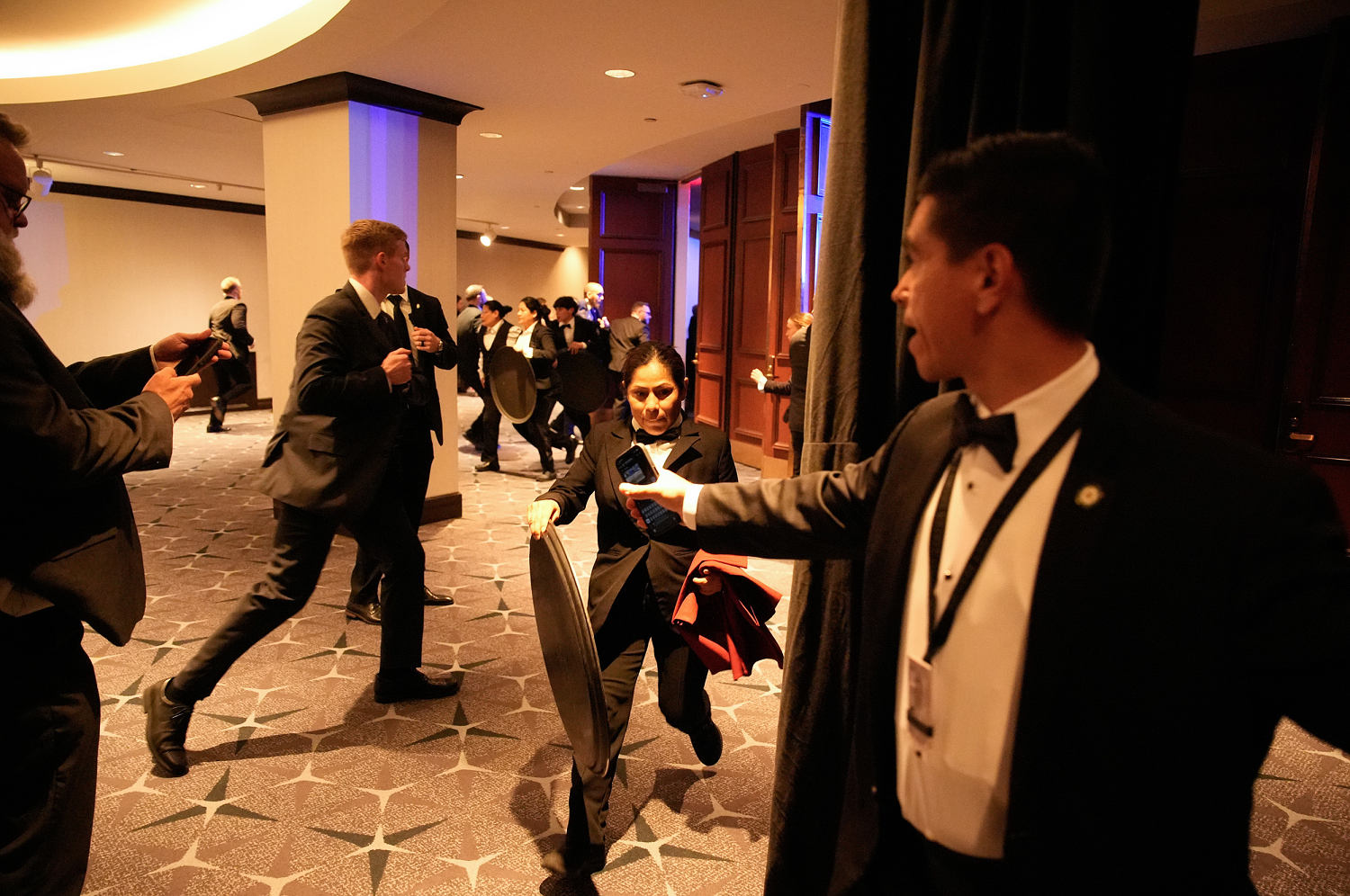
I saw a group of guests trying to sneak out a side service entrance, scurrying past bins of discarded food and laundry carts. It was a pathetic sight—the most powerful people in media and politics, fleeing through the kitchen like characters in a farce.
I chose the front door.
The transition was instantaneous. One moment, I was in the climate-controlled silence of the lobby. The next, the sound hit me like a physical blow. The chanting was rhythmic, a heartbeat of discontent. "Shame on you," they yelled. "Shame on you."
I walked to my car, my eyes stinging. Was it the remnants of some chemical deterrent the police had used? Or was it just the sheer weight of the moment?
I looked back at the Hilton. It sat on the hill, glowing with a dull, yellowish light. From a distance, it looked peaceful. It looked like the center of the world. But as I drove away, the chanting stayed with me, ringing in my ears long after the city's traffic had drowned out the actual voices.
The tuxedo was going back in the closet. The stains of the evening, however, weren't going to come out with a simple dry cleaning.
We are living in an era where the walls are no longer enough to keep the reality out. We can build our perimeters, we can hire our security, and we can tell our jokes in the basement. But eventually, the dinner ends. Eventually, we all have to walk back out into the wind, and when we do, we have to decide if we are there to record the world, or if we are simply trying to survive it.
The lights of the motorcade flickered in the rearview mirror, red and blue, cutting through the dark like a warning nobody was quite ready to heed.