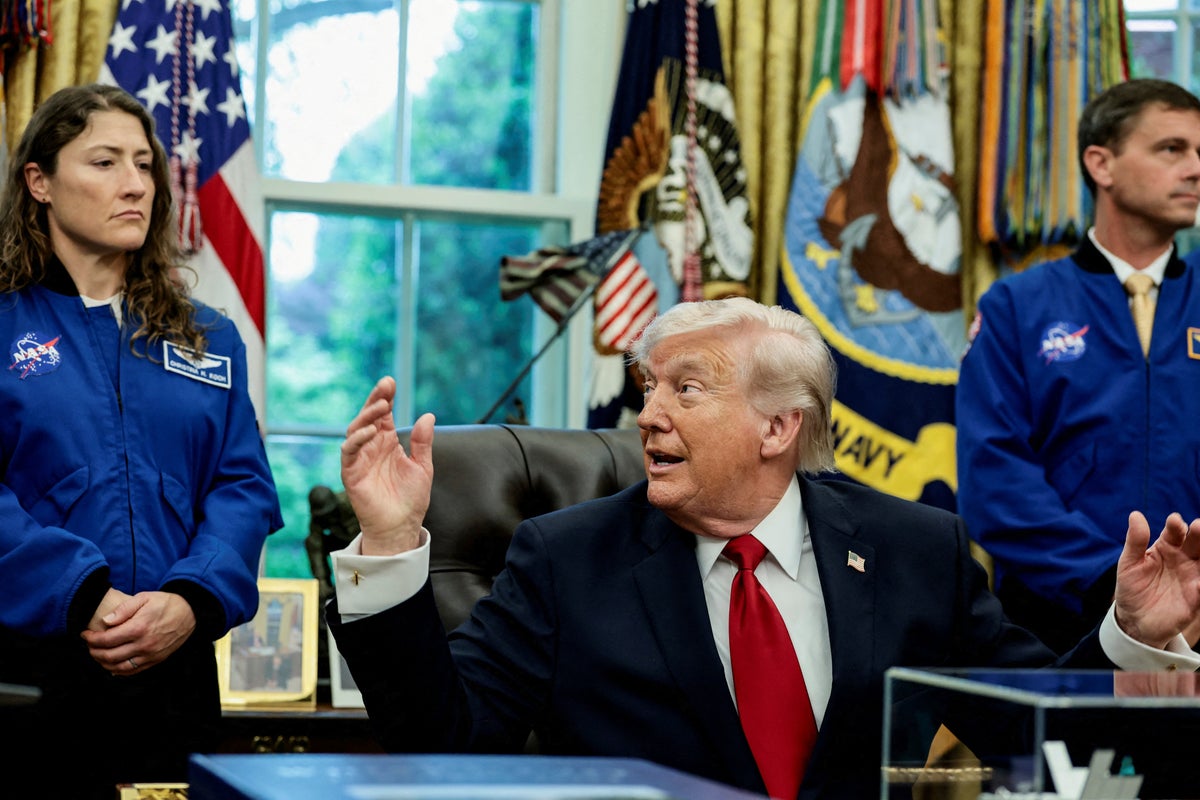
Donald Trump recently declared he would have no trouble serving as an astronaut, a claim that surfaced during a high-profile communication with the Artemis II crew as they looped around the moon. While the comment was delivered with his trademark bravado, it ignores a decade of physiological data and the brutal reality of spaceflight requirements. Transitioning from the Oval Office to an Orion capsule involves more than just a sense of adventure; it requires surviving a gauntlet of physical stresses that have grounded younger, more athletic candidates for decades.
The G Force Reality Check
Modern spaceflight is not a luxury cruise. During launch and reentry, astronauts endure forces several times the pull of Earth's gravity. For a man of Trump’s age and physical profile, these "G-loads" present a specific cardiovascular risk. When a rocket accelerates, blood pools in the lower extremities, forcing the heart to work exponentially harder to keep oxygen flowing to the brain.
NASA’s medical standards for long-duration flight are notoriously rigid. Applicants must pass a rigorous long-duration physical that monitors everything from bone density to heart rhythm. While the agency has flown older individuals—John Glenn famously returned to orbit at age 77—Glenn was a lifelong military pilot who had maintained a strict fitness regimen and served as a human guinea pig for geriatric research. Trump’s self-assessment bypasses the fact that NASA's current Artemis mission profile is significantly more demanding than the Shuttle missions of the 1990s.
The Political Precedent of Payload Specialists
History shows that the path for a politician to reach the stars usually involves the "Payload Specialist" designation. This was a loophole used in the 1980s to send sitting members of Congress, like Jake Garn and Bill Nelson, into orbit. Garn, specifically, became the gold standard for "space sickness," experiencing such severe nausea that NASA created a "Garn Scale" to measure motion sickness in subsequent crews.
The investigative reality is that these flights were largely diplomatic or budgetary maneuvers. NASA needed funding, and inviting the chairmen of oversight committees was an effective, if risky, strategy. However, the 1986 Challenger disaster effectively ended the era of "tourist" politicians. The agency pivoted back to a professional-only core, emphasizing that every seat must be occupied by someone capable of performing emergency repairs or complex scientific maneuvers.
The Privatization Loophole
If there is a legitimate path for Trump to reach orbit, it likely bypasses NASA entirely. The rise of commercial spaceflight through entities like SpaceX or Blue Origin has rewritten the rulebook. These companies operate under "informed consent" rather than strict government health mandates.
- Commercial Standards: Private missions have already flown civilians with prosthetic limbs and corrected vision.
- The Isaacman Model: Jared Isaacman, whom Trump recently tapped for a leadership role, proved that private citizens can even perform spacewalks if they have the capital to fund the mission.
- Medical Waivers: In the private sector, a "no trouble" claim is only as good as the liability waiver the passenger is willing to sign.
While Trump’s Space Force remains his "baby," his path to the stars would likely require him to step out of the government infrastructure he helped build and into the private sector he championed.
Radiation and the Deep Space Factor
The Artemis II mission Trump praised was different from the Low Earth Orbit (LEO) flights of the Space Shuttle. The crew traveled 250,000 miles from Earth, passing through the Van Allen radiation belts and entering deep space where cosmic rays are a constant threat.
The shielding on the Orion capsule is advanced, but the long-term effects of radiation on an older human body remain a primary concern for flight surgeons. In deep space, there is no Earth magnetosphere to hide behind. A solar flare during a mission could deliver a lifetime's worth of radiation in hours. For a former president, the secret service logistics alone of managing a high-radiation environment would be a nightmare that no "no trouble" boast can solve.
The Autograph and the Legacy
During his call to the Artemis crew, Trump mentioned asking for their autographs—a rare admission of admiration from a man who usually demands the spotlight. This suggests that the "astronaut" claim is less about a career change and more about a desire for the ultimate validation of American exceptionalism.
The sheer audacity of the claim serves a dual purpose: it reinforces his image as a man of action while keeping the Space Force and Artemis programs in the news cycle. Whether or not he could actually clear the medical hurdles of a NASA physical is secondary to the narrative of a "frontier nation" that he wants to lead. The hardware is ready, the private sector is willing, but the biological clock remains the one adversary that even a Commander-in-Chief cannot out-negotiate.
Inside the Artemis II Mission
This video provides a direct look at the historic Artemis II mission and the specific call where the conversation about modern-day pioneers took place.