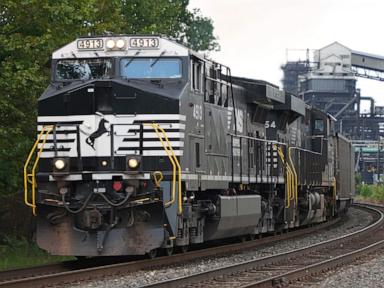
Union Pacific is currently flush with cash and brimming with enough operational confidence to believe it can swallow its largest Eastern rival. On April 23, 2026, the Omaha-based giant reported a 5% climb in first-quarter net income to $1.7 billion, a result fueled by an relentless drive for efficiency that pushed its operating ratio down to a leaner 59.9%. But these figures are more than just a quarterly win for shareholders. They are a carefully staged exhibit in a high-stakes trial before federal regulators. Union Pacific is attempting to prove that its machine is so well-oiled it deserves to manage the first true coast-to-coast rail network in American history by acquiring Norfolk Southern.
The financial performance serves as a shield against critics who argue that mega-mergers in the rail industry inevitably lead to service meltdowns and monopolistic pricing. By showing that it can improve "velocity"—the speed at which cars move through the system—even while navigating the messy early stages of a merger application, Union Pacific CEO Jim Vena is making an audacious claim. He is betting that the Surface Transportation Board (STB) will prioritize the theoretical efficiency of a single-line transcontinental service over the historical reality of rail consolidation, which has often left shippers stranded and supply chains fractured.
The Ghost of Mergers Past
The railroad industry is haunted by the wreckage of 1990s consolidation. When Union Pacific acquired Southern Pacific in 1996, the result was a systemic collapse that paralyzed the Western United States for months. Trains sat idle for days; grain rotted in silos; and the "red block" of gridlock became a cautionary tale for every logistics manager in the country. Vena knows this history well. His current strategy is to front-load operational improvements to argue that today's Union Pacific is a different beast entirely.
In the first quarter of 2026, the railroad reported freight car velocity of 235 daily miles, a 9% jump from the previous year. Terminal dwell—the time cars spend sitting in yards—dropped by 11%. These aren't just dry metrics. They are the ammunition Vena needs to convince a skeptical STB that a $85 billion merger won't result in a repeat of the 1990s disaster. The argument is simple: if we can move more with less right now, imagine what we can do with a seamless line from Los Angeles to Savannah.
However, efficiency on a spreadsheet rarely accounts for the friction of human and mechanical integration. Integrating the East and West requires merging two vastly different cultures, aging infrastructure, and incompatible software systems. The STB has already shown its teeth, rejecting the initial merger application in January 2026 due to "missing information" regarding market share and trackage rights. While a revised application is slated for April 30, the setback signals that the federal government is no longer rubber-stamping the dreams of rail titans.
The Fight for the Gulf Coast
The most significant hurdle isn't just the paperwork; it is the predatory interest of rivals who see the merger as an opportunity to carve out their own gains. Keith Creel, CEO of Canadian Pacific Kansas City (CPKC), has already signaled a desire for "concessions." Specifically, CPKC wants access to the lucrative petrochemical clusters along the Gulf Coast—territory that Union Pacific guards with religious intensity.
Vena has remained defiant, stating that he sees no reason to grant concessions to competitors just because they want a piece of the action. This stance sets up a collision course with the STB’s mandate to protect competition. In the past, the board has forced merging railroads to sell off tracks or allow competitors to use their lines to ensure shippers aren't trapped with a single provider. If Union Pacific refuses to budge, the merger could die on the vine, or worse, be approved with so many strings attached that the projected $250 billion enterprise value begins to bleed out before the first black and yellow engine ever pulls a Norfolk Southern car.
Why Shippers are Terrified
For the companies that actually pay to move goods—the chemical manufacturers, the grain co-ops, and the auto giants—the merger represents a potential nightmare. Trade groups like the American Chemistry Council are already lobbying hard against the deal. Their fear is grounded in decades of data showing that as the number of "Class I" railroads shrinks, the power of the shipper evaporates.
- Pricing Power: With only one company controlling a transcontinental route, the ability to play one railroad against another vanishes.
- Service Priority: In a massive network, low-margin freight often gets pushed to the back of the line in favor of high-volume intermodal containers.
- Reciprocal Switching: Shippers are fighting for rules that would force railroads to hand off cargo to competitors if service fails, a move the STB is currently considering but the industry is fighting.
The Regulatory Squeeze
The current political climate is notably more hostile to corporate consolidation than it was during the last great wave of rail mergers. The STB’s Strategic Plan for 2026-2030 emphasizes "market forces" and "national security," but it also focuses on reducing "regulatory barriers" for shippers, not necessarily for the railroads themselves.
Union Pacific's 5% profit growth is a double-edged sword in this context. While it proves the company is healthy, it also provides ammunition for those who argue that the railroad doesn't need this merger to survive or thrive. If the company is already achieving record efficiency and mid-single-digit earnings growth, what is the public benefit of allowing it to absorb a massive competitor? Vena’s answer is the "Great Connection"—the promise of removing 24 to 48 hours from transit times by eliminating the need for interchanges in bottleneck cities like Chicago and Memphis.
Whether those 48 hours are worth the risk of a national rail monopoly is the question that will define the next two years of American logistics. The STB isn't expected to issue a final ruling until 2027. Until then, Union Pacific must maintain a perfect operational record. Any derailment, any service spike, or any dip in velocity will be used by opponents to argue that the giant is already too big to manage.
The $36 million in merger costs reported this quarter is just the beginning of the "transaction tax." The real cost will be measured in the concessions Union Pacific is forced to make to its rivals and the grueling scrutiny of a government that has grown tired of the "too big to fail" era of American rail. Vena is betting the farm on a transcontinental dream, but the tracks ahead are cluttered with the wreckage of those who tried to build empires on a foundation of pure efficiency.