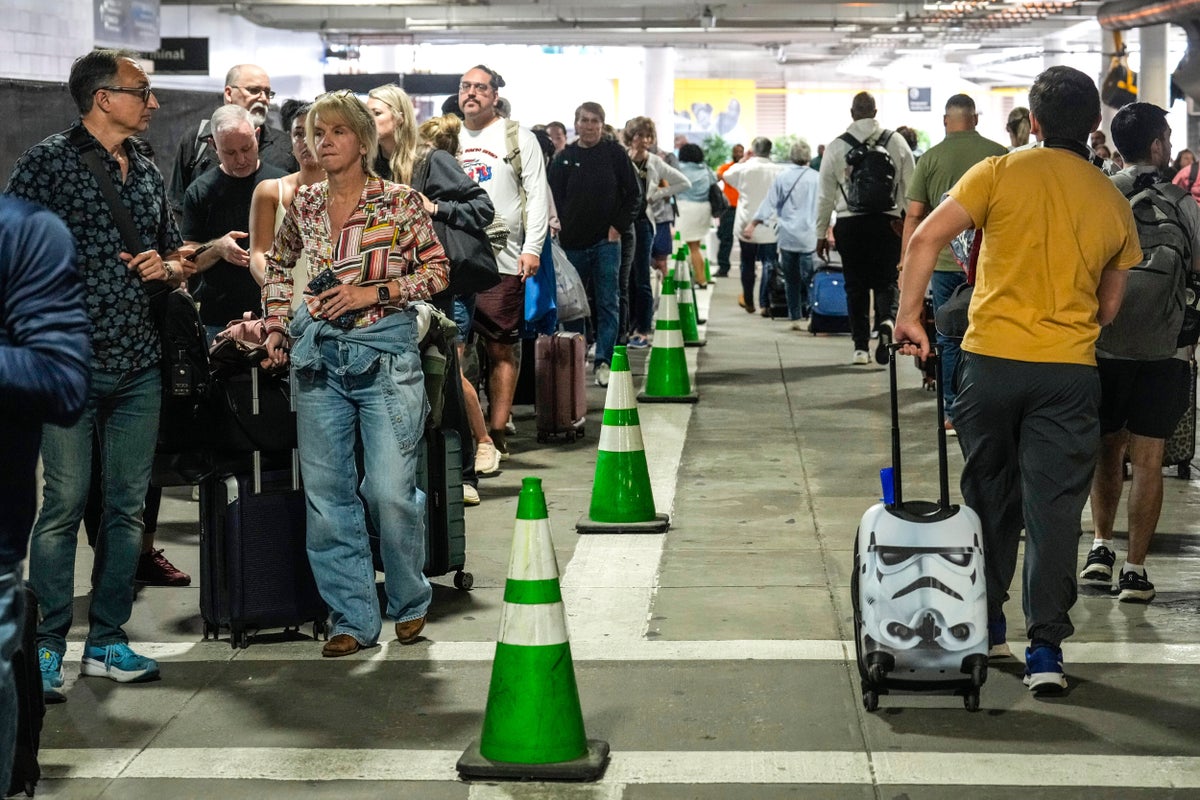
The media loves a good horror story involving a gray plastic bin and a five-hour wait. Whenever the federal government decides to play its perennial game of budget chicken, the headlines default to "traveler chaos." They point at the TSA agents working without a paycheck and the sprawling lines snaking past the Cinnabon as if it’s a sudden, unforeseen tragedy.
It isn’t.
The current "chaos" isn't a symptom of a broken budget; it’s the honest realization of a broken system that was never designed for efficiency. If you’re standing in a line that stretches into the parking garage, don't blame the shutdown. Blame the fact that you’ve been subsidizing a theater production for twenty years and finally had to see the stagehands without their makeup.
The "lazy consensus" says the shutdown is killing travel. The reality? The shutdown is merely stripping away the illusion of a functional security apparatus.
The Myth of TSA Essentialism
We’ve been conditioned to believe that the TSA is the thin blue line between a safe flight and catastrophe. It’s an expensive lie. Before the shutdown even started, the Department of Homeland Security’s own internal testing showed that undercover investigators could smuggle mock weapons and explosives past TSA checkpoints at a failure rate that would get any private contractor fired in an afternoon.
When agents start calling out sick because they aren't getting paid, the system slows down. But it doesn't become significantly less "safe" because the baseline for that safety was already shockingly low. What you are actually experiencing isn't a security crisis. It is a throughput crisis.
The government shutdown reveals that the TSA is less of a security agency and more of a massive, federally-funded jobs program that relies on high-volume compliance. When that volume is disrupted by labor shortages, the "security" doesn't fail—the queue fails.
Efficiency Is A Choice You Didn't Make
People ask, "How can I avoid the five-hour wait?" They look for hacks. They buy $200 noise-canceling headphones to drown out the crying toddlers. They are asking the wrong question. The question isn't how to survive the line; it’s why you are still relying on a centralized, government-monopolized bottleneck in 2026.
If you are a frequent traveler complaining about the shutdown lines but you haven’t invested in every available biometric shortcut, you are part of the problem.
- TSA PreCheck is the bare minimum.
- Global Entry is a prerequisite for anyone with a passport.
- CLEAR is the private-sector middle finger to government inefficiency.
I have sat in airport lounges and watched executives lose $5,000 worth of billable time while whining about a shutdown. They’ll spend $900 on a last-minute ticket but won’t spend $189 on a CLEAR membership that would have bypassed the entire mess. This isn't just about the money; it's about the refusal to acknowledge that in a crisis, the "standard" lane is for people who haven't valued their time correctly.
The Brutal Truth About Spring Break
The competitor pieces scream about "Spring Break Chaos." They act as if the combination of a shutdown and a holiday is a "perfect storm."
It’s actually a perfect filter.
Spring Break is the time when "amateur travelers"—the ones who fly once a year and still don't know they have to take their shoes off—clog the arteries of the aviation world. The shutdown just amplifies their incompetence. When a seasoned agent is replaced by a skeleton crew, they no longer have the patience to explain the 3-1-1 liquids rule to a family of six.
The friction you see at the airport isn't caused by the absence of workers. It’s caused by the presence of unprepared passengers who require constant hand-holding. If the government stayed shut down forever, we would eventually see a Darwinian shift in travel behavior. People would learn to pack light, use digital IDs, and stop treating the security checkpoint like a surprise party they weren't expecting.
Private Security Is The Only Way Out
San Francisco International (SFO) and a handful of other airports use the Screening Partnership Program (SPP). They use private contractors instead of federal TSA employees. Guess what? During shutdowns, these airports often perform better. Why? Because private firms have different labor contracts, more flexible staffing models, and a bottom-line incentive to keep people moving.
The "chaos" is a uniquely federal product.
We are told that a federalized workforce is "paramount" for national security. (Actually, strike that—the word is irrelevant). We are told it’s necessary. But the data doesn't back it up. Private screeners at SFO have historically matched or outperformed TSA screeners in detection rates while maintaining higher efficiency.
The shutdown is the best argument we’ve had in a decade for the total privatization of airport security. If a business can’t stay open because its parent company (the US Government) is having a board-room spat, that business shouldn't have a monopoly on your movement.
Stop Waiting For A Resolution
The "People Also Ask" sections are filled with: "When will the shutdown end?" and "Is it safe to fly?"
Here is the brutally honest answer: It doesn't matter when it ends. If it ends tomorrow, the TSA will still be a slow, bloated, and ineffective bureaucracy. If it lasts another month, the sky won't fall, but your patience will.
Safety is a constant; the only variable is your own tolerance for a lack of agency.
I’ve spent fifteen years in the logistics and travel sector. I've watched airlines collapse and airports freeze. The travelers who win are the ones who stop looking at the government as a service provider and start looking at it as an obstacle to be navigated around.
If you’re stuck in a five-hour line, you aren't a victim of a political stalemate. You are a victim of your own reliance on a system that was never built to respect your time.
Stop checking the news for a budget deal. Check your own luggage. Ship your bags via a private courier. Fly out of regional airports that the "chaos" hasn't touched yet. Use the private terminals (FBOs) if you can afford it.
The shutdown isn't the problem. The monopoly is.
Pack your bags, skip the "standard" line, and stop expecting a broke government to facilitate a smooth vacation.
Get out of the line or stop complaining about the wait.