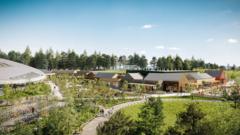
Scotland’s Land Reform Act of 2003 was supposed to be the "gold standard" of public access. It told every citizen they had the right to be anywhere, provided they were responsible. Then came Center Parcs.
The headlines are buzzing about the first Scottish Center Parcs at Hawick, specifically the "restriction" of the right to roam on the site. The local consensus is one of mild grumbling or cautious optimism about jobs. Both are wrong. This isn't just a planning permission tweak. It is the corporate enclosure of the Scottish soul, sold back to us as a "forest retreat."
If you think this is about safety or "operational requirements," you’ve bought the brochure. This is about the commodification of the outdoors. We are watching the legal privatization of the commons in real-time, and we’re doing it for the sake of a tropical cyclone slide and a pancake house.
The Myth of "Managed Access"
The developers argue that you can't have random hikers wandering through a site where families are cycling in matching sweatshirts. They claim it’s a liability nightmare. This is a classic straw man.
I’ve spent twenty years navigating the intersection of land use and commercial development. In every other context, the "liability" argument is the first shield raised by lawyers who don't want to do the work of creative integration. Under the Scottish Outdoor Access Code, land managers are generally not liable for risks arising from natural features or even many man-made ones, provided they aren't setting traps.
By allowing Center Parcs to fence off a massive chunk of the Borders, the authorities are admitting that private profit trumps public right. They are creating a precedent: if your investment is big enough, the law doesn't apply to you.
Why the Jobs Argument is a Trap
"But the jobs!" the councils cry. "1,200 permanent roles!"
Let's look at the math. These are, by and large, low-wage service roles. Housekeeping, lifeguarding, flipping burgers. While those roles have value, they do not replace the loss of an ecosystem or the permanent alteration of the landscape.
When a massive multinational enters a rural area like Hawick, it doesn't just "boost" the economy; it distorts it. It sucks the labor pool dry, making it harder for local, independent businesses to find staff. It creates a monoculture. If Center Parcs decides in fifteen years that the Scottish climate is too expensive to heat, they leave. The fence stays. The land remains altered. The local economy, now dependent on a single titan, collapses.
Real economic resilience comes from diverse, small-scale land use—exactly what the right to roam encourages by supporting independent hikers, photographers, and small-scale tourism operators who don't hide behind a paywall.
The Suburbanization of the Wilderness
Center Parcs isn't "nature." It’s a sanitized, Disney-fied version of the woods designed for people who are afraid of actual mud.
By granting this restriction, we are endorsing the idea that nature is only valuable when it is manicured, fenced, and monetized. The "forest" in these resorts is a backdrop for consumption. The moment you require a wristband to enter a woodland, that woodland ceases to be part of the Scottish landscape and becomes a retail floor.
Imagine a scenario where every scenic glen in the Borders is evaluated not by its biodiversity or its place in the community, but by its "resort potential." If we waive the right to roam for one developer, how do we say no to the next ten? We are witnessing the death of the "everyman" land right by a thousand cuts—or in this case, a thousand lodges.
The Security Theater
The planning documents frequently cite "guest security" as the reason for the perimeter fence. This is the most offensive part of the deal. It implies that the Scottish public—the people who actually live in Hawick—are a threat to holidaymakers.
Since when did walking through a forest become a security breach? The right to roam explicitly excludes the "curtilage" of buildings—the immediate gardens and private spaces. The law already protects the guests' privacy. The fence isn't there to keep guests safe; it’s there to ensure that every person on that property has paid for the privilege of being there. It’s an admission fee disguised as a safety measure.
The Reality of Land Reform
The 2003 Act was designed to prevent the "Berlin Wall" approach to the Scottish countryside. It was a reaction against the Victorian sporting estates that kept people off the hills. Now, we are circling back to the same exclusionary tactics, just with better branding.
- The Competitor’s View: A necessary compromise for economic growth.
- The Reality: A legal surrender that signals Scotland's land is for sale to the highest bidder, rights included.
Stop Asking if it’s Good for the Economy
Start asking if it’s good for the country.
A country is not just a balance sheet. It is a collection of shared rights and identities. The right to roam is one of the few things that makes Scotland genuinely unique in the UK. In England, only about 8% of the land is accessible. In Scotland, it was 100%—until now.
When you carve out 400 acres here and 500 acres there for "exclusive" developments, you aren't just building a hotel. You are shrinking the map. You are telling the next generation that the "great outdoors" is something you buy a ticket for, not something you inherit by birthright.
If we want to save the Borders, we don't need a massive, fenced-in bubble of artificial tropicality. We need investment that respects the law of the land, rather than asking to be exempt from it.
Go to the public consultations. Don't ask about the traffic. Don't ask about the noise. Ask the developers why their business model is so fragile that it cannot survive the presence of a Scotsman walking his dog through the trees. If they can't answer that without mentioning "liability," they don't deserve the land.
The fence is already being built in the minds of the planners. It’s time to tear it down before the first post is even sunk.
Stop celebrating the "investment" and start mourning the enclosure.