The room where the world changes is rarely as grand as the movies suggest. It is usually a quiet space, smelling of stale coffee and the hum of high-end air filtration systems, where men in tailored suits trade words that carry the weight of millions of lives. In these rooms, a single "no" can be a shield. A "perhaps" is a dagger.
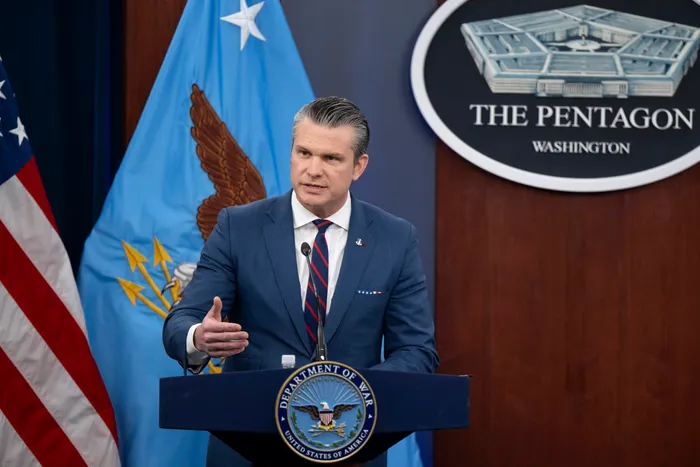
Pete Hegseth, the man currently holding the ledger of American defense, walked into the public eye recently with a message that sounds, on its surface, like a sigh of relief. China, the sprawling industrial heart of the East, has looked the United States in the eye and offered a promise. They will not, they say, send weapons to Iran.
To understand why this matters, you have to look past the ink on the briefing papers. You have to look at the map of the world as if it were a living, breathing organism.
Imagine a shipping container sitting in a port in Ningbo. It is a giant steel box, unremarkable among thousands of others. In one version of the future, that box is filled with microchips, high-grade sensors, or the kind of precision-guided components that turn a crude drone into a surgical instrument of war. If that box moves toward Tehran, the temperature of the entire globe rises by five degrees. If it stays put, or if it carries washing machine parts instead, the world keeps spinning on its axis for another day.
This is the invisible stakes of the Hegseth announcement. It isn't just about diplomacy. It is about the physical movement of the tools of destruction.
The Weight of a Handshake
For decades, the relationship between Washington and Beijing has been a choreographed dance on a floor made of thin glass. We buy their goods; they buy our debt. We watch their seas; they watch our skies. But the entry of Iran into this equation changes the chemistry of the room.
Iran sits at the heart of the world’s most volatile energy corridor. For China, Iran is a gas station. For the United States, Iran is a regional disruptor that threatens the stability of every ally from Tel Aviv to Riyadh. When the Secretary of Defense tells us that China has offered assurances, he is describing a moment where the two giants of the 21st century have found a rare patch of common ground.
But why would Beijing give this up? They aren't doing it out of the goodness of their hearts.
Every decision in the halls of the Great Hall of the People is a calculation of survival and growth. China knows that a Middle East in total flames helps no one, least of all a country that relies on the steady, predictable flow of oil to keep its factories humming. By promising to keep their weapons out of Iranian hands, they aren't just doing America a favor. They are protecting their own bottom line.
They are choosing the stability of the global market over the chaos of a proxy war.
The Ghost in the Machine
We often talk about "weapons" as if they are only tanks and missiles. In the modern era, that is a dangerous oversimplification. The real weapons are the things you can’t see until they strike.
Consider the "dual-use" problem. This is the gray area where a computer chip intended for a civilian medical device can, with a bit of clever engineering, become the brain of a cruise missile. When Hegseth speaks of assurances, the skeptics in the back of the room immediately point to this loophole.
It is easy to promise not to send a crate of rifles. It is much harder to police the flow of high-end transistors.
The human element here is the intelligence officer sitting in a windowless basement in Virginia, staring at satellite imagery of a freighter. They aren't looking for missiles. They are looking for the ghosts of missiles—the components, the precursors, the specialized chemicals.
Hegseth’s task is to convince the American public, and perhaps himself, that the Chinese assurance covers the ghosts too. It is a gamble on trust in an era where trust is the rarest commodity on earth.
The Mirror of History
We have been here before. During the Cold War, the "Red Telephone" was the ultimate symbol of the need for direct talk between rivals. It wasn't actually a telephone, but the sentiment was real: when the stakes are high enough, you have to be able to hear the other person’s voice.
Hegseth’s update is the modern version of that line. It suggests that despite the rhetoric about trade wars and TikTok bans and naval maneuvers in the South China Sea, there is still a working connection. The line is open.
However, the pressure is mounting. The American defense establishment is currently undergoing a massive internal shift, trying to balance the needs of old-school kinetic warfare with the new reality of cyber-fronts and economic leverage. In this context, a "no" from China regarding Iran is a massive strategic win. It allows the Pentagon to breathe. It moves one piece off an overcrowded chessboard.
Think of the sailor on a U.S. destroyer in the Persian Gulf. For that person, this news isn't a headline. It is a reduction in the statistical probability of a localized nightmare. It is the difference between a quiet night watch and a frantic scramble to the battle stations.
The "human-centric" reality of geopolitics is that every high-level assurance eventually trickles down to a person standing in the wind, holding a weapon, hoping they don't have to use it.
The Silence After the Promise
There is a specific kind of silence that follows a major diplomatic announcement. It is the silence of the "wait and see."
The skeptics will tell you that China’s word is a tactical delay. They will argue that the shipments will simply move through third parties, through "dark fleets" of oil tankers, or through the back-alleys of the global black market. And they might be right. The world is too big to be perfectly policed, and the borders are too porous for any promise to be 100 percent airtight.
But the fact that the promise was made at all is a signal. It tells us that Beijing currently values its relationship with the West—or at least the stability that relationship provides—more than it values the leverage it could gain by arming a revolutionary state.
It is a moment of cold, hard pragmatism.
As Hegseth moves forward with his agenda, he carries this assurance like a fragile glass ornament. He has to show it to the world to prove he is doing his job, but he has to hold it carefully, knowing how easily it could shatter. If a single Chinese-made guidance system shows up in the wreckage of a drone in the Red Sea next month, the assurance vanishes. The glass breaks. And the room where the world changes becomes a much darker place.
We live in a time of grand narratives, where we are told that the East and West are on an inevitable collision course. We are told that the friction is too great, the differences too deep, and the history too bloody for anything but conflict.
Then, a man stands behind a podium and tells us that a deal has been struck in the shadows. He tells us that, for now, the containers will remain filled with the mundane tools of peace rather than the efficient tools of death.
It isn't a victory parade. It isn't a treaty signed on the deck of a battleship. It is something much more modern and much more precarious. It is a pause. It is a breath taken in the middle of a sprint.
The shipment that didn't happen is the most important story in the world today, even if it’s the one we will never see on a grainy piece of surveillance footage. It is the ghost of a war that was averted by a string of words whispered across a distance of ten thousand miles.
The containers are stacked high on the docks of Ningbo, casting long shadows in the afternoon sun, silent and still.