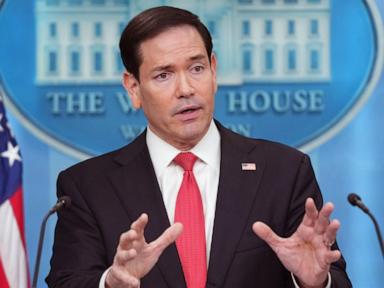
The smoke has cleared from the recent kinetic operations within Iranian borders, and the official word from Washington is that the immediate cycle of escalation has reached its coda. Senator Marco Rubio, acting in his capacity as a senior voice on the Intelligence and Foreign Relations committees, has signaled that while the current military exchange has reached a temporary standstill, the fundamental problem remains untouched. The "operation" may be over in the tactical sense, but the strategic threat posed by Iran’s stockpiles of highly enriched uranium has never been more acute. This isn't just about a single night of missile exchanges. It is about a ticking clock that has moved dangerously close to midnight while the world was distracted by the logistics of the strikes.
To understand why this moment is different, one must look past the immediate damage assessments of radar sites or drone factories. The core issue is the material. Intelligence reports indicate that Iran possesses enough uranium enriched to near-weapons grade—60% purity—to produce several nuclear devices if they choose to pursue the final "breakout." Once that material is moved, hidden, or processed further, the window for a conventional military solution effectively slams shut. Rubio’s insistence that this "has to be addressed" reflects a growing consensus in the intelligence community that the policy of containment is failing. Don't miss our earlier post on this related article.
The Enrichment Trap and the Limits of Conventional Force
Military strikes can destroy buildings. They can even collapse tunnels. But you cannot bomb knowledge, and you cannot easily destroy chemical compounds stored deep beneath several hundred feet of reinforced concrete and granite. The recent operations served as a demonstration of reach, proving that internal Iranian airspace is not the fortress Tehran claims it to be. However, the enrichment facilities at Fordow and Natanz are different beasts entirely.
Fordow is buried so deep within a mountain that many analysts believe conventional bunker-busters would struggle to do more than scratch the surface. This creates a psychological stalemate. If the United States or its allies engage in a campaign that fails to neutralize the nuclear core, they risk triggering the very thing they want to prevent: a frantic, final sprint to a finished bomb by a regime that feels it no longer has anything to lose. If you want more about the background here, NBC News provides an excellent summary.
The technical reality is sobering. Moving from 60% enrichment to the 90% required for a weapon is a much smaller leap than most people realize. It is not a linear process; it is exponential. Most of the work is already done. At this stage, the "operation" being over is merely a pause in a much larger, more dangerous game of chicken.
The Intelligence Gap and the Shadow of 2003
The veteran observer knows that rhetoric about "addressing" nuclear threats carries a heavy historical weight. We have seen this play before. The difficulty lies in the "known unknowns." While international inspectors still have some level of access, that access has been throttled and restricted over the last twenty-four months. We are operating on high-quality guesswork.
One overlooked factor is the decentralization of the Iranian nuclear program. It is no longer a single, centralized target. It is a web of specialized workshops, many of them located in nondescript urban areas or deep underground, producing the centrifuges needed to keep the enrichment cycle moving. Rubio’s comments suggest that the intelligence community is seeing something in the data that hasn't fully hit the public cycle yet—a shift in the "sneak-out" capability where Iran could potentially produce the necessary material in a timeframe shorter than our current detection cycle.
Beyond the Proxy War
For years, the conflict with Iran was fought in the shadows through proxies in Lebanon, Yemen, and Iraq. That era is dead. We are now in a period of direct state-on-state friction. The danger of this new phase is that it removes the layers of deniability that previously prevented total war. When Senator Rubio says the operation is over, he is describing the end of a chapter, not the book.
The focus now shifts to the diplomatic and economic levers that have been pulled so often they are starting to come off in our hands. Sanctions have been the primary weapon for decades, yet Iran’s nuclear program has only accelerated. This suggests a failure of the current international architecture. The "Maximum Pressure" campaign and the subsequent attempts to revive the JCPOA have both landed in the same place: a more advanced Iranian nuclear infrastructure than ever before.
The Technical Hurdle of Weaponization
Possessing the material is only half the battle. To have a functional nuclear deterrent, Iran must master weaponization—the art of shrinking a nuclear device to fit atop a ballistic missile and ensuring it can survive the intense heat and vibration of re-entry into the atmosphere.
While the enrichment gets the headlines, the engineering side of the house is where the real secret war is being fought. Cyberattacks, mysterious explosions at research labs, and the targeted disappearance of key scientists have slowed the progress, but they haven't stopped it. The engineering challenges are significant, but they are solvable. For a regime that has successfully built a world-class drone industry and long-range ballistic missiles under the most restrictive sanctions in history, weaponization is a matter of "when," not "if."
The Regional Arms Race has Already Started
We cannot view this in a vacuum. Riyadh, Abu Dhabi, and even Ankara are watching the American response with clinical detachment. If the United States cannot, or will not, provide a definitive "addressing" of the Iranian nuclear material, these regional powers will seek their own deterrents.
The Saudi leadership has been remarkably blunt: if Iran gets a bomb, they will get a bomb. We are looking at the potential for the most volatile region on earth to become a multi-polar nuclear landscape. This is the "why" behind the urgency in Rubio's tone. It isn't just about Iran; it’s about the total collapse of the non-proliferation regime globally.
The Hard Truth of the Next Phase
What does "addressing" the material actually look like? There are no easy answers, and anyone selling one is a liar.
The options are narrowed down to three equally unpalatable paths:
- Total Sabotage: A massive, coordinated cyber and physical sabotage campaign that goes far beyond anything seen previously.
- Diplomatic Capitulation: A new deal that recognizes Iran as a "threshold state" in exchange for strict, permanent monitoring—a move that would be politically radioactive in Washington.
- Preventative Strike: A full-scale military campaign designed to destroy the entire nuclear supply chain, which would almost certainly trigger a regional war with global economic consequences.
Rubio’s statement that the operation is "over" is a tactical reality, but his warning about the nuclear material is the strategic truth. The current policy is a holding pattern. We are circling an airport that is running out of runway. The material exists. It is being refined every hour of every day. The centrifuges do not care about press releases or the end of a single military operation.
The assumption that we can simply live with a "threshold" Iran is a gamble with the highest possible stakes. The window for a non-kinetic resolution is closing. We are moving toward a point where the choice will no longer be between "war and peace," but between "nuclear Iran and the cost of stopping it." The move to 90% enrichment isn't just a technical milestone; it is a point of no return that will redefine global security for the next fifty years.
The material is the mission. Everything else is just noise.