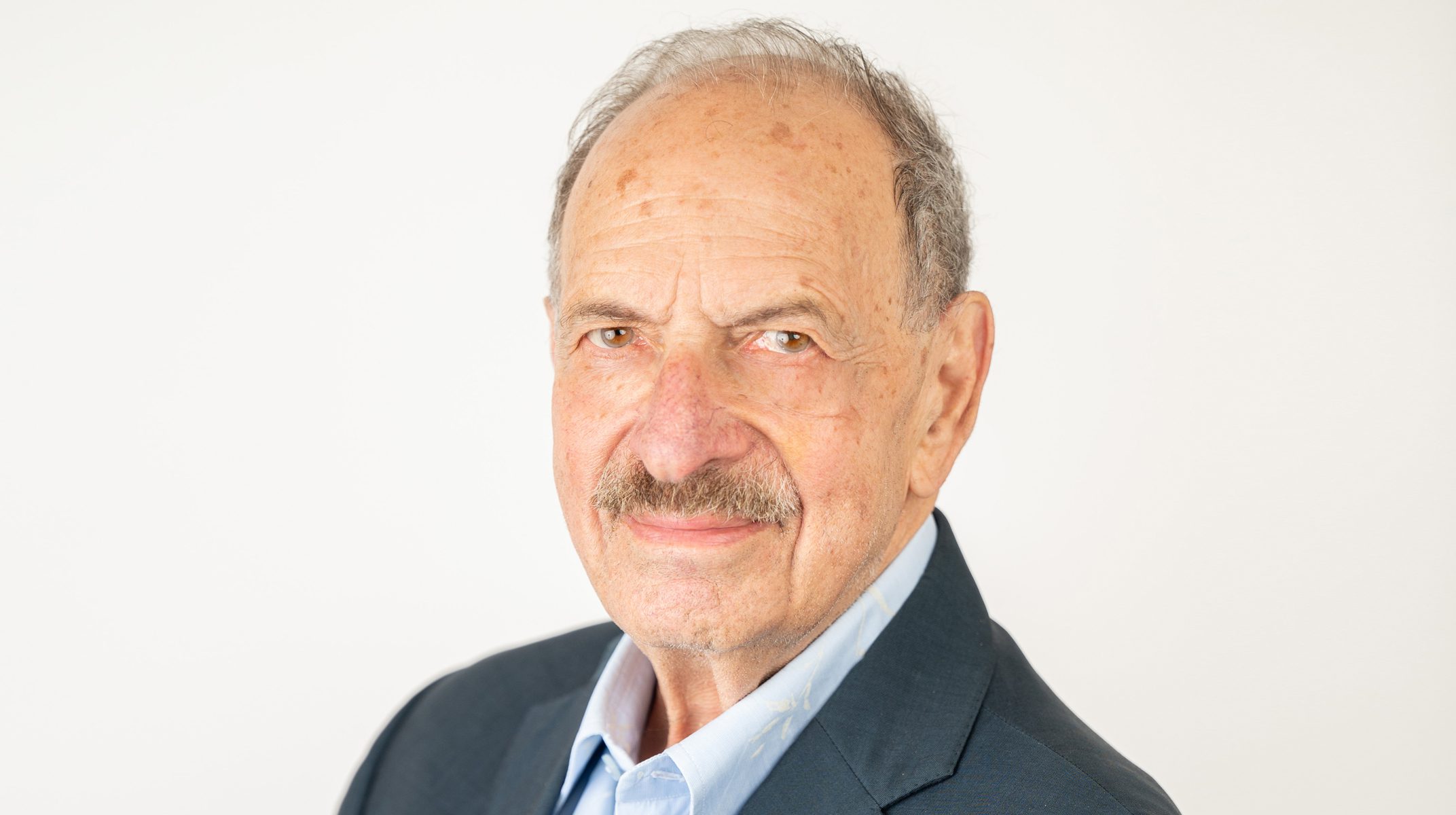
David Gross didn't win a Nobel Prize for being an alarmist. He won it for discovering asymptotic freedom in the theory of the strong interaction, a cornerstone of the Standard Model of physics. But when a man who understands the fundamental glue of the universe suggests that the human experiment might wrap up within five decades, it isn't just another headline. It is a mathematical warning from the edge of reality. Gross argues that the convergence of nuclear instability, climate collapse, and a widening chasm between scientific capability and social wisdom has put us on a trajectory toward a "Great Filter."
We are currently living through a period of extreme technological puberty. We have the power of gods but the emotional regulation of toddlers. Gross points out that the next 50 years represent a bottleneck. If we don't navigate the transition from a fossil-fuel-dependent, tribalistic species to a globally integrated civilization, the laws of entropy will simply do what they always do. They will win.
The Physicality of Extinction
Most people view the threat of extinction as a vague, distant ghost. Physicists see it as a matter of energy and resource management. The core problem isn't just that we are burning carbon; it’s that we are doing so at a rate that exceeds the planet's ability to maintain equilibrium. This isn't a political debate. It is a calculation.
Gross’s concern stems from the fact that our survival depends on solving problems that operate on timescales much longer than a four-year election cycle or a quarterly earnings report. When a system—in this case, global civilization—is pushed too far from its steady state, it doesn't just degrade. It snaps. We are seeing the first hairline fractures in the planetary life-support systems, from the acidification of the oceans to the breakdown of predictable weather patterns that make industrial agriculture possible.
The Nuclear Wildcard
While climate change is a slow-motion wreck, nuclear proliferation remains the immediate "off" switch. Gross has spent years advocating for scientific diplomacy because he knows the math of a nuclear exchange. The Cold War never ended; it just became decentralized. Today, the barriers to entry for nuclear technology are lower, and the geopolitical actors are less predictable.
We are entering an era where the concept of Mutually Assured Destruction (MAD) is being tested by smaller, regional conflicts that could easily escalate into global winter. The deterrent of the 20th century relied on rational actors who feared the end of the world. In a world increasingly driven by ideological fervor and resource scarcity, that rationality is no longer a guaranteed variable in the equation.
The Intelligence Gap
There is a fundamental mismatch between the speed of scientific discovery and the evolution of human governance. Gross highlights that while we can map the human genome and detect gravitational waves from across the cosmos, we still haven't figured out how to share a planet without killing each other over imaginary lines in the dirt.
This isn't just a social critique. It is a structural failure. As our tools become more powerful—think CRISPR, advanced AI, and autonomous weaponry—the margin for error shrinks to zero. A single mistake, whether it’s a lab leak or an algorithmic glitch in a defense system, can have planetary consequences. We are playing a high-stakes game where we have to be right 100% of the time, while nature and human fallibility only need to be right once to end it.
The Problem with Short-Termism
Modern capitalism and democratic governance are built on the "now." This was an effective strategy for most of human history when the biggest threat was a bad harvest or a local plague. But in the 21st century, the biggest threats are cumulative.
The incentives are currently aligned to prioritize immediate comfort over long-term viability. We are effectively eating our seed corn. Gross argues that unless we shift toward a "scientific mindset"—one that values empirical data and long-range planning over tribal instinct—we are simply waiting for the inevitable. This requires a radical restructuring of how we value the future. Currently, we "discount" the future in economic models, essentially saying that a person living 50 years from now is worth less than a consumer today. The physics of survival suggests the opposite should be true.
Why Science Is Failing to Save Us
It is tempting to think that a "breakthrough" will save the day. We hope for fusion energy or carbon-capture tech that works at scale. But Gross is cautious here. Science provides the tools, but it doesn't provide the will to use them correctly.
The institutionalization of science has, in some ways, slowed our response. Research is often siloed, and the pressure to produce marketable results outweighs the need for fundamental shifts in how we live. We are looking for technical patches for what are essentially biological and philosophical bugs. If we develop infinite clean energy but use it to power a global war machine or an even more destructive industrial complex, we haven't actually solved the problem. We’ve just accelerated it.
The Fragility of Complexity
Our civilization is a "tightly coupled" system. This means that a failure in one part—say, the semiconductor supply chain or a specific grain-producing region—cascades rapidly through the entire network. As we become more interconnected, we become more efficient, but we also become more fragile.
A physicist looks at this and sees a system with very little "slack." When you remove the buffers, any shock to the system is magnified. This is why the 50-year window is so critical. We are currently adding more stressors to the system (population growth, resource depletion, geopolitical tension) while simultaneously removing the buffers (biodiversity, stable climate, diplomatic norms). It is a recipe for a systemic collapse that no amount of "innovation" can fix once it gains momentum.
The Counter-Argument of Human Resilience
There is, of course, the perspective that Gross is being too pessimistic. Human history is a long list of predicted doomsdays that never arrived. We solved the Malthusian trap with the Green Revolution. We avoided nuclear war during the Cuban Missile Crisis. We are, as a species, remarkably good at the "eleventh-hour save."
But relying on luck is not a strategy. The challenges we face now are different in kind, not just in degree. For the first time, we are hitting the physical limits of the planet. There is no more "away" to throw things. There are no more frontiers to exploit when the current ones fail. The resilience of the past was often predicated on having a surplus of resources to burn through. That surplus is gone.
The Role of the Global Scientific Community
Gross believes the only way through the bottleneck is a unified, global scientific effort that transcends national interests. This sounds like utopian dreaming to a career politician, but to a physicist, it is the only logical path. If the ship is sinking, the nationality of the person plugging the leak doesn't matter.
We need a "Manhattan Project" for survival, but one that is transparent and collaborative rather than secret and destructive. This would involve massive investment in energy transitions, planetary defense (both against asteroids and our own biology), and a fundamental rethinking of how we distribute the essentials of life. It requires moving away from a zero-sum mentality where one nation’s gain is another’s loss. On a finite planet, that logic is a suicide pact.
The Cost of Inaction
What happens if we do nothing? The collapse won't be a single cinematic event. It will be a "long descent." We will see the gradual erosion of the middle class, the rise of authoritarianism as people trade freedom for perceived security, and a series of "small" catastrophes that eventually overwhelm our ability to respond.
We are already seeing the migration patterns of climate refugees. We are seeing the rise of "truth decay" where objective reality is sacrificed for political gain. These are the pre-shocks. If we continue on this path, the year 2076 won't be a celebration of progress, but a struggle for basic calories and clean water. The 50-year warning isn't a countdown to a bang; it’s a countdown to the moment when the situation becomes irreversible.
The Technological Trap
We often look to AI as a potential savior. Perhaps a super-intelligence can solve the equations we can't. But this ignores the fact that AI is trained on human data, human biases, and human goals. If our goal remains "infinite growth on a finite planet," AI will simply find the most efficient way to strip-mine the earth to achieve that goal.
We cannot outsource our survival to an algorithm. The decisions that need to be made are ethical and existential. They require a level of consciousness and empathy that machines do not possess. We have to decide, as a species, that we actually want to survive. Right now, our collective actions suggest we are still undecided.
The Physics of Hope
Is there a path out? Gross doesn't suggest it’s impossible, just that it’s unlikely given our current trajectory. The laws of physics don't dictate our doom, only the consequences of our choices. We have the energy, the materials, and the knowledge to create a sustainable, high-tech civilization that could last for millennia.
The barrier isn't the speed of light or the second law of thermodynamics. The barrier is the six inches of grey matter between our ears. We are still running on software designed for the Pleistocene, trying to manage a world of quantum computers and thermonuclear weapons. To survive the next 50 years, we don't just need better technology. We need to grow up. We need to accept that we are the stewards of a very small, very lonely island in a very cold vacuum. If we fail to recognize that reality, the universe will continue on without us, indifferent to our disappearance.
The most chilling part of Gross’s warning isn't the threat of fire or ice. It’s the realization that we have everything we need to save ourselves, but we might simply lack the collective will to do it. We are the first species in the history of the Earth that is capable of predicting its own extinction and, potentially, the first that will choose to let it happen anyway.
Stop looking at the 50-year mark as a deadline and start seeing it as the end of the fuse. We are currently holding the match.