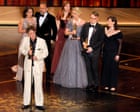
The Academy of Motion Picture Arts and Sciences often finds itself entangled in accusations of performative activism, but the recent crowning of the documentary focusing on the grassroots defiance against the Kremlin marks a rare moment where Hollywood’s vanity aligned with a visceral, global emergency. By awarding the top prize to a film that chronicles the systemic attempt to erase political dissent in Russia, the industry did more than hand out a gold statuette. It signaled that the medium of film remains the most potent weapon against the high-tech authoritarianism practiced by Vladimir Putin.
This win is not a surprise to those tracking the intersection of cinema and geopolitics. It is a calculated blow to the narrative of inevitability that the Russian state works so hard to maintain. The film’s victory serves as a definitive rejection of the "Mr. Nobody" label often cast upon dissidents by state-run media—a tactic designed to make the opposition feel small, invisible, and irrelevant. Instead, the global spotlight has effectively turned a localized struggle into a permanent record of state overreach.
The Architecture of a Narrative Threat
For the Kremlin, the documentary medium is far more dangerous than traditional news reporting. News cycles are ephemeral. They burn bright for forty-eight hours and then vanish into the archives of the internet. A feature-length documentary, particularly one with the weight of an Academy Award behind it, possesses a different kind of shelf life. It creates a definitive historical text that cannot be easily scrubbed from the collective consciousness.
The documentary in question succeeds because it pulls back the curtain on the mechanics of modern repression. It doesn't just show the protest; it shows the boredom of the bureaucrats, the frantic energy of the investigators, and the quiet, terrifying efficiency of the surveillance state. This is what keeps the siloviki—the elite security officials—awake at night. They rely on the mystery of their power to maintain control. When a film strips away that mystery and shows the cracks in the armor, the illusion of total control begins to dissolve.
The Myth of the Invisible Dissident
State propaganda in Russia operates on the principle of isolation. If you can convince the public that the person standing up to the regime is a "nobody," a lone actor with no support, you neutralize the threat of a movement. The film’s title and its subsequent global acclaim flip this script. It demonstrates that these individuals are only "nobodies" until the world decides to look.
The Academy’s recognition provides a form of diplomatic immunity through visibility. While it doesn't offer physical protection on the streets of Moscow or in a penal colony, it raises the political cost of further aggression. Every time a filmmaker is honored for documenting the truth, it forces the oppressor to weigh the benefits of silence against the backlash of international outrage.
Beyond the Red Carpet
Critics often argue that awards ceremonies are a vacuum of self-congratulation. In this instance, that cynicism misses the mark. We have seen how cultural soft power can influence hard political realities. During the Cold War, banned literature and underground films did as much to erode the foundations of the Soviet Union as any economic policy.
Today, the digital landscape allows for a much faster dissemination of these "subversive" works. Despite the Russian government’s attempts to throttle YouTube and block independent websites, the "Oscar effect" ensures that the film will be pirated, shared via Telegram channels, and viewed behind closed doors across all eleven Russian time zones. The win validates the risks taken by the cinematographers who smuggled footage out of the country, often at the risk of long-term imprisonment under "foreign agent" laws.
The High Cost of Veracity
Documenting the internal collapse of democracy is a high-stakes gamble. The production of this film involved a cat-and-mouse game with the FSB that would seem far-fetched in a fictional thriller. We are talking about encrypted drives hidden in mundane objects and clandestine meetings in third-party countries.
- Risk Mitigation: The crew operated in small, decentralized cells to avoid mass arrests.
- Data Integrity: Multiple backups were stored in non-extradition jurisdictions.
- Source Protection: Facial blurring and voice alteration were used not just for aesthetics, but for survival.
This isn't just filmmaking; it is an act of information warfare. The Oscar serves as the final victory in that specific campaign, proving that the truth can be packaged, exported, and celebrated even when the subject of the film wants it buried six feet under.
The Ripple Effect in Global Cinema
This victory will undoubtedly change how documentaries are funded and produced in the coming years. Investors and studios are notoriously risk-averse when it comes to projects that might offend major geopolitical players. However, the commercial and critical success of a film that stares down a dictator provides a blueprint for future creators.
It proves there is a massive, underserved market for reality. Audiences are increasingly tired of sanitized, "both-sides" narratives that fail to take a stand. They want to see the dirt. They want to see the struggle. By rewarding the story of a man standing against a machine, the Academy has signaled to the industry that courage is a bankable asset.
Challenging the Kremlin’s Media Monopoly
The Kremlin spends billions annually on RT and other state-sponsored media outlets to craft a specific image of Russia—strong, unified, and defiant against Western "decadence." An Oscar for a film that shows the internal rot, the corruption, and the genuine desire for change among the youth is a direct hit to that investment.
It is a reminder that you can buy the airwaves, but you cannot buy the hearts of the storytellers. The narrative of the "strongman" is fragile. It depends entirely on the absence of a counter-narrative. Now, that counter-narrative has been etched into the history of the 21st century.
A New Era of Resistance
The significance of this moment extends far beyond a single film or a single director. It marks a shift in how the global community interacts with authoritarian regimes. We are moving past the era of quiet diplomacy and into an era of loud, visual confrontation.
When the lights went down in the Dolby Theatre and the names of those fighting for a free Russia were spoken, it was a moment of profound recognition. The "nobodies" of the world are watching. They see that the highest levels of global culture are willing to stand with them, even when their own governments are trying to erase them.
The film serves as a manual for the modern dissident. It shows that the camera is just as important as the protest sign. It demonstrates that humor, resilience, and a stubborn refusal to go away are the most effective tools in an activist's kit. As Putin continues to tighten his grip on the domestic media, the international stage becomes the only place where the true story of Russia can be told.
The award is a debt of gratitude paid by the world to those who risk everything to keep the light on. It is a promise that their names will be remembered, their stories will be told, and their struggle will not be in vain. The statues may be gold, but the impact is measured in the quiet defiance of every viewer who sees the film and realizes that they are not as alone as they have been told.
Ask yourself what happens when the people no longer fear the person they are supposed to fear. That is the question the Kremlin must now answer.
Would you like me to analyze the specific distribution strategies used by independent filmmakers to bypass state censorship in Eastern Europe?