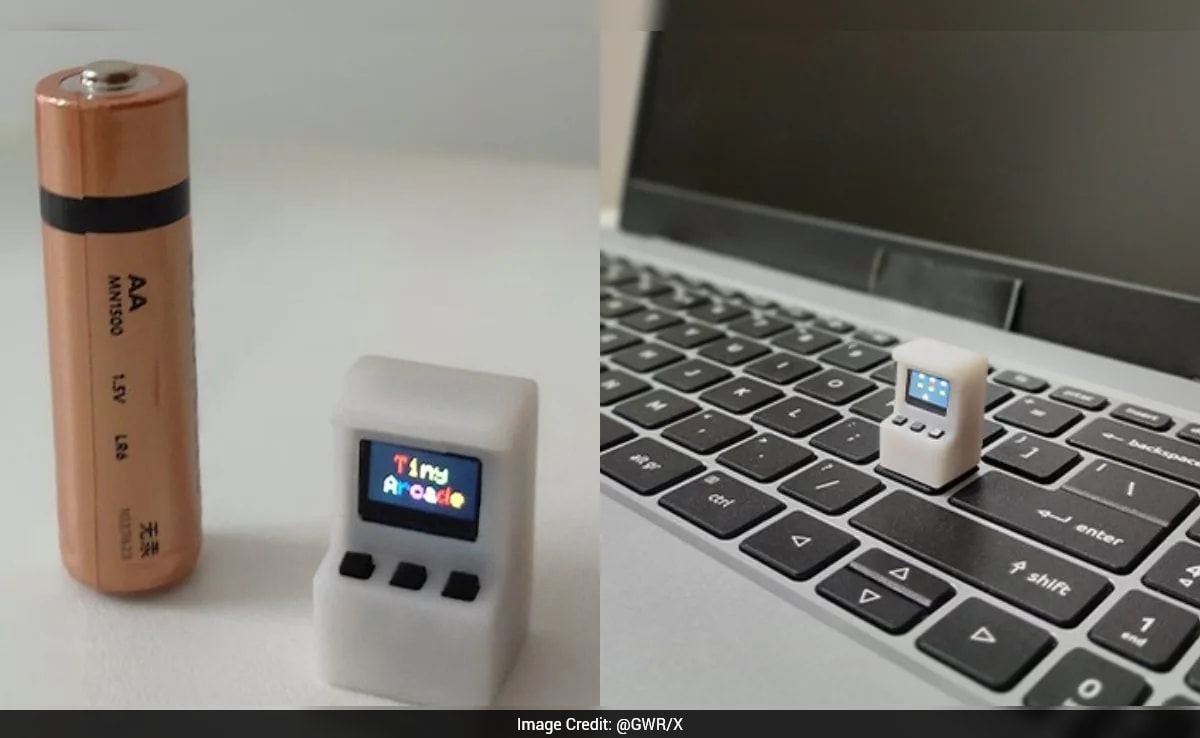
Engineering at the fringes of the possible often looks like a toy. When Siddharth Gupta, an electronics enthusiast from India, decided to compress a fully functional gaming cabinet into a frame no larger than a standard AA battery, he wasn't just chasing a Guinness World Record. He was wrestling with the physics of extreme miniaturization. The result is a device measuring roughly 0.26 inches by 0.35 inches by 0.51 inches. It is a microscopic marvel that challenges our understanding of human-machine interfaces.
Most people see a novelty. They see a tiny screen and a tiny joystick and wonder how anyone actually plays Pac-Man on something the size of a fingernail. But for those who have spent decades tracking the trajectory of silicon and copper, this isn't about the game. It is about the brutal reality of thermal management, circuit density, and the ergonomic limits of the human body.
Beyond the Novelty of Smallness
Shrinking a computer is easy in an era of nanometer-scale transistors. Making that computer interact with a human being is where the project nearly collapses under its own weight. To earn the Guinness World Record, Gupta couldn't just build a static model. The machine had to be "playable." This requirement introduces a series of technical hurdles that go far beyond simple hobbyist soldering.
The core of the build relies on an OLED display so small that its resolution is measured in dozens, not hundreds, of pixels. Driving such a screen requires a microcontroller that can handle video processing while sipping power from a footprint smaller than a grain of rice. When you move into this territory, standard wires become too thick. They act like structural beams, pushing against components and threatening to snap delicate solder joints.
Gupta utilized a custom-designed Printed Circuit Board (PCB). This wasn't a standard off-the-shelf part. It required a multi-layer design to route signals in a space where there is effectively no "room" left for error. A single microscopic bridge of solder would turn the record-breaking attempt into a piece of expensive e-waste.
The Ergonomic Wall
There is a fundamental disconnect between digital capability and physical reality. We can make processors smaller, but we cannot make human fingers smaller. This is the "ergonomic wall."
To navigate this, the builder had to rethink the joystick. Traditional mechanical switches were out of the question. Instead, the machine utilizes microscopic tactile buttons that require the precision of a surgeon—or a pair of very fine tweezers—to operate. This raises a legitimate question about the definition of playability. If a device requires specialized tools to function, does it still count as a "machine," or has it become a laboratory specimen?
The Guinness World Records team has strict criteria for these attempts. The device must mirror the proportions and functionality of its full-sized counterparts. It needs a screen, a controller, and the ability to run software natively. Gupta’s machine manages this by running a simplified version of classic arcade code, proving that the logic of 1980s gaming can survive even when the hardware is stripped of its physical substance.
The Problem of Heat and Power
In the world of high-end computing, we talk about liquid cooling and massive fans. In a battery-sized arcade cabinet, heat is a silent killer. Even a low-power microcontroller generates thermal energy. In a large casing, that heat dissipates into the surrounding air. In a microscopic enclosure, that heat has nowhere to go. It builds up in the silicon, potentially warping the plastic housing or desoldering the very connections that keep the machine alive.
Gupta’s choice of materials was restricted by weight and size, yet he had to ensure the device wouldn't melt during a long gaming session—if anyone could actually endure a long session on such a tiny interface. Power delivery is equally fraught. You cannot fit a standard lithium-ion battery into a space this small without the battery itself becoming the entire machine. The solution involves external power leads that are as thin as human hair, hidden to maintain the aesthetic of a standalone unit.
Why India is Becoming a Hub for Hardware Hacking
This project didn't happen in a vacuum. India has seen a massive surge in "maker culture" over the last decade. High-quality components that used to require an import license are now available in local markets or through rapid shipping. More importantly, there is a cultural shift toward extreme engineering.
Young engineers are no longer content writing software for Western firms. They are reclaiming the hardware space. They are taking the "Jugaad" philosophy—frugal innovation—and applying it to high-precision electronics. Gupta represents a generation that views hardware as a playground rather than a fixed commodity.
The Future of the Micro-Interface
What does this mean for the rest of us? We aren't going to be playing Street Fighter on a battery-sized screen in our living rooms. That’s not the point. The point is the stress test of integration.
When a developer successfully crams a display, a processor, and an input method into a space this small, they are solving problems that will eventually migrate into medical tech, wearable sensors, and "smart" materials. The techniques used to wire this arcade machine are the same techniques needed for an ocular implant or a sub-dermal health monitor.
The arcade cabinet is a proof of concept for a world where electronics are invisible. It is a reminder that the only thing holding back the next generation of devices is our ability to interface with them. We are reaching the point where the machine is ready, but the human finger is the bottleneck.
The Technical Specs of a Record Breaker
| Component | Specification |
|---|---|
| Height | 0.51 inches |
| Width | 0.26 inches |
| Screen Type | Micro-OLED |
| Primary Input | Micro-tactile switch |
| Frame Material | High-precision resin / 3D Print |
Building this was a exercise in patience. Every time a wire snapped, Gupta had to start over under a microscope. It is a grueling process that rewards the obsessive and punishes the hurried. It highlights a specific type of genius: the ability to see a massive system and visualize its tiny, essential ghost.
The next time you look at your smartphone, realize that it is a behemoth compared to what is possible. We carry bricks in our pockets because we need the screen real estate, not because the technology demands that size. Gupta’s record proves that the "arcade" is no longer a place or even a specific piece of furniture. It is a set of logic gates that can now fit inside a pocket change.
If you want to understand the limits of modern manufacturing, stop looking at the latest flagship phone. Look at the man with the tweezers and the magnifying glass. He is the one finding the actual edge of the map.
Test the limits of your own hardware by attempting to run a basic emulator on the most underpowered chip you can find. It will change how you view "efficiency."