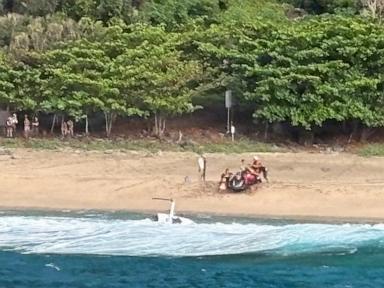
The sky over Kauai's Na Pali Coast is usually a postcard of tropical perfection. But for a group of travelers recently, that beauty turned into a nightmare in seconds. We now have the first real technical look at what happened during the July 2024 crash of a Robinson R44 helicopter operated by Ali’i Air Tours. It’s a sobering read. According to the National Transportation Safety Board (NTSB) preliminary report, the pilot experienced sudden, violent vibrations before the aircraft spun out of control and plummeted into the Pacific. Three people died.
Whenever a helicopter goes down, the public immediately looks for a smoking gun. Was it the engine? Did the pilot mess up? While the NTSB doesn't assign official "cause" in a preliminary report, the details provided by the surviving pilot paint a terrifying picture of mechanical or structural failure. This wasn't a slow drift or a gradual loss of power. It was a catastrophic shift in flight dynamics that left the person at the controls with almost zero options.
The pilot told investigators that everything seemed fine until it wasn't. They were cruising at about 1,000 feet. Suddenly, the helicopter began to vibrate. Not a little shimmy. These were heavy, airframe-shaking vibrations. Seconds later, the aircraft yawed—that's a sideways rotation—to the right. The pilot tried to correct it. It didn't work. The helicopter entered a spin and hit the water near Hanakoa Valley.
Breaking down the mechanics of a fatal spin
To understand why this happened, you have to understand how a Robinson R44 works. It uses a "teetering" rotor system. It's simple and effective for light utility work and tours, but it’s notoriously sensitive to certain conditions. If you lose tail rotor authority or experience a "mast bumping" event, things go south fast. The pilot's description of a violent vibration followed by an uncommanded right yaw is a massive red flag.
In a standard American helicopter, the main rotor turns counter-clockwise. To counter that torque, the tail rotor pushes against it. If the tail rotor fails—due to a mechanical break or a bird strike—the helicopter will spin right. The pilot's account of a right-hand spin strongly suggests that the tail rotor was either no longer producing thrust or the connection to it had been severed.
I've talked to plenty of pilots who fly these islands. They'll tell you that the Na Pali Coast is one of the most demanding environments in the world. You have micro-climates, sudden wind gusts, and salt air that eats metal for breakfast. Maintenance isn't just a suggestion out there. It's a lifeline. The NTSB is currently looking at the wreckage that was recovered, specifically focusing on the drive system and the blades.
The harsh reality of Hawaii tour safety
Hawaii sees millions of tourists every year, and many of them want that "Jurassic Park" view from the air. It’s big business. But this crash adds to a growing list of incidents that have local residents and safety advocates calling for tighter regulations. Honestly, the safety record of tour operators in the islands has been under a microscope for years.
Federal investigators have pushed for years to make "black box" recorders mandatory on these smaller tour aircraft. Most light helicopters don't have them. This makes the NTSB's job way harder. They have to rely on witness accounts and the twisted metal at the bottom of the ocean. In this case, having a surviving pilot is a huge deal for the investigation. Usually, in crashes this violent, there's nobody left to tell the story.
The NTSB report notes that the weather at the time was relatively clear, with about 10 miles of visibility. That rules out the "flying into a cloud and getting disoriented" scenario that kills so many pilots. This looks like a mechanical failure. Whether that failure was due to a manufacturing defect, a maintenance oversight, or simple metal fatigue is the million-dollar question.
What happens when a Robinson R44 hits the water
Hitting water in a helicopter is like hitting concrete if you don't have floats. This specific R44 was not equipped with emergency floats. When it hit the ocean, it didn't bob around. It sank. The pilot managed to escape the cockpit and was rescued by another tour boat in the area. The passengers weren't so lucky.
Recovery efforts in Hawaii are notoriously difficult. The water gets deep fast. You’re dealing with heavy swells and unpredictable currents. Divers and remote-operated vehicles had to find the fuselage in about 80 feet of water. What they found was a mangled airframe. The fact that the pilot survived is nearly a miracle, but the trauma of that descent is something that doesn't just go away.
Key technical points from the report
- Altitude: The aircraft was at approximately 1,000 feet MSL (Mean Sea Level).
- Vibration: Reported as sudden and "severe."
- Rotation: An uncommanded right yaw led to a rapid descent.
- Wreckage: The main cabin and tail boom were located on the seafloor.
The problem with light helicopters in turbulent air
Some people swear by the Robinson R44. It's the most-produced civil helicopter in the world. It’s cheap to run and easy to fly—usually. But critics argue it shouldn't be used for high-frequency tours in turbulent areas like Kauai. The rotor system is a "low-G" sensitive design. If a pilot pushes the nose down too quickly or encounters a severe downdraft, the rotor can actually chop off the tail boom.
I’m not saying that happened here. But when you hear "vibration" followed by "spin," you have to look at the rotor head. If a blade pitch link snaps or a bearing seizes, the imbalance is so violent it can tear the aircraft apart in mid-air. The NTSB is currently examining the "sprag clutch" and the drive belts. These components transfer power from the engine to the rotors. If that system slips or breaks, you're a brick with a very expensive paperweight on top.
How to check tour safety before you book
If you’re planning a trip to Hawaii and want to see the sights from above, don't just pick the cheapest option on Groupon. You need to do some homework. The FAA has oversight, but they can't be everywhere at once.
Look for operators who use twin-engine helicopters like the Airbus H130 or the Bell 407. These are much more stable and have redundant systems. If one engine fails, you have another. If one hydraulic system leaks, there's a backup. The Robinson R44 is a single-engine, light-duty machine. It’s great for flight training or checking fences on a ranch. Using it for heavy-duty tour cycles in salt air is a choice that carries more risk.
Check the company’s history on the NTSB's accident database. It's public record. If a company has a history of "minor incidents" or maintenance write-ups, walk away. Your life is worth more than a $300 flight.
Waiting for the final word
The NTSB will take another 12 to 24 months to issue a final report. They’ll look at the metallurgy of the bolts. They’ll check the maintenance logs of Ali’i Air Tours. They’ll look at the pilot’s training records. Until then, the tour industry in Kauai continues, but with a heavy shadow over it.
The pilot’s description of those final seconds is a haunting reminder of how fast things go wrong in aviation. One minute you're looking at a waterfall, and the next, you're fighting a machine that has decided to quit.
If you want to stay safe, ask the operator about their "over-water" equipment. Do they have floats? Do passengers wear life vests? Are they equipped with emergency air canisters? These things save lives when the vibration starts and the spinning begins. Don't take "it'll be fine" for an answer. Demand to see the safety gear before you strap in.
The investigation continues, and the wreckage is being shipped to a secure facility for a teardown. We’ll eventually know if a part failed or if the environment simply overwhelmed the aircraft. For now, the focus remains on the families of the three victims and a pilot who has to live with those final moments. Aviation is a game of margins. This time, the margins simply ran out.