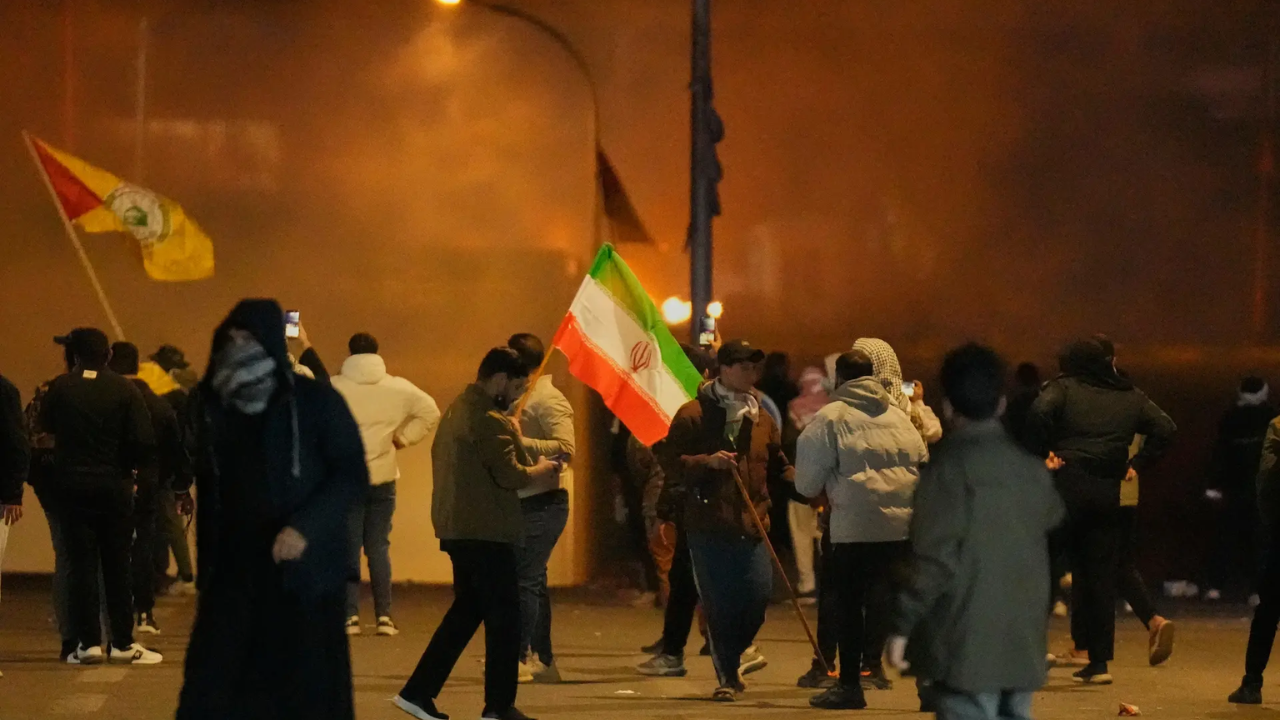
The coffee in the chipped ceramic mug has gone cold, but Elias doesn't notice. He is staring at the horizon of Beirut, where the darkness isn't quite dark enough. There is a specific hue to the night sky now—a bruised purple, punctured by the orange glare of things that shouldn't be burning. For five days, the rhythm of life has been dictated by the acoustics of the air. You learn to differentiate the sounds: the low, vibrating hum of a drone that feels like it’s drilling into your molars, and the sudden, atmospheric tear of a missile that sounds like the world’s largest sheet of silk being ripped in half.
This is the fifth day of a sequence that historians will later map with cold, clinical arrows on a digital display. But for those underneath the arrows, it is not a sequence. It is a siege of the senses.
The Geography of Dust
Across the Middle East, the geography is changing. Not the borders on a map—those have been contested for a century—but the physical makeup of the air. In Eastern Syria and Western Iraq, the wind carries the scent of scorched metal. US assets, static and sprawling, have become magnets for friction. From the perspective of a boardroom in DC or a command center in Tehran, these are tactical exchanges. To the soldier sitting in a fortified hangar in Al-Asad, it is the sound of gravel hitting a tin roof, followed by a shockwave that reminds you exactly where your internal organs are located.
The strikes are no longer isolated events. They have become a conversation, albeit a violent one. When Israel launched its latest wave of sorties into the heart of Lebanon and across the borders toward Iranian interests, it wasn't just hitting coordinates. It was sending a telegram written in fire. The message? The old rules of engagement have been shredded.
Consider a hypothetical shopkeeper in Nabatieh. Let’s call him Omar. Omar spent twenty years building a spice business. On day five, his inventory isn't saffron and sumac anymore; it’s pulverized concrete and the smell of ozone. He isn't thinking about the geopolitical "tit-for-tat" or the strategic depth of the northern front. He is wondering if the foundation of his home can handle one more tremor.
The Calculus of the Unseen
What the news tickers rarely capture is the invisible weight of the "wait." War is 90% waiting for something terrible to happen and 10% surviving it. In Tel Aviv, the sirens are a rhythmic intrusion. People filter into shelters with a practiced, weary grace that is more heartbreaking than frantic. They bring tablets for the kids and chargers for phones that they check every thirty seconds. They are looking for news of the strikes on Iran, trying to calculate if the "fresh strikes" reported on the radio mean the end of the escalation or just the end of the beginning.
The complexity of these maneuvers is staggering. When we talk about "Israel hitting Iranian assets," we are talking about a ballet of electronic warfare. It starts long before the jets take off. It begins with the blinding of sensors, the ghosting of radar screens, and the silent hacking of communication nodes.
- Phase One: Information blackout.
- Phase Two: Suppression of air defenses.
- Phase Three: The kinetic impact.
But even the most precise "smart" bomb creates a very "dumb" reality on the ground. It creates heat. It creates grief. It creates a vacuum where a neighborhood used to be.
The American Shadow
While the world watches the exchange between Israel and its immediate neighbors, the American presence in the region sits like a massive, grounded lightning rod. Bases that were meant to be deterrents are now targets of opportunity. It is a strange, precarious position for a superpower: to be the most powerful entity in the room and yet be restricted by the heavy chains of diplomacy and the fear of a total regional collapse.
Every time a rocket splashes down near a US outpost, the global economy flinches. We see it in the flickering numbers on the oil markets. We see it in the diverted flight paths of commercial airliners that now have to skirt around entire countries like they are avoided black holes. The stakes aren't just "regional stability." They are the very veins of global movement.
If you look at the satellite imagery from day five, you see a pattern of scars. There is a strike in the Bekaa Valley. A retaliatory drone in Iraq. A precision hit near Isfahan. It looks like a nervous system under attack, with sparks flying at every synapse.
The Language of the Crater
There is a specific kind of silence that follows a heavy bombardment. It’s not a peaceful quiet; it’s a vacuum. It’s the sound of thousands of people holding their breath at once, waiting to see if there is a second "double-tap" strike coming.
In these moments, the political rhetoric about "sovereignty" and "deterrence" feels like a foreign language. The only language that matters is the one spoken by the rescue workers. They speak in shouts, in the rhythmic thud of shovels, and in the frantic tapping on stones to see if anyone taps back from underneath.
The strikes on Lebanon have been described as "surgical," a word that suggests a clean, medical intervention. But surgery involves anesthesia and consent. This is something else. It is an extraction of safety. When a residential block is leveled because an "asset" was tucked in the basement, the surgery leaves the patient unrecognizable.
We often talk about these conflicts as if they are a chess match. But in chess, the pawns don't have families. The bishops don't have memories of the olive trees they planted thirty years ago. In the real world, every "move" on the board is a lifetime of work being turned into a headline that will be forgotten by tomorrow's news cycle.
The Infinite Loop
As the sun begins to creep over the horizon on the morning of day six, the cycle prepares to reset. The smoke from the Iranian strikes hasn't even cleared before the next set of threats is issued. It’s an infinite loop of "if they do X, we must do Y."
But what happens when we run out of letters in the alphabet?
The danger of day five—and day fifty, if it comes to that—is the normalization of the extraordinary. We get used to the tickers. We get used to the images of orange fire against a black sky. We start to see the Middle East not as a collection of ancient cultures and vibrant cities, but as a permanent theater of kinetic energy.
Elias finishes his coffee. It’s bitter and cold. He stands up from his balcony and looks at his hands. They are shaking, just a little. Not because he is afraid—he passed through fear three days ago—but because he is exhausted. The sky is finally quiet, but it is the heavy, loaded quiet of a gun being reloaded.
Behind the statistics of "assets hit" and "sorties launched" lies the true cost of the week: the realization that for millions of people, the concept of "home" has become a temporary condition. The maps will be redrawn, the bases will be rebuilt, and the cold facts will be filed away in archives. But the vibration of the drones stays in the bones long after the engines have stopped.
The world watches the fire, but it’s the embers that burn the longest.