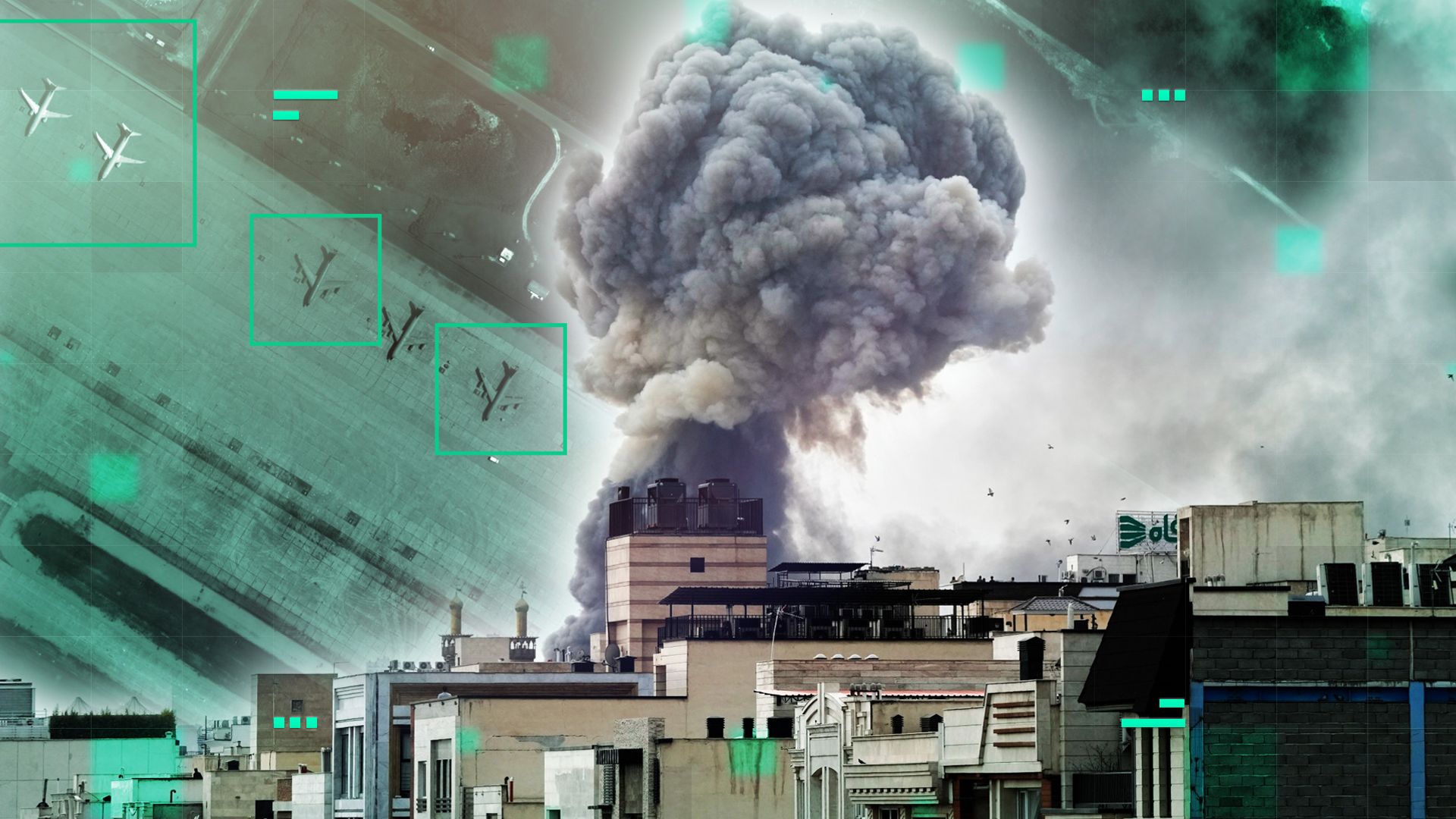
The windows in Isfahan don't just rattle; they hum. It is a low-frequency vibration that starts in the soles of your feet before the sound even reaches your ears. For those living near the enrichment plants or the drone factories tucked away in the jagged creases of the Zagros Mountains, that hum has become the soundtrack of a nervous era. On the nights when the air defense batteries wake up, the sky isn't dark anymore. It turns a bruised purple, illuminated by the frantic arc of interceptors chasing ghosts—or steel.
We talk about "military assets" as if they are chess pieces on a board of polished wood. We map out the strikes on Parchin or the radar arrays in Tabriz with the clinical detachment of a surgeon. But maps are flat. They don’t show the heat of the fire or the way a neighborhood holds its breath when a ballistic missile, weighing several tons and traveling at five times the speed of sound, begins its terminal descent.
The Anatomy of the Arc
To understand what has been hit, you have to understand the geometry of modern fear. A missile launch isn't just a firework. It is a calculated gamble involving liquid fuel, solid-state sensors, and the sheer, brutal force of gravity. When the first volleys of Fattah or Emad missiles leave their underground silos—those "missile cities" carved deep into the Iranian bedrock—they leave behind a trail of scorched earth and a geopolitical vacuum.
Consider a father in a suburb of Tel Aviv. He has roughly ninety seconds to get three children and a dog into a reinforced room. In that window of time, the "assets in play" cease to be items on a spreadsheet. They become the difference between a roof and a crater. The Arrow-3 interceptors, those slender needles of American and Israeli engineering, meet their targets in the exosphere. It happens in the blackness of space. Silent. A kinetic collision of two objects moving at miles per second.
When the metal fragments eventually rain down, they are cold. But the political heat they leave behind is blistering.
The Invisible Shield and the Broken Spear
The "assets" we keep hearing about are divided into two categories: things that hit and things that hide. Iran’s strategy relies on the sheer volume of its "spears." Thousands of drones—the Shahed-136 models that look like terrifying, oversized delta wings—are designed to overwhelm the "shield." They are cheap. They are loud. They sound like lawnmowers in a nightmare.
The goal of a Shahed isn't always to destroy a building. Often, its job is simply to exist. It forces the defender to fire an interceptor missile that costs two million dollars to stop a drone that costs twenty thousand. It is a war of attrition played out in the bank accounts of nations before it ever reaches the battlefield.
On the other side, the shield is a digital masterpiece. The Iron Dome, David’s Sling, and the Arrow system are interconnected by a nervous system of radar that can track a tennis ball from a hundred miles away. When a strike hits an Iranian S-300 air defense battery—a Russian-made system that was supposed to be the gold standard—it isn't just a loss of hardware. It is a puncture in the armor. It tells the world that the shield is thinning.
The Ghost of Parchin
Names on a map rarely tell the whole story. Parchin, a military complex southeast of Tehran, is often described as a "suspected nuclear-related site." To the world, it is a point of contention in a UN briefing. To the people living in its shadow, it is a fortress of secrets.
In the recent exchanges, the strikes targeted the very things that make a modern military move: the mixing bowls for solid fuel and the precision lathes used to shape missile nose cones. If you destroy a tank, the enemy has one less tank. If you destroy the lathe, the enemy has no more tanks tomorrow. This is the new doctrine. It is no longer about occupying land; it is about amputating the future capacity to fight.
But consider the people who work there. Not the generals, but the technicians. The engineers who studied in Europe or Asia and returned home to build things they hoped would never be used. When a precision-guided munition finds its way through a ventilation shaft at 3:00 AM, the "strategic asset" being neutralized is often decades of human knowledge and billions of rials in infrastructure, vaporized in a millisecond.
The Cost of a Clear Sky
There is a specific kind of silence that follows a night of anti-aircraft fire. It is heavy. It smells like ozone and burnt rubber. In the morning, people go to work. They buy bread. They check their phones to see what the "experts" are saying about the "escalation ladder."
The ladder is a metaphor we use to pretend we are in control. We say, "Iran moved to rung four," or "Israel responded on rung five." It implies that there is a top to the ladder, a place where the climbing stops. But in reality, the ladder is leaning against a burning building.
The assets currently in play are not just F-35 fighter jets or hypersonic missiles. The real assets are the nerves of the people in the street. In Tehran, the queues at gas stations grow long after a strike. Why? Because the most vulnerable asset in any war isn't a missile silo; it's the supply chain. If the refineries at Abadan are hit, the country doesn't just lose fuel; it loses the ability to move. The economy, already strained by years of sanctions, begins to fray at the edges like an old rug.
The Tech of the Shadows
We are seeing the first truly "transparent" war. In the past, you waited for the morning newspaper to know what happened. Now, we have synthetic aperture radar (SAR) satellites that can see through clouds and smoke. Within twenty minutes of a strike, commercial satellite images are being analyzed by amateurs on social media.
This transparency is a double-edged sword. It removes the "fog of war" for the public, but it forces the hands of the leaders. If a strike is caught on camera and shared a million times, the pressure to "respond in kind" becomes a political necessity. The technology that was supposed to make war more precise has also made it more performative. We are watching a high-stakes drama where the actors are armed with nuclear-capable missiles and the audience is the entire world.
The Weight of the Metal
If you were to walk through the wreckage of a downed drone in the Negev desert or a shattered radar station in Isfahan, you would see the same thing: charred circuit boards, twisted aluminum, and wires that look like scorched veins.
There is no glory in the metal. There is only the realization of how much effort humanity pours into the art of breaking things. We have perfected the science of the "hit." We can put a bomb through a window from a thousand miles away. We can intercept a missile in the vacuum of space. We have become gods of destruction while remaining children in the art of peace.
The maps will keep being updated. New dots will appear in red to indicate "targets neutralized." Lines will be drawn showing the range of the next generation of bombers. But the map is not the territory. The territory is a mother in Isfahan holding her child’s hand a little tighter when the wind picks up. The territory is a student in Tel Aviv wondering if they should bother studying for an exam when the sky might fall again tonight.
The real assets are the lives caught in the crossfire of "strategic interests." As the purple glow of the interceptors fades and the sun begins to rise over the ancient dust of the Middle East, the only thing that remains certain is the cost. It is a cost paid in the currency of sleep, of stability, and of the quiet, unspoken hope that tonight, for once, the sky will just be black.
The hum in the windows continues. It doesn't stop just because the news cycle moves on. It is the sound of a world waiting for the next arc to begin.
Would you like me to analyze the specific technical capabilities of the S-300 and Arrow-3 systems mentioned in this narrative?