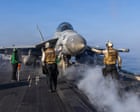
The foreign policy establishment is currently obsessed with a singular, flawed narrative: that American "shows of force" in the Middle East create a power vacuum or a "distraction" that Beijing is eager to exploit. They look at a carrier strike group in the Persian Gulf and see a wasted asset. They look at tactical surges and see a gift to the Chinese Communist Party (CCP).
They are looking at the board upside down.
The reality is far more cynical and, for Beijing, far more terrifying. Every time the United States doubles down on Middle Eastern security, it isn't "yielding" the Indo-Pacific; it is subsidizing the very energy arteries that keep the Chinese economy from flatlining. Washington isn't creating a weakness for China to exploit; it is maintaining a global commons that China is forced to depend on but cannot yet control.
If the U.S. actually wanted to "thwart" China, the most devastating move wouldn't be more ships in the South China Sea. It would be a total, quiet withdrawal from the Strait of Hormuz.
The Myth of the Distraction
The "distraction" argument suggests that the Pentagon has a finite amount of "attention" and that every hour spent on Middle Eastern de-escalation is an hour lost on the "Pivot to Asia." This is a fundamental misunderstanding of how global hegemony functions.
The U.S. military is not a flashlight that can only point in one direction. It is a floodlight.
When the U.S. demonstrates overwhelming force in the Middle East, it reinforces the stability of the global energy market. China imports roughly 10 million barrels of oil per day. A massive chunk of that—over 50%—originates from or passes through the Middle East.
China’s "exploitation" of American presence is actually a desperate, parasitic reliance. Beijing doesn't want the U.S. to leave. If the U.S. left tomorrow, the resulting regional chaos would spike Brent Crude to $200 a barrel, incinerating the Chinese manufacturing sector's margins and sparking domestic unrest in Shenzhen and Shanghai.
I’ve sat in rooms with energy analysts who sweat over "Malacca Dilemmas," but the real dilemma is the "Hormuz Dependency." China has no blue-water navy capable of escorting its tankers through a hot zone in the Gulf. They are hitching a ride on the back of American security while complaining about the driver.
China’s Belt and Road is a Defensive Crouch, Not an Offensive Strike
Mainstream pundits point to China's "Belt and Road Initiative" (BRI) as a brilliant maneuver to bypass American maritime dominance. They see it as a bold expansion.
It isn't. It’s an incredibly expensive, inefficient insurance policy.
Building pipelines across Central Asia and through the Karakoram Highway in Pakistan is a logistical nightmare. It costs five to ten times more to move a unit of energy over land via pipeline or rail than it does to move it via a VLCC (Very Large Crude Carrier) over the ocean.
If China were truly confident in its ability to "exploit" American weakness, they wouldn't be burying hundreds of billions of dollars in the dirt of "Stans" and precarious states. They are doing it because they know that as long as the U.S. Navy owns the waves, China is a hostage to American policy.
The Logic of the Hostage
- Dependency: China needs the oil.
- Incapability: China cannot protect the oil routes.
- Irony: The U.S. protects the oil routes for the sake of "global stability."
- Reality: The U.S. holds the kill-switch to the Chinese economy.
By maintaining a "show of force," the U.S. isn't being "distracted." It is reminding Beijing who owns the thermostat.
The "Weakness" Fallacy: Why Tactical Surges Matter
There is a loud contingent of "restraint" advocates who argue that any American kinetic action in the Middle East emboldens China to move on Taiwan. The logic follows that the U.S. will be "too tired" or "too depleted" to respond.
This ignores the nature of modern attrition. A few dozen Tomahawk missiles and a carrier deployment do not deplete the stockpile required for a high-intensity conflict in the Taiwan Strait. In fact, these "shows of force" serve as a live-fire laboratory for the very technologies that China fears most:
- Integrated Air Defense suppression.
- Drone swarm neutralization.
- Real-time satellite-to-shooter data links.
I have seen the internal data on how these deployments sharpen the edge of the logistics chain. Moving a carrier group isn't just "showing off"; it's a stress test of the most complex supply chain in human history. Every time the U.S. flexes in the Middle East, Chinese intelligence officers are frantically taking notes on how fast the U.S. can mobilize. They aren't seeing weakness. They are seeing a terrifyingly efficient machine that doesn't even need to use its "A-team" assets to dominate a region.
The Brutal Truth of Energy Security
People also ask: "Doesn't China's mediation between Iran and Saudi Arabia prove they are the new regional power?"
No. It proves they are desperate for peace at any price because they cannot afford a war they can't stop.
The 2023 China-brokered deal between Riyadh and Tehran was a diplomatic PR win, but it lacked any security guarantees. If a missile hits an Abqaiq processing plant tomorrow, China can’t do a thing. They can't deploy an expeditionary force. They can't intercept the missiles. They can't even offer credible sanctions.
The U.S. "weakness" is actually a form of strategic patience. By remaining the primary security guarantor, the U.S. forces China to remain a "free rider." In the short term, this looks like China is "winning" by not spending money on wars. In the long term, it means China has zero experience in regional power projection and zero infrastructure for long-range logistics.
The High Cost of the Contrarian Take
Admittedly, this strategy has a massive downside for the United States: The Cost.
The American taxpayer is effectively paying the security bill for the energy that powers the factories that are currently outcompeting American domestic industry. It is a bizarre, circular form of economic masochism.
- U.S. spends $1 trillion+ on Middle East presence over a decade.
- This ensures stable oil flow to China.
- China uses that stable oil to produce cheap goods.
- Those goods undercut U.S. manufacturing.
The "lazy consensus" says we should stay to stop China. The "contrarian truth" is that we should stay only if we acknowledge we are subsidizing our primary rival’s existence. If we wanted to "exploit" a weakness, we would let the Middle East balance itself. The resulting volatility would crush China’s fragile, debt-heavy economy within months.
We don't do that because the global financial system is a Jenga tower, and we’re the ones at the bottom.
Stop Asking if We Are "Distracted"
The question isn't whether the U.S. is distracted. The question is why we continue to provide a "Safe Mode" for the global economy that benefits our greatest competitor more than ourselves.
China isn't "exploiting" a show of force. They are praying it continues. They are terrified of an America that decides it no longer cares about the price of oil in Beijing.
When you see a headline about American "overreach" or "weakness" in the Levant or the Gulf, remember: the person who wrote it thinks geopolitics is a game of Risk where you only have so many pieces to move. In reality, it’s a game of poker where the U.S. has all the chips, owns the table, and is currently paying for the electricity in the room while China tries to bluff with a pair of twos.
The real threat isn't American presence in the Middle East. It’s the day the U.S. decides to stop being the world’s unpaid security guard and lets the "multipolar world" China claims to want actually happen.
Beijing wouldn't last a week.
Stop misinterpreting muscle for fatigue. Stop confusing a subsidy for a vulnerability. The U.S. isn't stuck in the Middle East; China is stuck with a U.S. that refuses to let the Middle East fail.
If you want to see China truly exploit a weakness, wait until they have to start paying for their own protection. Until then, every American carrier in the region is a reminder of China's ultimate, inescapable dependence.