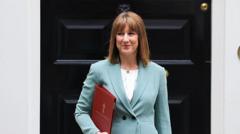
The consensus is already hardening into a shield. Economic commentators are lining up to provide Rachel Reeves with her first "Get Out of Jail Free" card. They argue that escalating tensions in the Middle East, potential oil price shocks, and disrupted trade routes are the external shocks that will inevitably derail the Chancellor’s fragile growth plans.
It is a comfortable narrative. It’s also wrong.
Blaming a regional conflict for the UK’s structural stagnation is the ultimate macroeconomic gaslighting. If the Treasury’s plans are so brittle that a spike in Brent Crude or a delay in Red Sea shipping lanes collapses the "Growth Mission," then the plan wasn't a growth plan—it was a hope.
I have spent decades watching governments use "external factors" to mask internal incompetence. In 2008, it was the "global" financial crisis—ignoring the domestic credit bubble. In 2022, it was "Putin’s price hike"—ignoring a decade of failed energy storage policy. Now, the stage is set for the "Middle East Headwind" to excuse why the UK remains the sick man of the G7.
The Myth of the Fragile Recovery
The prevailing argument suggests that the UK is on a "knife-edge" recovery. Economists point to the Consumer Price Index (CPI) and whisper that any fluctuation in energy costs will force the Bank of England to keep rates higher for longer, suffocating Reeves’s investment agenda.
This ignores the fundamental reality of the UK’s inflation problem. Our inflation isn't just a byproduct of global oil prices; it is a structural byproduct of a low-productivity, high-tax, services-heavy economy that has stopped making things.
If a 15% increase in energy costs destroys your industrial strategy, you don't have an industrial strategy. You have a subsidy scheme. A real growth plan anticipates volatility. It prices it in. It uses the chaos to pivot toward resilience. By framing the Middle East conflict as a "threat" to the budget, the Treasury is actually signaling its own lack of ambition. They are preparing the public for failure before the first shovel hits the ground.
Oil is the Great Distraction
Let’s dismantle the oil obsession. Yes, the Middle East produces roughly a third of the world’s oil. Yes, the Strait of Hormuz is a choke point. But the link between oil prices and UK GDP growth has been decoupling for twenty years.
The UK economy is roughly 80% services. While logistics and manufacturing feel the squeeze of high fuel costs, the primary driver of our stagnation is not the price of a barrel of oil—it is the price of a square foot of office space and the suffocating cost of childcare and planning permission.
When the Treasury warns about "global instability," they are redirecting your eyes from the real inhibitors:
- The Planning Trap: We cannot build data centers, laboratories, or housing because of a Victorian-era planning system.
- The Investment Drought: UK pension funds invest less in domestic equities than almost any other developed nation.
- The Tax Burden: We are at a 70-year high, yet public services are failing.
Reeves doesn't need a peaceful Middle East to fix the planning system. She doesn't need low oil prices to mandate pension fund reform. These are choices. Blaming the Levant is just a way to avoid the political capital required to take on the NIMBYs and the institutional inertia of Whitehall.
The "Safe" Bet is the Riskiest Path
The "lazy consensus" says that in times of global turmoil, a Chancellor should be "fiscally prudent." This is the mantra of the IMF and the cautious academics at the Institute for Fiscal Studies (IFS). They suggest that Reeves should trim her investment sails because the "fiscal headroom" is shrinking.
This is exactly how you manage a decline, not how you spark a rebirth.
Imagine a scenario where a corporation is facing a market downturn. The "prudent" CFO cuts the R&D budget to save the quarterly dividend. Five years later, the company is irrelevant. The "bold" CEO doubles down on the one technology that will dominate the next decade.
The UK is currently that failing corporation.
By adhering to "fiscal rules" that were designed for a stable, low-inflation era, Reeves is tying her own hands. If she uses the Middle East conflict as a reason to scale back the £28 billion—or whatever the current diluted figure is—for the green transition or infrastructure, she isn't being "responsible." She is being negligent.
The Misunderstood Role of Defense Spending
The competitor articles often frame Middle East instability as a drain on resources—money that must be diverted to defense rather than "growth."
This is a failure to understand how modern economies actually function. Defense spending is industrial strategy.
The internet, GPS, and jet engines did not come from a "fiscally prudent" committee looking for "headroom." They came from massive, mission-oriented state spending during times of intense geopolitical friction. If Reeves was truly sharp, she would stop viewing the Middle East as a threat to her budget and start viewing it as the catalyst to rebuild the UK’s sovereign capability in aerospace, cyber-security, and advanced manufacturing.
Instead, the rhetoric suggests we are a helpless leaf in a global storm. We aren't a leaf; we are an G7 nation with a massive financial hub and a seat on the UN Security Council. We should be the storm.
Stop Asking "Will Conflict Hurt Growth?"
The question itself is flawed. It assumes growth is something that happens to us when the world is quiet.
People also ask: "How will the Middle East conflict affect my mortgage?"
The honest, brutal answer: It won't—at least not directly. Your mortgage is high because the UK failed to build enough houses for thirty years and the Bank of England had to mop up the mess of the 2020-2021 money printing spree. The conflict is a 0.5% variable in a 5% problem.
People also ask: "Is Rachel Reeves right to be cautious?"
No. Caution in a burning building is just a slower way to die. She inherited a mess, yes. But you don't fix a mess by staring at it and waiting for the neighbors to stop arguing.
The Battle Scars of "Wait and See"
I’ve seen this movie before. In 2010, the "shock" was the Eurozone crisis. In 2016, it was the "uncertainty" of the referendum. In 2020, it was the pandemic. There is always a reason to wait. There is always a reason to be "prudent."
The result of fifteen years of this "prudence" is a country where the average person is poorer than they were in 2008 in real terms. The Chancellor's biggest risk isn't a spike in oil prices; it's the risk of doing exactly what her predecessors did: managing the margins while the core rots.
The Middle East is a tragedy. It is a geopolitical nightmare. But as a factor in the UK’s long-term economic failure, it is a rounding error.
The Real Red Line
If the Treasury fails to deliver on its growth targets, it won't be because of the Houthis or the IRGC. It will be because they were too timid to reform the labor market, too scared to touch the triple lock, and too "responsible" to borrow for high-return infrastructure.
The Middle East conflict isn't the hurdle. It's the excuse.
Watch the language in the coming months. Every time a minister uses the words "global headwinds" or "geopolitical instability" to explain why a project has been delayed or a tax has been raised, know that you are being lied to. They are hoping you don't look at the domestic policy failures piling up behind the curtain.
Growth isn't a result of a peaceful world. Growth is the result of a country that decides to work, build, and invest regardless of what is happening in the Gulf. Anything else is just PR.
Stop looking at the maps of the Levant and start looking at the planning maps of the South East. That’s where the real conflict is—and it’s the only one Rachel Reeves has the power to win.
Would you like me to analyze the specific UK planning reforms that would actually move the needle on GDP, regardless of global oil prices?