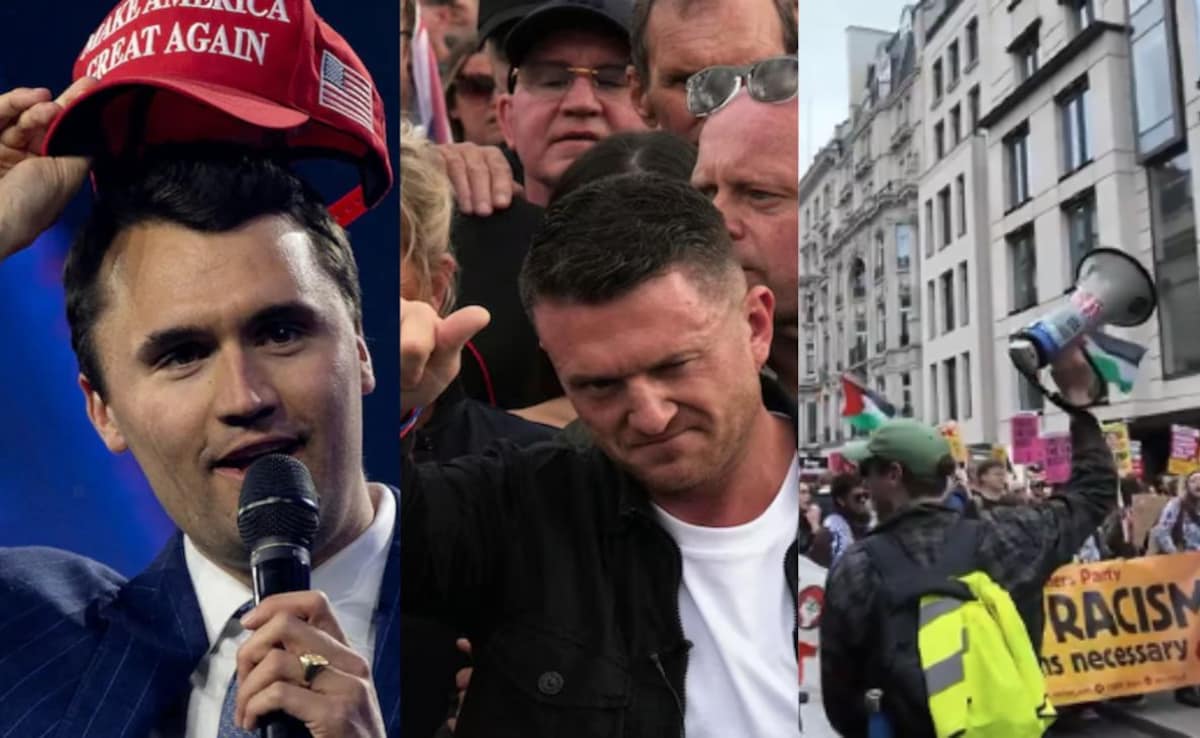
The escalation of political rhetoric into specific threats of lethal violence—exemplified by chants targeting public figures like Charlie Kirk during London demonstrations—represents a critical failure in the regulatory and social frameworks designed to manage mass assembly. This phenomenon is not merely an emotional outburst but a predictable outcome of three intersecting vectors: the radicalization of proximity, the erosion of legal deterrence through volume, and the psychological transition from collective grievance to individual targeting.
The Triad of Mass Protest Radicalization
The transformation of a peaceful protest into a space where violent threats are normalized follows a specific structural logic. When thousands of individuals gather under a singular ideological banner, the "protest environment" ceases to be a simple collection of people and becomes a high-pressure system characterized by three distinct pillars.
1. Deindividuation and the Mask of the Crowd
In high-density environments, the individual identity is subsumed by the collective. This psychological shift reduces the perceived risk of personal accountability. When a chant calling for the "shooting" of a specific individual is initiated, the speaker relies on the auditory camouflage of the group. The cost of deviating from social norms—which usually prohibit calls for murder—drops to near zero because the "crowd" becomes the primary actor, shielding the individual from legal and social consequences.
2. The Feedback Loop of Escalation
Rhetoric in mass movements operates on a competitive scarcity model. To maintain attention and emotional momentum, participants must continually increase the intensity of their messaging. What begins as a policy disagreement transitions into moral condemnation, then into dehumanization, and finally into the solicitation of violence. The "Charlie Kirk" chant serves as a high-value signal within this economy of escalation; it is more "authentic" or "committed" than standard slogans precisely because it crosses a legal and moral threshold.
3. Target Specification
Generalized grievances (e.g., "End the War") are difficult to sustain emotionally over long durations. Human psychology gravitates toward personification. By identifying a specific "enemy" figure—regardless of that individual's actual proximity to the local policy issue—the movement creates a tangible focal point for abstract rage. This transition from systemic critique to personal targeting is the primary precursor to physical violence.
The Failure of Legal Deterrence and the Volume Threshold
The presence of police at these rallies often fails to prevent violent rhetoric due to a phenomenon known as "The Volume Threshold of Enforcement." In the United Kingdom, the Public Order Act and various hate speech laws theoretically prohibit the incitement of violence. However, the operational reality of policing a crowd of 100,000+ people creates a massive enforcement gap.
- Tactical Prohibitions: Arresting an individual for a verbal chant in the middle of a dense, agitated crowd carries a high risk of "sparking" a riot. Officers are forced to prioritize "crowd stability" over "statute enforcement."
- The Impunity Calculation: Protesters are aware of this tactical constraint. They calculate that the probability of being identified, detained, and prosecuted for a spoken threat in a mass group is statistically negligible.
- Documentation Lag: While body-worn cameras and CCTV provide retrospective evidence, the immediate deterrent effect is lost. By the time a video of a violent chant goes viral on social media, the psychological "win" for the radical element has already been achieved.
Semantic Dilution and the Normalization of Extremism
The specific language used in the London chants—"Shoot him in the neck"—is notable for its clinical, descriptive nature. This is not metaphorical "political fighting." It is a specific execution fantasy. The proliferation of such language within a mainstream protest movement leads to Semantic Dilution, where the gravity of the threat is minimized by its repetition.
When organizers or fellow participants fail to immediately and physically distance themselves from such rhetoric, they provide tacit "social proof" that the behavior is acceptable. This creates a new baseline for the next demonstration. Over time, the movement’s "Overton Window" shifts; views that were considered fringe and dangerous two years ago become the standard vernacular of the street.
The Role of Digital Amplification
The "Charlie Kirk" incident demonstrates how physical events are now designed for digital consumption. The protesters are not just speaking to those around them; they are performing for the camera.
- Algorithmic Reward: Violent or extreme content generates higher engagement metrics on platforms like X and TikTok.
- Virtual Reinforcement: A protester filmed making a threat receives instant validation from global digital subcultures that share their ideology. This creates a bridge between "street radicalization" and "online echo chambers," where the two environments reinforce one another in a continuous loop.
Cognitive Dissonance in Movement Leadership
A recurring structural flaw in mass movements is the "Radical Flank Effect." Movement leaders often face a strategic dilemma: denounce the extremists and risk fracturing the movement, or remain silent and allow the extremism to define the movement’s public image.
In the case of the UK Pro-Palestine rallies, the failure to self-police the "violent chant" elements suggests a prioritization of "mass" over "legitimacy." This creates a long-term strategic liability. When a movement is perceived as a host for violent threats against specific individuals, it loses the ability to influence centrist policy-makers and shifts into a purely disruptive force.
Quantifying the Risk of Transition to Kinetic Action
Data from historical civil unrest suggests that the transition from "violent rhetoric" to "kinetic violence" (actual physical attacks) is preceded by three measurable variables:
- Direct Target Frequency: The number of times a specific individual is named in violent chants across multiple events.
- Visual Symbolism: The introduction of props (effigies, mock weapons) that mirror the rhetoric.
- Proximity Convergence: When the target of the rhetoric appears in the same geographic vicinity as the energized crowd.
The targeting of Charlie Kirk—an American commentator—in a British rally indicates that the "enemy list" of these movements is now global and decoupled from local legislative goals. This increases the unpredictability of the threat, as the "target" may have no direct connection to the protesters' grievances, making the violence purely symbolic and performative.
Structural Interventions for Public Order
To mitigate the rise of violent rhetoric in mass assemblies, the current "passive observation" model of policing must be replaced with a "structural friction" model.
- Acoustic Interventions: Using directional Long Range Acoustic Devices (LRAD) to disrupt the synchronization of violent chants without resorting to physical force.
- Organized Liability: Holding permit-holders legally and financially responsible for the failure to provide internal marshaling that interrupts violent rhetoric.
- Rapid Identity Correlation: Utilizing high-resolution forensic imaging to identify individuals making specific threats and issuing "Public Order Notices" within 24 hours of the event, thereby closing the "impunity gap."
The goal is not to suppress the political message, but to reintroduce a cost-function for the solicitation of murder. Without a tangible consequence for those who cross the line from protest to threat, the breakdown of the civil square is an inevitable mathematical certainty. The strategy must move toward identifying and isolating the radical nodes within the crowd to prevent the "contagion" of violence from reaching the broader participant base.