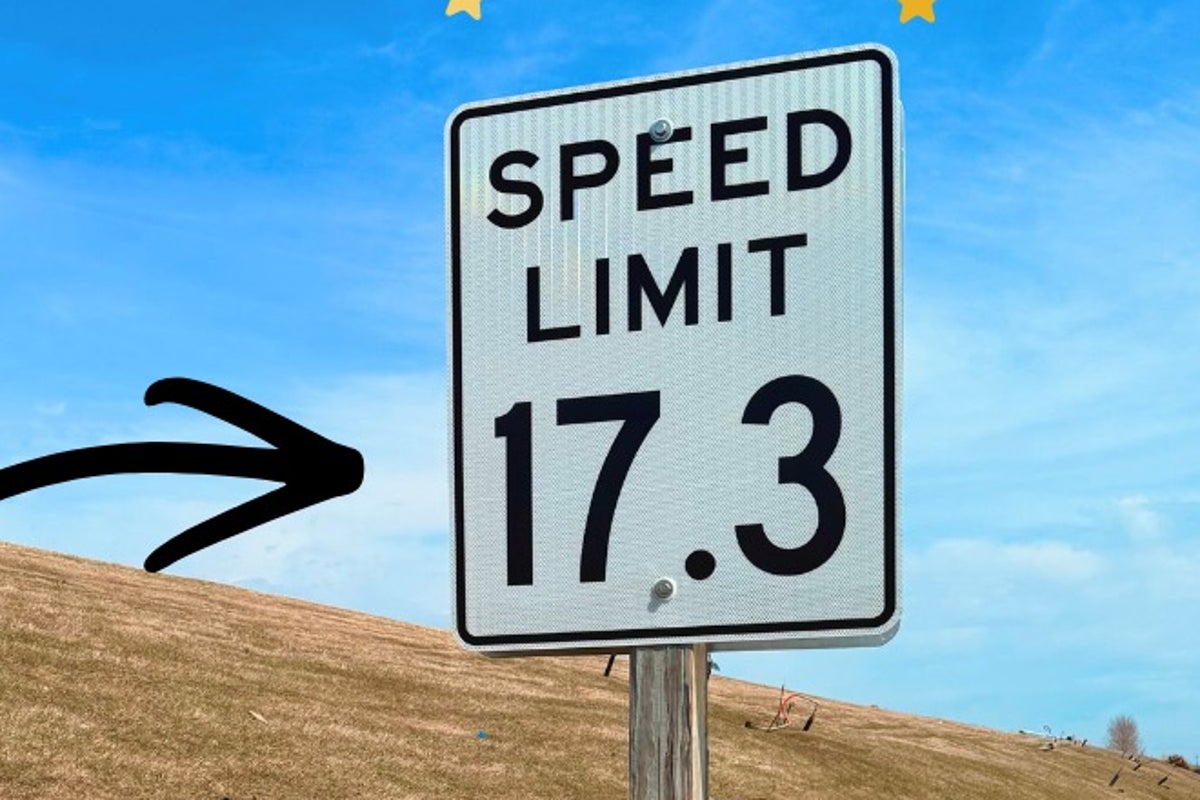
The speed limit sign on Valley View Road in the Town of Somers, Wisconsin, looks like a typo or a prank. It reads 19.5 mph. In a country where speed limits almost exclusively move in five-mile-per-increment jumps, that decimal point stands out as a bizarre defiance of American civil engineering norms. However, this isn't a mistake. It is a calculated, desperate attempt by a local government to use behavioral psychology to solve a problem that traditional enforcement could not touch.
Most drivers view speed limits as suggestions. On a standard 25 mph residential street, the "flow of traffic" often pushes toward 30 or 35 mph because the human brain categorizes numbers ending in five or zero as broad brackets. By introducing a decimal, the Town of Somers has effectively hacked the driver’s subconscious. You cannot ignore a 19.5 mph sign because it forces the brain to pause. It demands a level of precision that a round number does not.
The Psychology of the Odd Number
The logic behind the 19.5 mph limit is rooted in a concept known as the "von Restorff effect." This psychological principle suggests that when multiple similar objects are present, the one that differs from the rest is most likely to be remembered. When every other road in the state follows a predictable pattern of 25, 35, or 55, the brain goes into autopilot. A driver sees a standard sign and internalizes it without truly processing the data.
When that same driver hits Valley View Road, the autopilot shuts off. The decimal point acts as a visual speed bump. The brain must reconcile the unusual precision. Is the radar that sensitive? Is the local police force that pedantic? That moment of hesitation—that split-second where a driver wonders why the limit is so specific—is exactly when they take their foot off the gas.
The Town of Somers board didn't arrive at this number by accident. They were facing a specific safety crisis on a narrow, winding road where residents felt unsafe walking their dogs or checking their mail. Traditional 20 mph signs were being ignored. Lowering it to 15 mph felt too restrictive for the flow of traffic. The decimal was the compromise, a way to signal that the speed limit here is not a general guideline, but a specific requirement.
Engineering the Human Element
Civil engineering has long struggled with the "85th percentile rule." This is the industry standard which dictates that speed limits should be set at the speed that 85% of people naturally drive under free-flowing conditions. The theory is that most people are reasonable and do not want to crash. But this rule often fails in residential pockets where the "natural" speed of a modern car, designed for smooth handling and quiet cabins, far exceeds what is safe for a pedestrian-heavy environment.
On Valley View Road, the physics of the car and the psychology of the driver were at odds. Modern vehicles are built to mask the sensation of speed. You can do 40 mph in a quiet SUV and feel like you are crawling. By setting the limit at 19.5, the town is attempting to re-establish a sense of place. It reminds the person behind the wheel that they are in a neighborhood, not a transit corridor.
Critics often argue that such signs are a distraction. They claim that drivers will spend more time looking at their speedometer than the road, trying to hit a mark that their analog needles can't even accurately display. Yet, the data from similar experiments across the country suggests otherwise. In areas where "odd" speed limits like 14 mph or 17 mph have been implemented, average speeds typically drop by several miles per hour compared to standard signage. It is the power of the specific over the general.
The Regulatory Loophole
There is also a bureaucratic angle to this story. State laws often dictate how and when a municipality can change a speed limit. Many states require expensive engineering studies to justify moving a limit away from the standard 25 mph baseline. However, the exact wording of these statutes sometimes leaves room for "advisory" speeds or specific local ordinances if the road meets certain criteria regarding width, grade, or residential density.
Somers officials realized that while they might face hurdles in a sweeping overhaul of local traffic laws, a highly specific adjustment to a problematic stretch of road could serve as a test case. It is a low-cost intervention. A few custom-printed aluminum signs cost the taxpayer almost nothing compared to the price of installing physical speed humps, chicanes, or permanent roundabouts.
These physical "traffic calming" measures are often hated by the public. They damage suspension systems, slow down emergency response vehicles, and create noise as cars bottom out or accelerate rapidly between humps. The 19.5 mph sign is a "soft" intervention. It uses information rather than asphalt to change behavior.
Why the Decimal Point Matters
The decimal point is the most aggressive part of the strategy. A 19 mph sign is unusual, but a 19.5 mph sign implies a level of scientific calibration. It suggests that someone, somewhere, did the math and determined that 19.6 mph was dangerous, while 19.5 mph was the golden mean of safety.
Of course, no such calculation exists in a vacuum. No car’s braking distance changes significantly between 19 and 20 mph. But the perception of that precision is what matters. It creates an atmosphere of strict oversight. If a town is willing to go to the trouble of printing a decimal point on a sign, a driver assumes they are also willing to write a ticket for 21 mph.
This is a form of "nudge theory," the Nobel-winning concept that small changes in how choices are presented can have a massive impact on behavior. By making the speed limit a conversation piece, the town ensures that everyone who drives that road is thinking about their speed. You cannot claim you didn't see the sign when the sign is the only one of its kind in the county.
The Limits of Novelty
The primary risk with this tactic is the "novelty fade." Human beings are remarkably good at adapting to their environment. The first time a local drives past the 19.5 mph sign, they slow down out of curiosity. The tenth time, they might still slow down out of habit. By the hundredth time, the sign becomes part of the background. It becomes "that weird sign on Valley View" rather than a directive to check the speedometer.
For the decimal point to remain effective, it must be backed by occasional, visible enforcement. Behavioral nudges work best when they are paired with a credible threat of consequence. If the residents of Somers see that the odd number is just a psychological trick with no teeth, the speeds will eventually creep back up to the 30 mph range.
Furthermore, there is the issue of "sign pollution." If every road in Wisconsin adopted a decimal-point speed limit, the effect would be neutralized instantly. The 19.5 mph limit works precisely because it is an outlier. It is a high-stakes game of keeping the driver’s attention in an era where cars are becoming increasingly automated and drivers are increasingly distracted by mobile devices and massive infotainment screens.
The Future of the Roadside Hack
We are entering an era where the road itself will talk to the car. Intelligent Speed Assistance (ISA) systems, which are already becoming mandatory in parts of Europe, use GPS and camera recognition to limit a vehicle's speed automatically. In that world, a 19.5 mph sign is easy for a computer to read and execute. But until the entire fleet is automated, we are stuck with the messy, unpredictable nature of human biology.
The Town of Somers has recognized that the biggest safety feature in any car is the driver’s attention span. While federal and state agencies continue to pour billions into infrastructure and high-tech safety suites, a small municipality in Wisconsin found a solution in a pint of ink and a decimal point. It is a reminder that in a world of complex problems, the most effective answer is often the one that makes us stop and ask, "Wait, is that real?"
Drivers on Valley View Road now have a choice. They can scoff at the precision, or they can recognize the sign for what it truly is: a plea from a community to remember that the strip of asphalt in front of them isn't just a track—it’s someone’s front yard. The success of the 19.5 mph experiment will be measured not in tickets issued, but in the silence of a road where people finally feel safe enough to walk.
Check your speedometer. The decimal point is watching.