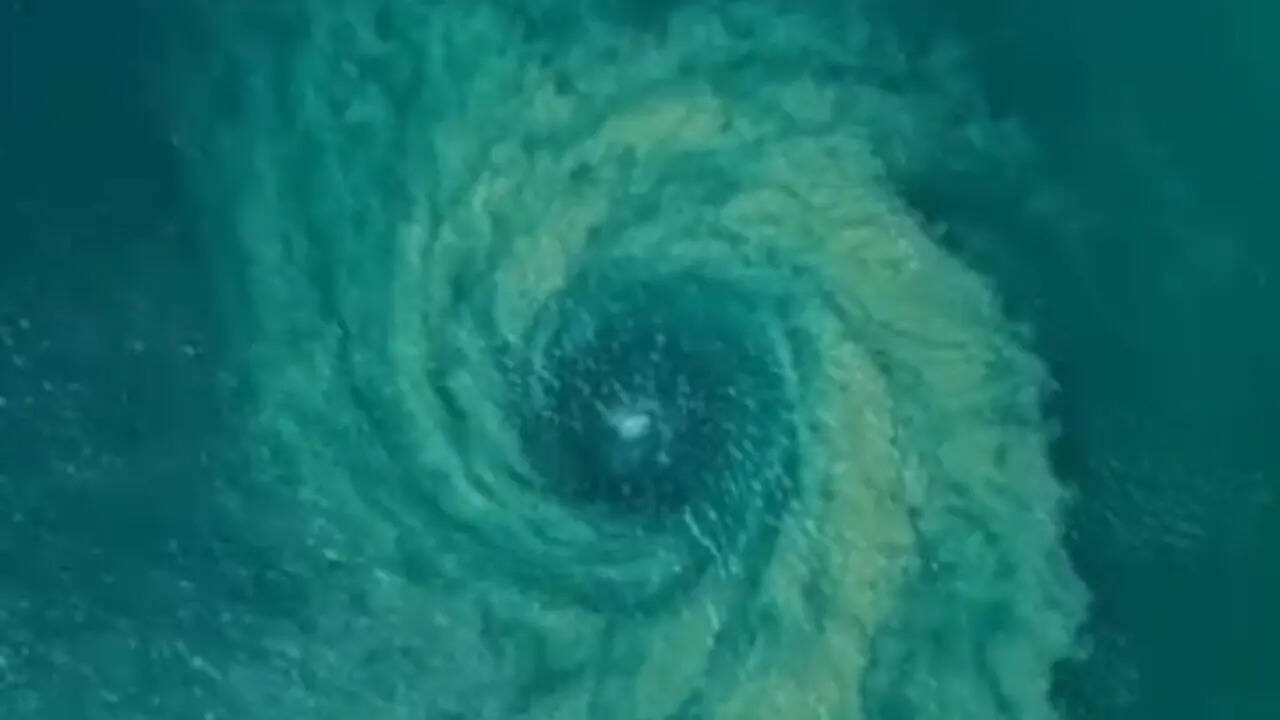
Manly Beach just reminded everyone why the ocean is basically a different planet. You’ve probably seen the footage by now. A dark, swirling mass of water spinning in a tight circle just off the coast of Sydney. People are calling it an underwater tornado, and while that sounds like a Hollywood disaster flick, the reality is actually more interesting—and a lot less supernatural.
I've watched enough coastal phenomena to know that when the internet sees a circle in the water, it panics. But if you're standing on the sand at Manly, you're looking at a rare, high-energy interaction between tides, topography, and the specific shape of the seabed. It isn't a "tornado" in the atmospheric sense. It's a massive, concentrated whirlpool or an eddy, but the scale of this one off Australia's coast is what makes it worth your time.
Why the Manly Beach vortex happened
Most people think the ocean just sloshes back and forth. It doesn't. It's a complex system of conveyor belts. At Manly, you have a unique setup where the swell hits the headland and gets shoved into a corner. When you get a massive pulse of energy—like the recent strong swells hitting New South Wales—that water has to go somewhere.
It doesn't just disappear. It hits the "corner" of the beach, bounces off the rocks, and begins to rotate. If the tide is pulling out at the same time the swell is pushing in, you get a shear zone. This is exactly where the strong circular motion starts. It's fluid dynamics in its most violent, beautiful form.
Scientists often refer to these as submesoscale eddies. Think of it like a spinning top made of thousands of tons of saltwater. While a regular rip current pulls you straight out to sea, these vortices trap water in a localized loop. The reason this one looked so much like an "underwater tornado" is the sediment. The force was strong enough to suck sand and debris from the floor, coloring the water and making the invisible physics visible to everyone with a smartphone.
The difference between a whirlpool and a waterspout
Let's clear up some bad science floating around social media. A waterspout is a literal tornado that forms over water, connecting the clouds to the surface. That’s an atmospheric event. What happened at Manly is a hydrodynamic event.
- Waterspouts: Driven by wind, heat, and air pressure. They pull water up.
- Underwater Vortices: Driven by currents, tides, and bottom contour. They pull things down or spin them in place.
If you were caught in that Manly vortex, you wouldn't be lifted into the sky like Dorothy. You'd be pinned in a heavy, rotating wash cycle. Local surfers know the "washing machine" effect well, but the sheer diameter of this specific event was what caught the Bureau of Meteorology's attention. It wasn't just a small swirl; it was a powerful engine of moving water that could easily swamp a small craft or exhaust even a strong swimmer in seconds.
Australia's coastline is a geographic freak show
The East Australian Current (EAC) is legendary for a reason. It’s not just a plot point in Finding Nemo. It’s a massive river of warm water moving south, and it’s constantly peeling off into smaller circles. When these circles—eddies—hit the shallow shelf near beaches like Manly, things get weird.
Geologists and oceanographers often point to the Sydney Coastal Councils Group data which shows how our coastline's jagged nature creates these "trap zones." Manly is particularly prone because of its orientation. It faces the brunt of South-Southeasterly swells. When that energy gets funneled, the physics doesn't have a choice. It has to spin.
I've talked to divers who have been near smaller versions of these. They describe the sound as a low-frequency hum. You feel the vibration in your chest before you see the sand start to spiral. It's a reminder that the seafloor isn't a flat desert; it's a rugged terrain of trenches and sandbars that dictate exactly how the water behaves.
Is this becoming more common
You'll hear plenty of talk about "unprecedented" events. Honestly, these things have probably been happening for thousands of years. The difference today? Everyone has a 4K camera in their pocket and a drone in their car. We are documenting the ocean's tantrums in ways we never could before.
However, there is a catch. Marine heatwaves and shifting current patterns are changing how energy moves along the Australian coast. Warmer water holds more energy. More energy means stronger currents. Stronger currents mean more frequent and more intense eddies. It's a simple equation. So, while I wouldn't say "underwater tornadoes" are the new normal, I'd bet we'll see more of these spectacles as the East Australian Current continues to behave erratically.
How to spot a dangerous vortex before you get in
If you're heading down to the Northern Beaches, you need to know what you're looking at. A vortex isn't always as obvious as the one in the viral Manly video. Sometimes it just looks like a patch of "flat" water where the waves aren't breaking.
Look for these signs:
- Discolored water: If one patch of water is significantly browner or murkier than the rest, it’s likely sucking up sand from the bottom.
- Debris patterns: Watch the foam. If the sea foam is moving in a circle rather than washing straight in or out, stay away.
- The "Hole": In very intense cases, the center of the rotation will actually sit slightly lower than the surrounding water level.
The biggest mistake people make is thinking that "no waves" means "safe." In the case of a powerful circular current, the lack of breaking waves actually means all that energy is concentrated beneath the surface. It’s a trap for the unwary.
Respect the power of the NSW coast
The Manly event is a classic example of why we can't treat the ocean like a swimming pool. It’s a dynamic, living system. When you see a rare underwater tornado, you aren't just seeing a cool video for your feed. You're seeing the raw power of the Pacific Ocean being squeezed into a tiny space.
If you ever find yourself near one of these, don't try to swim against the rotation. Much like a rip current, you have to work with it. Most of these eddies eventually "shed" or move. Your goal is to stay buoyant and wait for the energy to dissipate or for the rotation to eject you. Trying to fight a thousand tons of spinning water is a losing game.
Next time you're at Manly, look past the surfers and the tourists. Watch the way the water hits the rocks at the southern end. Watch how it swirls around the point. The physics is always there, hidden just beneath the surface, waiting for the right swell to turn the beach into a giant, spinning laboratory.
Stay out of the dark water. Watch from the promenade. Let the drones do the work.


:strip_icc()/pic2513216.jpg)