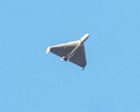
The sound starts as a faint, rhythmic irritation. It is the noise of a poorly maintained lawnmower or a moped struggling up a steep hill in a quiet neighborhood. In a different decade, that sound might have signaled a neighbor’s weekend chores or a teenager heading home before curfew. Today, in the high-rise suburbs of Kyiv or the rolling hills of the Galilee, it is the sound of a predatory revolution.
It is the sound of the Shahed.
When we think of modern warfare, we tend to conjure images of sleek, multi-billion-dollar jets tearing through the sound barrier, piloted by humans with years of elite training. We think of "Top Gun." We think of invisible stealth technology. But the Shahed-136, Iran’s signature contribution to global instability, is the polar opposite of a prestige weapon. It is slow. It is loud. It is made of fiberglass and parts you can find in a high-end RC hobby shop.
That is exactly why it is winning.
The Democratization of Terror
Consider a young soldier named Anton, stationed near an electrical substation on the outskirts of an industrial city. He has a thermal scope and a heavy machine gun. He is tired. For three hours, he has been staring into the blackness, listening. The radar operators back at headquarters have already sent the alert: a "swarm" is inbound.
Anton isn’t looking for a fighter jet. He is looking for a triangle of plastic no bigger than a dining table.
The Shahed does not need a runway. It launches from the back of a standard flatbed truck, hidden under a tarp. It doesn't have a pilot to get scared or a complex computer brain that can be easily fried by electronic warfare. It simply follows its GPS coordinates with the mindless persistence of an insect. If you shoot one down, another is five minutes behind it. If you shoot that one down, ten more are crossing the border.
This is the math of the new Middle East and the new Eastern Europe. A single interceptor missile for a sophisticated air defense system—like a Patriot or an IRIS-T—can cost upwards of $2 million. A Shahed costs about $20,000.
War has always been a game of attrition, but the Shahed has turned it into a cruel joke of accounting. The attacker spends the price of a used sedan to force the defender to spend the price of a luxury mansion. It is a slow-motion bankruptcy delivered by mail.
From the Testing Grounds to the Heartland
For years, the world viewed Iranian drone technology as a regional nuisance. We saw them in the hands of Houthi rebels in Yemen, targeting oil refineries in Saudi Arabia with surprising precision. We saw them as a "budget" solution for a nation under heavy sanctions.
Then came February 2022.
The plains of Ukraine became the world's most violent laboratory. Russia, finding its own high-tech munitions stocks dwindling and its air force surprisingly hesitant, turned to Tehran. The result was a marriage of convenience that changed the geography of fear. Suddenly, the "moped in the sky" wasn't just a Middle Eastern headline; it was a nightly reality for millions of Europeans.
The psychological weight of these machines is their most potent payload. Unlike a cruise missile that strikes in a heartbeat, a Shahed drones on for hours. You hear it coming long before it arrives. It forces a city to hold its breath. It turns the sky itself into a source of chronic anxiety.
But the story didn't end in Ukraine. It looped back.
The expertise gained on the battlefields of the Donbas has flowed back to the Middle East with a vengeance. The "Shahedization" of conflict is now the standard operating procedure for the "Axis of Resistance." From the borders of Lebanon to the shipping lanes of the Red Sea, the low-cost, long-range suicide drone has become the primary tool for shifting the balance of power without ever declaring a formal war.
The Invisible Stakes
Why does this matter to someone sitting in London, New York, or Sydney? Because the Shahed has effectively ended the era of "impenetrable" borders.
Historically, if you wanted to strike a target 1,000 miles away, you needed a massive military infrastructure. You needed satellites, aircraft carriers, and a logistical chain that spanned oceans. Now, you need a garage, a few thousand dollars in Western-made microchips smuggled through third-party countries, and a map.
This is the "Law of the Lowly Sky." We spent seventy years perfecting defenses against the fast and the high. We built radars that can see a needle at 30,000 feet. We are almost entirely unprepared for the slow and the low.
The Shahed flies under the radar—literally. By hugging the terrain and moving at speeds that some systems mistake for a large bird or a civilian Cessna, it exploits a gap in our collective security. It is a hack. A workaround. It is the military equivalent of a phishing email that bypasses a billion-dollar firewall because a human clicked a link.
The Human Cost of High-Tech Poverty
Let’s go back to Anton, or perhaps his counterpart in a village in northern Israel. He isn't just fighting a machine; he is fighting a philosophy. The philosophy says that human life and expensive technology are interchangeable, and that if you have enough of the latter, you can eventually wear down the former.
There is a specific kind of exhaustion that comes from fighting a swarm. It’s not the adrenaline-fueled terror of a dogfight; it’s the grinding, soul-crushing fatigue of swatting mosquitoes in a swamp. You can kill a hundred, but the hundred-and-first is the one that hits the power plant.
When the power goes out in a hospital in Kharkiv or a desalination plant in the Gulf, the Shahed has achieved its goal. It doesn't need to destroy a tank. It just needs to make modern life unsustainable. It aims for the thermostat, the light switch, and the water tap. It targets the "normalcy" of the civilian world.
A New Grammar of Conflict
The proliferation of these drones has created a new language of escalation. In April 2024, when Iran launched a massive direct attack on Israel, the Shahed was the vanguard. Hundreds of them were sent first, not necessarily to destroy targets, but to "soak up" the defenses. They were the sacrificial pawns meant to clear the way for the faster, more expensive ballistic missiles.
This is how the future of conflict looks: layers of cheap, disposable intelligence.
We are entering a period where the barrier to entry for becoming a "regional superpower" has never been lower. You don't need to build a stealth fighter. You just need to build a better lawnmower.
The global community is currently scrambling for an answer. We see the rise of "kinetic" solutions—cheap lasers that can burn a drone out of the sky for the cost of a gallon of gasoline—and high-powered microwave bursts that can drop a swarm instantly. But technology moves faster than bureaucracy. By the time the West deploys a standard defense, the software in the Shahed has been updated. The GPS spoofing has been countered. The "moped" has learned a new trick.
The real danger isn't just the explosion at the end of the flight. It’s the realization that the sky is no longer a sanctuary. For decades, the "civilized" world operated under the assumption that distance was a shield. We thought that if we controlled the high ground and the deep blue water, we were safe.
The Shahed proved that the middle ground—the lowly sky, just above the treeline and just below the clouds—is the new front line. It is a space occupied by machines that don't care about treaties, don't fear death, and never get tired of humming.
As night falls over another contested border, someone is listening. They are filtering out the wind, the crickets, and the distant traffic. They are waiting for that specific, rhythmic thrumming to emerge from the silence. It is a small sound, but it carries the weight of a changing world order.
The lawnmowers are in the air, and the world is finally realizing that silence was a luxury we can no longer afford.
Would you like me to research the specific counter-drone technologies currently being developed to combat the Shahed-136?