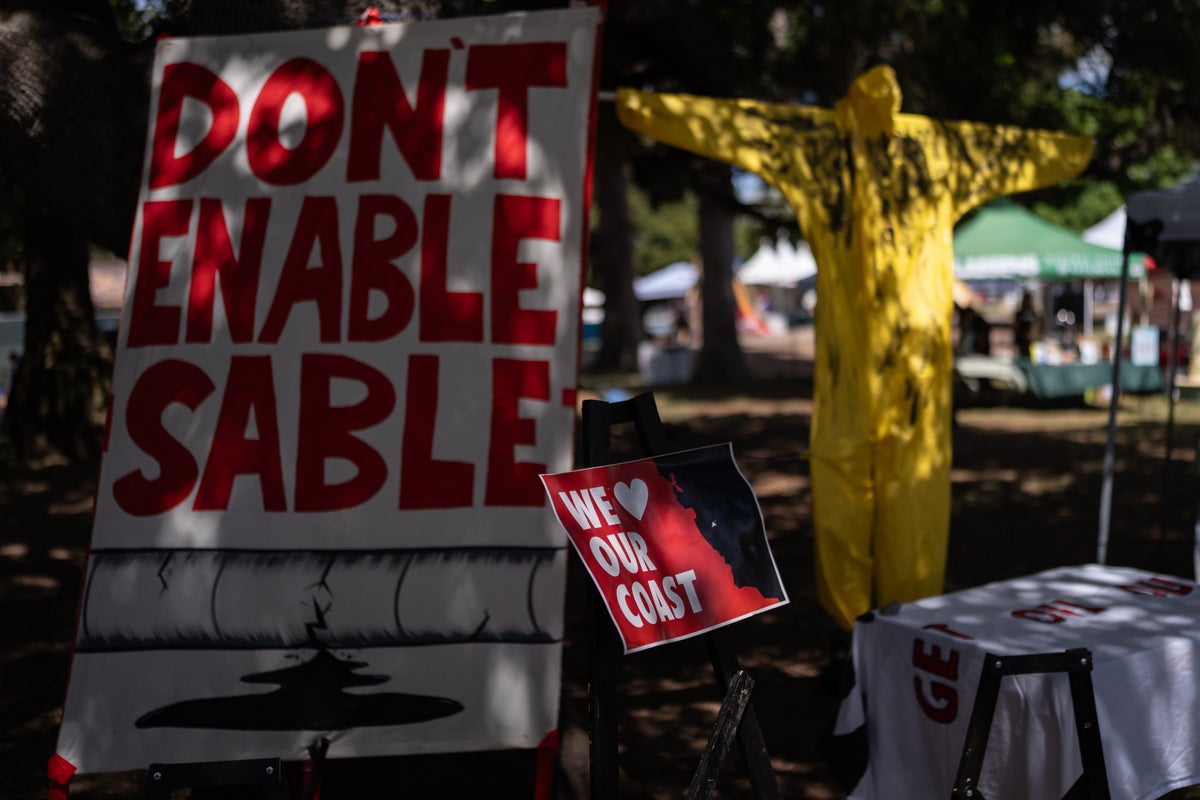
The constitutional friction between California’s environmental mandates and federal wartime energy directives is not a mere policy disagreement; it is a structural collision between two distinct legal authorities: the State Police Power and the Federal Commerce/War Power. At the center of this dispute lies the physical reality of pipeline infrastructure, which serves as a fixed asset caught between competing regulatory demands. To understand the trajectory of this conflict, one must analyze the mechanisms of preemption, the physics of energy distribution, and the economic variables that dictate state-level resistance during periods of national mobilization.
The Dual-Mandate Bottleneck
Pipeline management under current geopolitical stressors operates within a framework of conflicting incentives. On one side, the federal government prioritizes National Energy Security, viewed through the lens of the Defense Production Act and the Department of Energy’s emergency powers. This logic treats pipelines as strategic arteries that must remain operational at any cost to fuel military readiness and price stability.
On the opposite side, California operates under a Precautionary Risk Mitigation model. State regulators view aging pipeline infrastructure as a liability to public health and localized ecosystems. The "conflict" reported in mainstream media is actually a breakdown in the Integrated Resource Planning (IRP) process, where the federal government’s requirement for high-volume throughput directly contradicts the state’s safety testing protocols and decarbonization targets.
The technical bottleneck occurs because safety inspections—specifically hydrostatic testing or In-Line Inspections (ILI)—require the temporary decommissioning of segments. During a war-footing economy, the federal government views this downtime as an unacceptable risk to the energy supply chain. California, however, views the absence of these tests as a catastrophic risk to its citizens. This creates a zero-sum environment:
- The Federal Metric: Reliability and Throughput (Volume / Time).
- The State Metric: Integrity and Risk (Probability of Failure x Severity of Impact).
The Three Pillars of State Resistance
California’s ability to push back against Washington is not based on ideological defiance but on three specific legal and technical pillars.
1. The Clean Air Act Section 401 Waiver
States possess a unique lever through water quality certifications. By arguing that pipeline operations or expansions threaten local watersheds, California can effectively stall federal directives. This is a technical veto power that the federal government struggles to override without lengthy litigation in the 9th Circuit Court of Appeals. The mechanism here is the Nexus of Environmental Impact, where the state argues that federal wartime needs do not grant a license to violate established environmental thresholds.
2. Delegated Safety Authority
While the Pipeline and Hazardous Materials Safety Administration (PHMSA) sets federal floors, states often act as interstate agents for the federal government or maintain their own stricter standards for intrastate lines. California’s Public Utilities Commission (CPUC) leverages this delegated authority to impose testing frequencies that exceed federal requirements. When Washington demands "operational continuity," the CPUC counters with "operational integrity," citing the specific metallurgical vulnerabilities of pipelines crossing seismic fault lines.
3. The Economic Disincentive of Stranded Assets
California is aggressively transitioning its grid toward electrification. Every dollar spent maintaining or expanding oil and gas pipelines is viewed by state planners as a Stranded Asset Risk. The state’s logic follows a cost-benefit function:
$$C_{total} = C_{maintenance} + C_{environmental_liability} - V_{utilization}$$
As $V_{utilization}$ (the value of the energy delivered) is phased out by state mandates, the $C_{environmental_liability}$ (the risk of a leak or explosion) becomes mathematically intolerable. Washington ignores this long-term fiscal curve, focusing instead on the immediate $V_{utilization}$ required for the war effort.
The Preemption Mechanism and Its Limitations
The Supreme Court’s interpretation of the Commerce Clause usually favors federal interests in matters of interstate pipelines. However, the "War Power" adds a layer of complexity. Under the Supremacy Clause, federal law preempts state law when the two are in direct conflict. Yet, California has successfully pioneered a strategy of Regulatory Density.
Instead of flatly refusing a federal order, the state layer-cakes its requirements. It mandates specific permits for land use, noise ordinances for compressor stations, and air quality offsets for construction. This does not technically "block" the federal government—which would trigger immediate preemption—but it creates a Frictional Delay. The time required to clear state-level hurdles often outlasts the immediate tactical necessity of the federal directive.
The friction is quantified through "Permit Lag." For every one federal authorization, California can trigger four to seven secondary state or local reviews. This is a strategy of attrition rather than a frontal legal assault.
Quantifying the Risk of Infrastructure Failure vs. Supply Shortage
The debate is often framed as "Safety vs. Security," but a more precise analysis requires looking at the Probabilistic Failure Rate.
- Federal Hypothesis: The risk of a pipeline failure during a 24-month war window is statistically lower than the risk of an energy shortage that cripples industrial output.
- State Hypothesis: The probability of a failure increases exponentially when pipelines are run at maximum capacity (100% load factor) without the scheduled maintenance intervals required by state law.
Structural engineering data supports the state’s concern. Operating a pipeline at high pressure for extended periods accelerates Stress Corrosion Cracking (SCC). If a pipeline fails in a high-density California corridor, the resulting economic and human cost would likely exceed the benefit provided by the marginal increase in energy throughput. The state is essentially performing a localized Value at Risk (VaR) calculation that Washington refuses to acknowledge in its national-level aggregate data.
The Logic of Selective Compliance
California utilizes a "Targeted Interdiction" strategy. The state does not oppose all federal energy directives; it selects high-leverage points where the environmental or safety risk is most visible to the public. This maximizes political capital while forcing the federal government to expend legal resources on individual cases rather than a broad systemic overhaul.
This creates a Regulatory Fragmentation effect. Energy providers find it increasingly difficult to operate a unified national network when one of the largest nodes in that network (California) operates under a different set of physical and legal tolerances. The result is an "island" effect, where California’s grid and pipeline systems become increasingly decoupled from the national infrastructure.
Strategic Realignment of State Powers
The traditional view that "Washington wins during wartime" is being challenged by the complexity of modern infrastructure. In the 1940s, pipelines were simpler, and state environmental laws were non-existent. In the 2020s, the Administrative State at the local level is too robust to be brushed aside by a simple executive order.
The second-order effect of this pushback is the shifting of the "Energy Burden." If California successfully restricts pipeline throughput, the federal government is forced to rely on more expensive or less efficient alternatives, such as rail or maritime transport (Jones Act vessels). This increases the Unit Cost of Energy across the western United States, creating a negative feedback loop for the very war effort Washington seeks to protect.
Tactical Recommendation for Infrastructure Stakeholders
For operators caught in this jurisdictional crossfire, the only viable path is the implementation of Redundant Compliance Protocols. This involves:
- Hyper-Transparency in Data: Sharing real-time ILI (In-Line Inspection) data with both state and federal regulators simultaneously to remove the information asymmetry that fuels legal disputes.
- Seismic-First Engineering: Prioritizing maintenance on segments that overlap with state-defined high-consequence areas (HCAs) to neutralize the state’s "Safety First" legal argument.
- Alternative Throughput Modeling: Developing contingency plans for 15-20% reduced throughput, anticipating that state-level frictional delays will prevent 100% capacity utilization regardless of federal mandates.
The conflict will likely be resolved not by a definitive court ruling, but by the physical limits of the assets themselves. As California continues to de-rate its fossil fuel infrastructure, the federal government’s ability to "push" energy through the state will diminish, regardless of who holds the legal upper hand. The strategic play for the federal government is to stop fighting for old-line capacity and instead pivot to using war powers to accelerate the very renewable transitions California desires, thereby aligning national security with state-level policy. Failure to align these incentives will result in a degraded, high-risk infrastructure that serves neither the state’s safety nor the nation’s security.