The media is laughing at the wrong thing.
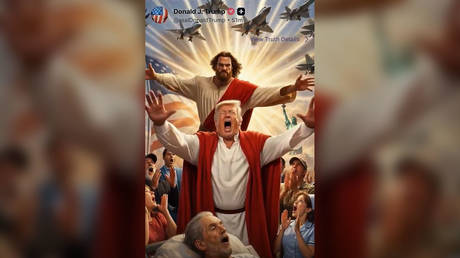
When Iranian state-linked accounts recently pushed a bizarre AI-generated video of Jesus Christ walking alongside Donald Trump, the Western press responded with its usual cocktail of mockery and "fact-checking." They called it "cringe." They called it a "twist." They analyzed the pixels and the uncanny valley movements of a digital Savior.
They missed the point entirely.
This wasn't a failed attempt at propaganda. It was a masterclass in psychological arbitrage. While pundits are busy counting fingers on AI-generated hands, the Iranian information apparatus is successfully hijacking the most powerful cultural symbols of their adversary to create a cognitive feedback loop.
Stop looking at the video quality. Start looking at the distribution of the virus.
The Lazy Consensus of Cringe
The standard take is simple: "Iran doesn't understand American culture, so they made a weird video that makes Trump look like a messiah to mock him."
This is wrong. It assumes the creators are trying to be subtle. In the world of modern digital influence, subtlety is for losers. The "lazy consensus" ignores the reality of how memes actually travel. Iran isn't trying to convert you to a new ideology; they are trying to occupy the space between your ears for free.
By pairing Trump with Jesus, they hit the "High-Arousal" button on both sides of the American political aisle.
- The Right sees it as a mockery of their faith or a weird tribute.
- The Left sees it as a confirmation of "MAGA cultism."
Both sides share it. Both sides scream about it. Both sides ensure the video reaches millions of impressions without Iran spending a single dollar on ad buy. That isn't a "twist." That's an ROI that would make a Madison Avenue executive weep.
Sovereignty is Dead in the Age of Large Language Models
We used to worry about "state-sponsored actors" as if they were monolithic entities sitting in dark rooms. I’ve seen intelligence reports that treat these digital campaigns like traditional troop movements. They aren't.
Today’s propaganda is decentralized. The barrier to entry for high-impact psychological operations (PsyOps) has been lowered to the cost of a mid-tier GPU. When Iran uses AI to generate these clips, they are performing a "Stress Test" on our social media algorithms.
They know our platforms are hard-coded to reward engagement. They know "outrage" is the most efficient form of engagement. Therefore, the more "cringe" or "incorrect" the video feels, the faster it spreads. The "glitches" in the AI aren't bugs; they are features that prove the content is disruptive.
The Mirage of the Fact-Check
People also ask: "How can we stop AI misinformation from influencing elections?"
The premise of the question is flawed. You’re asking for a filter when the entire water supply is already toxic. "Fact-checking" a video of Jesus and Trump is like trying to use a wet napkin to stop a forest fire. It only validates the fire’s existence.
When a news outlet writes a 1,000-word breakdown on why a video is "AI-generated," they have already lost. They are giving the content the one thing it craves: Authority. By treating a troll-farm video as a serious news item, the media elevates a digital hallucination into a geopolitical event.
The real danger isn't that people believe Jesus is walking with Trump. The danger is the Dilution of Reality. When every image is suspect, the truth doesn't become clearer; it becomes irrelevant. Iran knows this. They don't need you to believe their lie; they just need you to stop believing the truth.
Why Technical Superiority is a Liability
We have a fetish for "high-quality" AI. We think that better models like Gemini or Sora will save us because we’ll be able to spot the fakes easier or generate better counter-narratives.
This is a technical solution to a biological problem.
Human brains are wired for narrative, not data. Iran’s "Jesus Video" works because it taps into a pre-existing American narrative of religious-political fusion. You can have the most "robust" detection software in the world, but it won't stop a voter from feeling something when they see a symbol they care about being manipulated.
The downside to my contrarian view? It suggests we are essentially defenseless. If we respond, we spread the virus. If we ignore it, we allow the narrative to fester in echo chambers.
The Cost of Digital Isolation
I have watched organizations burn millions trying to build "influence detection" dashboards. They track bot accounts. They map networks. They give the actors cool codenames.
It’s all theater.
The Iranian campaign is a reminder that the most effective weapon in 2026 isn't a missile; it’s a prompt. If you can make an American citizen angry at another American citizen by using an AI-generated image of a deity, you have achieved more than a decade of sanctions could ever undo.
The "Twist" is a Distraction
The competitor article wants you to focus on the "twist"—the specific way the video ended or the specific account that posted it.
Ignore the twist. Focus on the Infrastructure of Indifference.
We have become so accustomed to digital noise that we no longer realize when our cultural symbols are being weaponized against us. We treat it as "content" to be consumed and mocked. But every time you click, every time you "debunk," and every time you laugh at the "bad AI," you are participating in the campaign.
The Iranian government doesn't need to win the AI race. They just need to make sure you lose the ability to tell the difference between a joke and a weapon.
Stop laughing at the video. It’s not a joke. It’s a mirror. And what it reflects about our own inability to look away from the digital carnage is far more terrifying than any AI-generated Savior.
Delete the app. Close the tab. The only way to win a war for your attention is to stop paying it.
The video wasn't made for Trump supporters, and it wasn't made for Trump haters. It was made for the algorithm. And the algorithm—which we built, nurtured, and fed—is currently the best agent the Iranian state has ever had.
Turn it off.