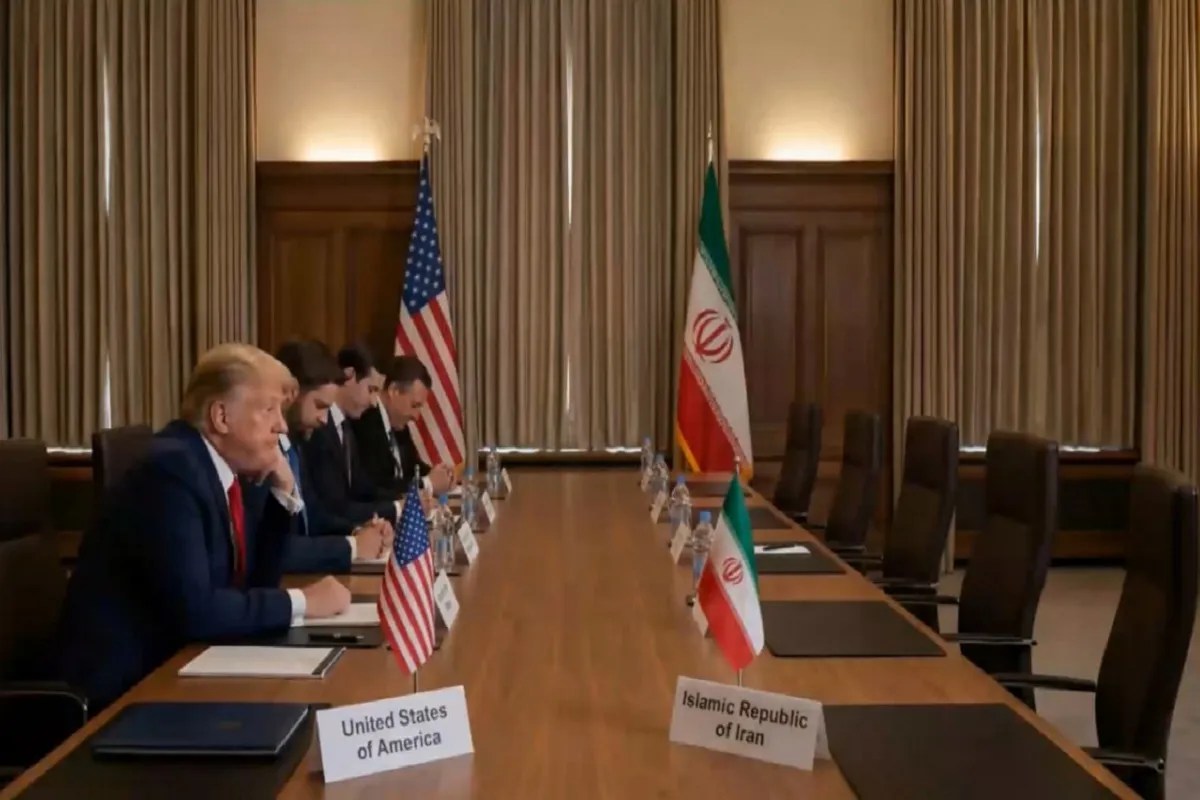
The digital frontier of the Middle East just became a hall of mirrors. While political pundits and social media influencers spent the last forty-eight hours debating the validity of a purported ceasefire extension involving the United States and Iran, Tehran decided to burn the script. They didn't do it with a formal diplomatic cable or a somber press conference. They did it with a satirical, AI-generated video designed to humiliate Donald Trump and dismantle the narrative of American mediation.
This isn't just about a "shut up" message directed at a former president. It is a calculated deployment of deepfake technology as a tool of state-level psychological warfare. By mocking the idea of a deal through high-fidelity manipulation, Iran is signaling that the era of traditional backdoor diplomacy is being replaced by a more chaotic, visual-first form of geopolitical rejectionism.
The Mechanics of the Mockery
The video in question utilizes sophisticated generative adversarial networks (GANs) to place Donald Trump in a position of public subservience and ridicule. It is crude in its sentiment but precise in its execution. The "core" of the message is simple: Iran claims that any talk of a ceasefire expansion facilitated by the former U.S. administration is a fabrication.
We are seeing the weaponization of the "Liar’s Dividend." This is a phenomenon where the mere existence of deepfakes allows political actors to dismiss real events as fake, while simultaneously using fake content to discredit their enemies. When Iran shares an AI-generated clip of an American leader being silenced, they aren't just trolling. They are systematically eroding the credibility of any future diplomatic communications. If the public cannot distinguish between a legitimate ceasefire announcement and a high-end parody, the psychological foundation for peace collapses.
Why the Ceasefire Narrative Failed
The rumor of a ceasefire extension was dead on arrival because it relied on the assumption that both parties still value the optics of stability. Tehran’s current strategy suggests they find more value in friction. The Iranian state media’s decision to amplify a deepfake "shut up" message serves three distinct purposes that traditional journalism often overlooks.
First, it consolidates the domestic hardline base. By showing their leaders "silencing" a Western powerhouse, even through digital fiction, they project a strength that masks internal economic pressures. Second, it tests the detection capabilities of Western social platforms. Every time a state-sponsored deepfake goes viral, the aggressor learns exactly how long it takes for Fact-Checkers to catch up. Usually, the damage is done within the first six hours—well before a "Manipulated Media" tag appears.
Third, and perhaps most critically, it serves as a pre-emptive strike against future negotiations. By mocking the very concept of a deal, Iran makes it politically toxic for any Western leader to come to the table without appearing weak.
The Technological Arms Race in the Gulf
This isn't an isolated incident of a social media manager going rogue. It reflects a massive investment by the Islamic Revolutionary Guard Corps (IRGC) into "soft war" capabilities. We are talking about server farms dedicated to rendering high-quality disinformation.
For years, the intelligence community focused on Iranian cyberattacks against infrastructure—water grids and banking systems. Those remain a threat. However, the shift toward "Cognitive Hacking" is more insidious. It targets the belief systems of the electorate. If you can make an entire population believe their leaders are being mocked and silenced on the world stage, you don't need to fire a single missile to destabilize a government.
The math of modern conflict has changed.
$$C = (P \times V) + D$$
In this simplified model for modern influence, $C$ represents the Impact of Content, $P$ is the Polished nature of the AI, $V$ is the Velocity of the social media algorithm, and $D$ is the pre-existing Distrust in the target population. Iran is currently maximizing every variable in that equation.
The Problem with the Western Response
The West is currently bringing a knife to a laser fight. The standard response to state-sponsored deepfakes is "debunking." But debunking is reactive. It happens after the emotional imprint has already been made on the viewer.
Journalism has a bad habit of treating these AI videos as "oddities" or "internet culture" stories. They aren't. They are the new projectiles of the 21st century. When a competitor's article focuses on the "humor" or the "insult," they miss the structural shift. We are witnessing the total decoupling of visual evidence from reality.
A Future of Permanent Uncertainty
We must stop looking for the "Truth" in digital video. That ship has sailed. The Iranian deepfake is a warning shot for the 2026 and 2028 election cycles. It proves that the barrier to entry for high-level international gaslighting is now effectively zero.
If a state actor can use the image of a former president to deny a ceasefire, they can use the image of a sitting general to declare a war. They can use the image of a central bank chair to crash a currency. The "Shut Up" video was a joke, but the infrastructure behind it is a threat to the concept of a shared objective reality.
The ceasefire claims were likely discarded not because they lacked merit, but because the digital noise surrounding them made them impossible to sustain. In the Middle East, a deal is only as good as the trust between the parties. When that trust is fed into an AI rendering engine and spat out as a mockery, there is no path back to the table.
Governments must now move beyond simple detection. We need a cryptographic verification of all official communications—a digital "blue check" that actually means something, anchored in blockchain or hardware-level signatures. Without a way to verify that a video of a leader is authentic at the moment of capture, diplomacy is effectively over. The world has become a place where the loudest, most convincing lie wins the day, and Tehran just proved they have the loudest speakers.
Verify every pixel or trust nothing at all.