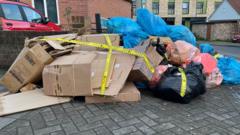
The morning mist usually hangs heavy over the narrow lanes of the English countryside, a silver veil that makes everything feel untouched. But for Sarah, a local volunteer who spends her Saturdays with a grabber and a heavy-duty bin bag, the mist often hides a jagged reality. Last Tuesday, it was a sodden, floral-print armchair dumped unceremoniously into a drainage ditch. Beside it, a stack of moldy drywall and a shattered television.
It isn’t just an eyesore. It is a slow-acting poison for the community. For years, the act of "fly-tipping"—the illegal dumping of waste—has been treated by the legal system as a nuisance, a bureaucratic headache settled with fines that many offenders simply view as the "cost of doing business." But the wind is shifting. The government is no longer looking at this as a mere environmental lapse. They are looking at the person behind the wheel.
The Weaponization of the Commute
Imagine a white transit van idling in a layby at 2:00 AM. The driver isn't a career criminal in the traditional sense. He might be a rogue tradesman looking to dodge a £150 tip fee, or a homeowner who thought a "man with a van" from a Facebook ad would dispose of their old kitchen ethically. When that tailgate opens and the rubbish hits the verge, a link is forged between the act and the vehicle.
Until now, the punishment stayed with the waste. A fine would arrive in the post, often contested, sometimes ignored. But new legislative proposals are aiming for the one thing most people value more than their bank balance: their right to drive.
The core of the new strategy is a direct strike at the driving license. By attaching penalty points to fly-tipping offenses, the government is reframing illegal dumping not as a littering issue, but as a serious motoring violation. If you use your vehicle to commit a crime against the land, your ability to use that vehicle at all is put on the line.
Why Money Failed to Stop the Rot
Fines have a ceiling. For a high-volume illegal clearance operation, a £400 fixed penalty notice is a rounding error. It doesn't carry a social stigma. It doesn't stop the van from heading out the next night to do it again.
Points are different.
Points are a ticking clock. For a young driver or someone who relies on their car for work, three or six points on a license is a tightening noose. It sends insurance premiums screaming upward. It creates a paper trail that employers see. It lingers for years, a persistent reminder that the "easy way" to get rid of a sofa was actually the most expensive mistake they ever made.
Consider a hypothetical courier named Jack. Jack is struggling to make ends meet and decides to earn an extra fifty quid by taking a neighbor’s old renovation debris to the "woods." Under the old system, Jack might get a fine he can't pay. Under the new system, Jack gets points. Those points push him toward a ban. Without a license, Jack loses his primary income. The stakes are no longer about a messy hedge; they are about his entire livelihood.
The Invisible Stakes of a Grass Verge
We often talk about fly-tipping in terms of "tonnage" or "cleanup costs," which currently drain millions of pounds from local council budgets every year. These are cold, distant numbers.
The real cost is felt when a farmer’s tractor tires are shredded by dumped glass, or when a local stream is choked by leaking chemicals from an old fridge. It is felt by the taxpayer who wonders why the potholes aren't being filled, unaware that the budget for road repair is being diverted to haul away 400 abandoned tires from a country lane.
The proposed shift toward license points acknowledges a psychological truth: people fear losing their freedom of movement more than they fear a letter from the council. It creates a visceral connection between the vehicle and the crime. If the car is the tool used to scar the landscape, then the car—and the right to drive it—becomes the focus of the penalty.
The "Man with a Van" Trap
There is a cautionary tale here for the average person, too. We live in a world of convenience, where an app can solve any problem. When you hire someone to take away your "junk," you are legally responsible for where it ends up. This is the "Duty of Care" that many find confusing or outright ignore.
If a homeowner pays a stranger £20 to take away a mattress, and that mattress ends up in Sarah’s drainage ditch, the trail leads back to the homeowner. If the driver of that vehicle is caught, or if the vehicle is traced via CCTV, the new point-based system could theoretically sweep up anyone involved in the logistics of the dump.
The message is clear: Know who is behind the wheel. Verify their waste carrier license. Because if they disappear into the night and leave your old carpet on a public footpath, the consequences are no longer just a guilty conscience.
A Culture of Accountability
The shift toward stricter motoring penalties reflects a broader exhaustion. Local authorities are tired of playing a game of "whack-a-mole" with dumpers who move from one village to the next. By integrating waste crime into the DVLA framework, the government is creating a national database of offenders that doesn't just reset at the county line.
This isn't about being "tough on crime" for the sake of a headline. It is about protecting the shared spaces that make a community livable. When someone dumps a bag of commercial waste, they are stealing from everyone else. They are stealing the beauty of the view, the safety of the road, and the tax money that could have gone to a school or a park.
The logic of the driving point system is elegant in its simplicity. Driving is a privilege, not a right. It is a social contract. If you use that privilege to systematically degrade the environment we all share, you have broken the contract.
Sarah still goes out every Saturday. She still finds the armchairs and the drywall. But she notices more cameras now. She sees more people stopping to ask how they can help. And soon, when she sees a van speeding away from a freshly dumped pile of rubble, she’ll know that the driver isn't just risking a fine. They are risking the very keys in their pocket.
The road ahead for fly-tippers is getting much narrower, and the price of the journey is about to become ruinous.
The next time you see a pile of trash on the side of a beautiful road, don't just see the mess. See the person who thought they could get away with it because they were in a car. Then realize that their license is now as fragile as the ecosystem they just tried to bury.