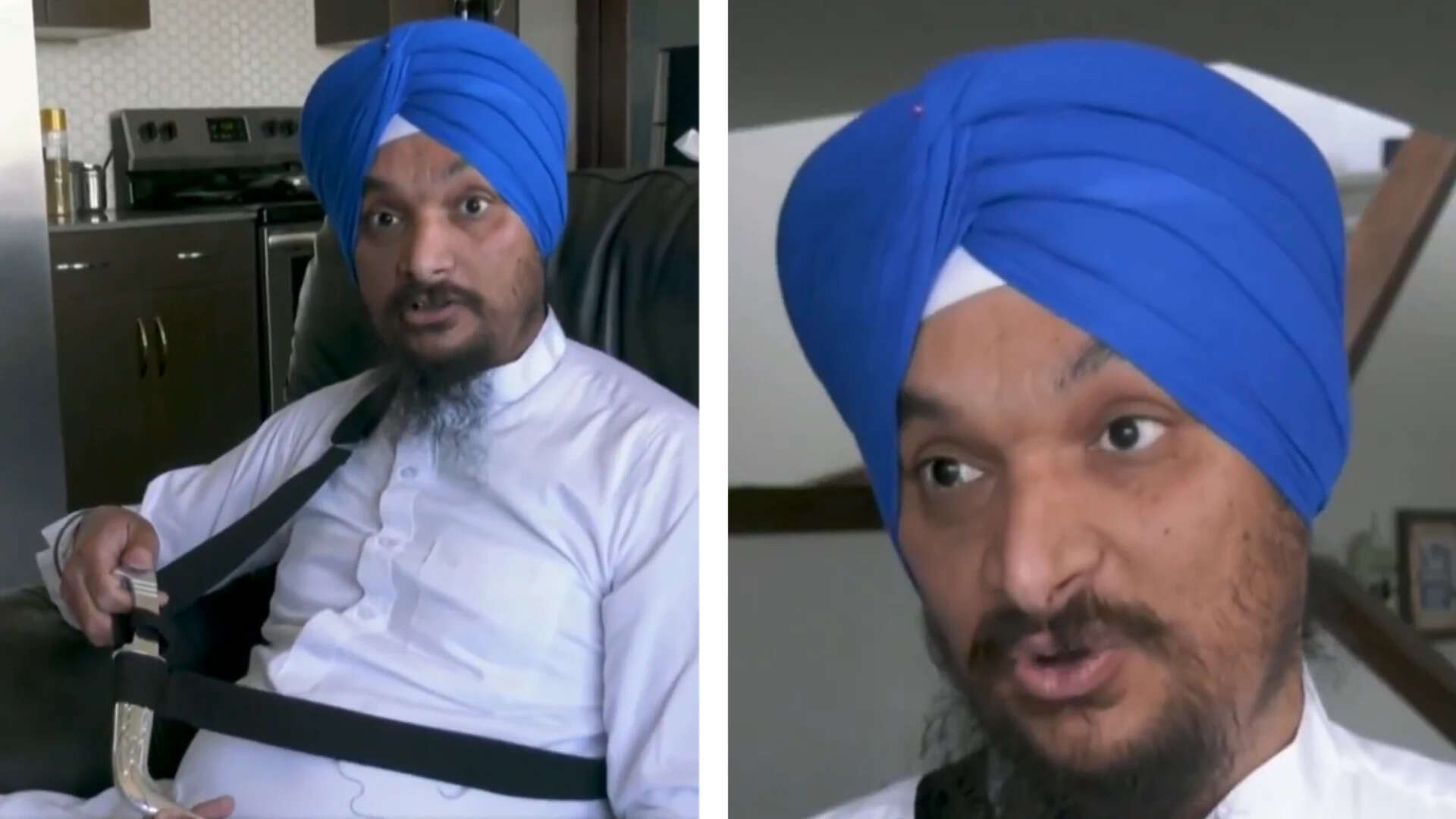
The exclusion of Amritdhari Sikh candidates from police examinations due to the carriage of the kirpan is not a localized HR dispute, but a systemic failure of institutional interoperability. When a candidate in Canada reports that their "dream was shattered" by a refusal to permit a ceremonial blade during a standardized test, the core issue is the collision between Public Safety Liability Models and Constitutional Duty to Accommodate. To analyze this, one must move beyond the emotional narrative of the individual and deconstruct the structural bottlenecks that prevent religious identity from integrating with state-sanctioned security protocols.
The Triad of Institutional Resistance
The refusal to allow a kirpan in a testing environment stems from three specific friction points that organizations fail to quantify: For a more detailed analysis into this area, we recommend: this related article.
- The Perceived Risk Variable: Security protocols at testing centers operate on a binary logic—weapons are either present or absent. The kirpan, regardless of its religious designation, is categorized as a "bladed weapon" within standard liability frameworks. This creates an immediate policy conflict where the burden of proof for safety is placed on the individual rather than the institution’s ability to manage a controlled environment.
- The Uniformity Doctrine: Law enforcement agencies often prioritize a "blank slate" aesthetic for recruits to signal impartiality and safety. Deviations from this aesthetic, even during the preliminary examination phase, are viewed by conservative risk assessors as potential precedents that could complicate future field gear requirements or physical intervention training.
- The Administrative Efficiency Trap: Accommodating a non-standard request requires an override of automated or outsourced proctoring rules. For many organizations, the cost—both in time and legal consultation—of modifying a protocol for one individual is seen as an inefficient use of resources, leading to blanket denials that trigger litigation.
Legal Frameworks vs. Operational Reality
The Canadian Charter of Rights and Freedoms, specifically Section 15 and the interpretation of Section 2(a), mandates that employers and state actors reach the point of Undue Hardship before denying accommodation. In the context of a police exam, the threshold for undue hardship is exceptionally high.
The Proportionality Test in Testing Environments
To determine if a kirpan poses a genuine threat during a written or computer-based exam, the institution must evaluate three metrics: For broader background on this development, comprehensive analysis can be read at BBC News.
- Accessibility: Is the blade physically accessible, or is it sewn into the sheath/undershirt (a common accommodation in high-security environments)?
- Intent and History: Does the individual’s adherence to the Sikh Code of Conduct (Sikh Rehat Maryada) correlate with a higher risk profile? Statistically, there is zero empirical evidence suggesting that Amritdhari Sikhs in professional settings pose a greater threat than unarmed counterparts.
- Alternative Mitigations: Could the security concern be resolved by a private testing room or a physical barrier between the candidate and the proctor?
Failure to apply these metrics results in "Prima Facie Discrimination." When an agency denies entry based on a tool of faith that has been successfully accommodated in the Supreme Court of Canada (Multani v. Commission scolaire Marguerite-Bourgeoys, 2006) and the Parliament of Canada, the agency is operating on outdated risk models that ignore established legal precedents.
The Logistics of the Kirpan in Tactical Environments
The "shattered dream" narrative hides a more complex tactical question: if a candidate cannot sit for an exam with a kirpan, how will they manage the physical requirements of a Police Academy?
Law enforcement involves high-intensity physical contact, including grappling and weapons retention. The institutional fear is that a kirpan could be used against an officer during a struggle. However, this fear ignores the existence of Integrated Carry Solutions. Modern law enforcement can—and does in jurisdictions like the UK and parts of Canada—utilize specific sheath designs that secure the kirpan to the body in a way that prevents it from being drawn by an assailant or interfering with duty belts.
The Cost-Benefit of Exclusion
The economic and social cost of excluding highly motivated candidates over a manageable gear conflict is significant.
- Recruitment Leakage: High-quality candidates with specialized linguistic skills and community ties are redirected to private sectors or competing agencies with more progressive accommodation policies.
- Litigation Overhead: The cost of defending a human rights complaint frequently exceeds the cost of developing an inclusive uniform policy by a factor of ten.
- Community Trust Degradation: In a "Peelian" policing model, the police are the public and the public are the police. If a segment of the public is structurally barred from participation, the legitimacy of the agency’s "service" mandate is eroded within that demographic.
Structural Bottlenecks in the "Duty to Accommodate"
The breakdown usually occurs at the Proctor Level. Third-party testing companies often lack the delegated authority to grant religious exemptions. This creates a "Liability Gap" where:
- The Police Service blames the testing agency’s "standard safety rules."
- The testing agency claims they are merely following the contract provided by the Police Service.
- The candidate is caught in a loop of non-accountability.
To solve this, the "Duty to Accommodate" must be written into the Service Level Agreement (SLA) between the government body and the private contractor. Without explicit language in the contract, a proctor will always default to the most restrictive safety protocol to avoid personal liability.
Toward a Standardized Accommodation Protocol
The move from "shattered dreams" to institutional integration requires a shift from ad-hoc responses to standardized frameworks. This involves:
1. Pre-Screening and Certification
Candidates should be able to submit a "Request for Accommodation" at the point of application. This allows the agency to review the specific dimensions and securing methods of the kirpan before the exam day, preventing high-stakes confrontations at the door.
2. Physical Security Tiering
Different environments require different levels of accommodation.
- Tier 1 (Written Exams): Absolute accommodation via private room or sheathed/sewn blade.
- Tier 2 (Physical Testing): Assessment of the kirpan’s impact on body mechanics.
- Tier 3 (Field Work): Integration of the kirpan into the tactical vest or under-armor, ensuring it meets safety standards for both the officer and the public.
3. Training and Sensitivity Audits
The "shock" experienced by security staff when encountering a kirpan is a failure of internal training. Agencies must treat religious articles as "standard variables" rather than "anomalies."
The Strategic Path for Law Enforcement Agencies
The current friction is a symptom of a larger struggle to define "neutrality" in a pluralistic society. If an agency defines neutrality as the absence of all religious markers, it effectively bans entire demographics from civil service. If it defines neutrality as the equal treatment of all qualified individuals regardless of markers, it must evolve its safety protocols to match that reality.
The immediate strategic requirement is for Canadian police services to audit their third-party testing contracts. Any contract that does not explicitly provide for the carriage of the kirpan—under specific, pre-negotiated safety conditions—is a legal liability waiting to be triggered.
Agencies must move away from reactive damage control and toward a "Policy-First" approach. This means developing a national standard for the carriage of religious articles in high-security civil service roles. By quantifying the actual risks and implementing engineered solutions (like secured sheaths or specialized carry positions), the institution removes the subjective "fear factor" and replaces it with an objective safety framework. This preserves the integrity of the exam while fulfilling the legal and ethical mandate of the state to remain open to all citizens who meet the physical and intellectual requirements of the role.