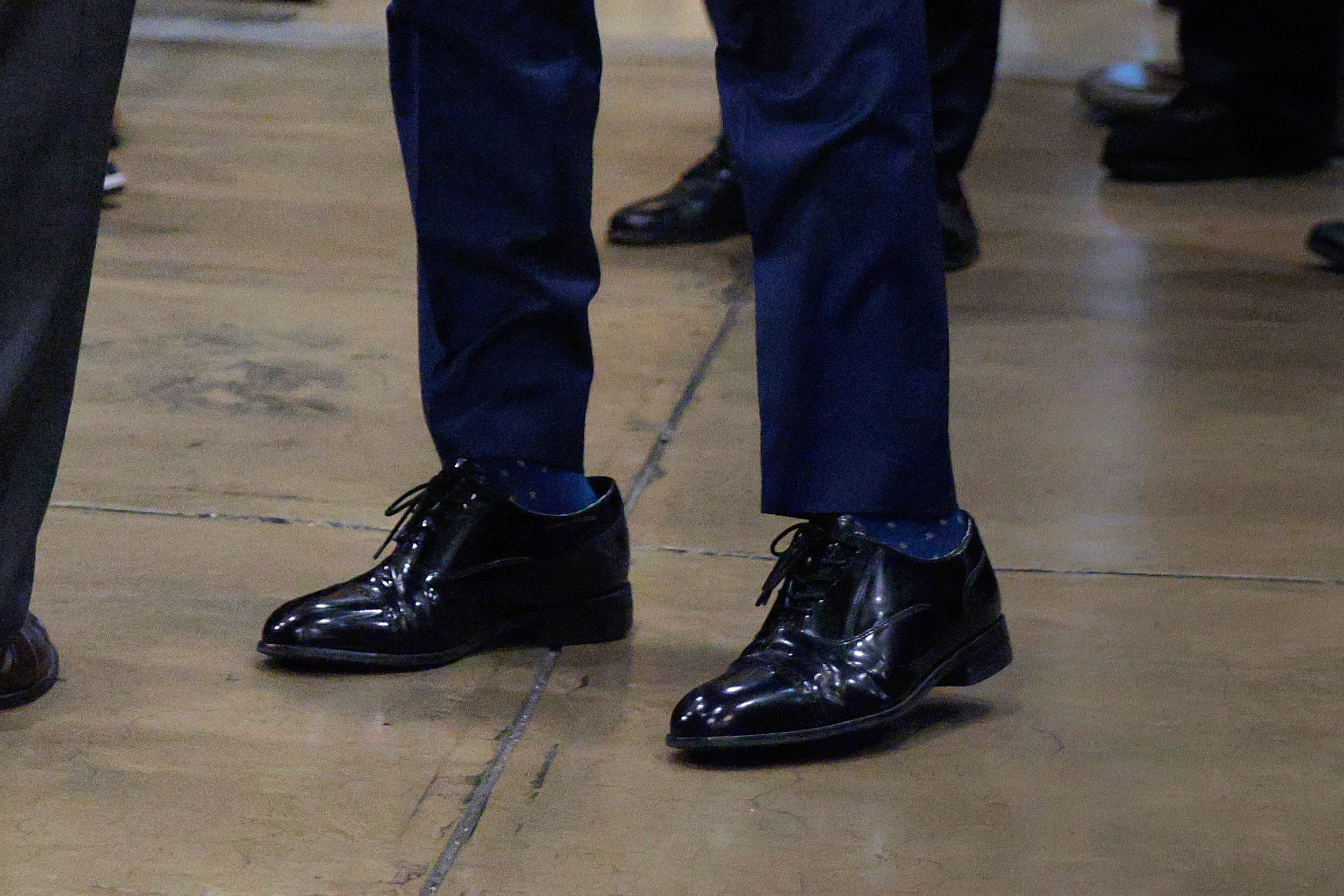
The floor of the West Wing is not just a surface. It is a stage. Every inch of those historic hallways is designed to amplify the weight of a footfall, echoing the gravity of the decisions made behind the heavy oak doors. In this environment, a man’s silhouette is his first and most enduring policy statement. But lately, the silhouette has begun to change in a way that suggests a deep, unspoken vulnerability. It isn't about the cut of the suit or the knot of the tie anymore. It is about the floor. Or more specifically, the distance between the floor and the man standing upon it.
High-stakes masculinity has always been a game of inches. We see it in the way world leaders square their shoulders or how they dominate the negative space in a photograph. Yet, a peculiar anxiety has taken hold in the highest corridors of power. It is a restless, shifting concern centered entirely on footwear. Men who command nuclear arsenals and manage global economies are suddenly, visibly preoccupied with their heels.
The Architecture of the Stature
Look closely at the next press briefing or bilateral summit. You might notice a certain stiffness in the gait of the men on stage. There is a reason for that. The traditional dress shoe, once a simple construction of leather and lace, has undergone a structural revolution. Thick, lugged soles—once reserved for hiking trails—are being grafted onto $1,000 oxfords. Internal "lifts" or hidden wedges are being slipped into boots to grant a subtle, vertical advantage.
This isn't merely a fashion trend. It is a biological arms race.
Consider a hypothetical official we will call James. James is a brilliant strategist, a man who can recite GDP fluctuations from memory. But when James stands next to a younger, naturally taller colleague, he feels a microscopic erosion of his authority. He imagines the camera lens looking up at his peer and down at him. To James, those three inches represent the difference between being the "senior" partner and the "junior" aide. So, James buys the shoes. He buys the height. But in doing so, he inherits a new kind of stress: the fear of being found out.
The Physics of the First Impression
The data on "heightism" is cold and unforgiving. Research consistently shows that taller men are perceived as more capable, more leader-like, and even more trustworthy by the lizard brain that still resides within the modern voter. We want our leaders to be literal giants. This primal bias creates a grueling psychological tax for the man of average height.
When a politician opts for a shoe with a two-inch external heel and a one-inch internal riser, they are fighting gravity and sociology simultaneously. The physical cost is immediate. The center of mass shifts forward. The lower back arches. The calf muscles remain in a state of permanent contraction. If you have ever wondered why some world leaders stand with a slight, forward-leaning tilt—resembling a person trying to remain upright on a moving ship—you are likely witnessing the mechanical struggle of the "elevator" shoe.
It is a precarious way to live. One slip on a rain-slicked tarmac or one trip up the stairs of Air Force One, and the illusion shatters. The "anxiety" isn't about the vanity of being short; it is the terror of the reveal. It is the fear that the public will see the scaffolding behind the image.
A History Written in Cobbled Leather
This obsession is not a modern invention, though our technology has made it more seamless. Louis XIV of France was perhaps the pioneer of the power heel, famously sporting red-soled shoes that added several inches to his frame. For the Sun King, height was a divine right. To be lower than his subjects was a theological impossibility.
Today, the red lacquer is gone, replaced by matte black calfskin, but the intent remains identical. We have traded the overt flamboyance of the monarchy for the "discreet" enhancements of the democracy. In the 1960s, the Beatles popularized the Chelsea boot with a Cuban heel, bringing a touch of theatrical height to the mainstream. But back then, it was a rebellion. Today, in the Oval Office and the boardrooms of the Fortune 500, it is a defense mechanism.
The stakes are invisible until they aren't. We live in a digital world where every frame of a video can be paused, zoomed, and dissected on social media. A leader’s shoe choice is no longer a private matter; it is a meme-ready data point. If the heel looks too chunky, the internet notices. If the trousers bunch up awkwardly over a high-top boot, the world comments. The very tools meant to project strength often end up signaling a deep-seated insecurity.
The Emotional Cost of the Lift
Imagine the ritual of the morning. A man who holds the fate of millions in his hands sits on the edge of his bed. He slides his feet into shoes designed to deceive. He feels the artificial lift, the slight pinch in the toes, the unfamiliar angle of the ankle. He stands up and feels, for a moment, like the giant he is expected to be.
But throughout the day, as he walks through the halls of power, he is hyper-aware of his feet. He avoids standing too close to the six-foot-four security detail. He calculates his position in group photos. He becomes a choreographer of his own existence.
This is the hidden tax of the modern leader. The mental bandwidth required to maintain a physical facade is bandwidth that isn't being used for governance. It is a quiet, persistent hum of anxiety that follows the click-clack of the heel on the marble.
We often talk about the weight of the crown, but we rarely talk about the height of the shoe. We expect our leaders to be superhuman, forgetting that they are subject to the same vanities and fears as any man standing in front of a bathroom mirror. The "shoe anxiety" hitting the highest offices is a reminder that even at the peak of global influence, the most daunting opponent isn't a rival political party or a foreign adversary. It is the person staring back in the glass, wondering if they are enough exactly as they are.
The next time you see a leader stepping onto a podium, don't just listen to the words. Watch the gait. Look at the silhouette. You might see a man commanding the world, but if you look closely at the heels, you might see a man just trying to keep his balance in a world that demands he be taller than he truly is.
The marble floors are unforgiving, and the climb is steep, but the hardest part is never letting anyone see you stumble on the very shoes you chose to wear.