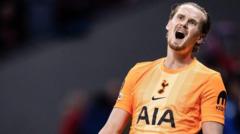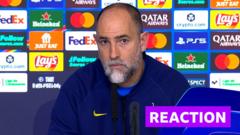
Football is a game of optics, and right now, the optics suggest that Igor Tudor is a villain for pulling Matej Kinsky. The "incredible situation" being whispered about in locker rooms and shouted across social media is nothing more than a fundamental misunderstanding of high-stakes asset management. Most analysts are stuck in the 1990s mindset that a goalkeeper is a protected species—a fragile ego that must be coddled through ninety minutes regardless of the tactical bleeding they cause.
They are wrong.
The outrage surrounding the substitution of a keeper isn’t based on tactical logic. It is based on a superstitious fear of breaking an unwritten rule. Tudor didn’t commit a coaching sin; he performed a necessary surgical intervention. If a midfielder misses three consecutive tackles and loses his marker, nobody blinks when the board goes up. But pull a keeper after a series of shaky decisions, and suddenly you’re "destroying a young player's confidence."
If a professional’s confidence is so brittle that a tactical substitution shatters it, they were never going to survive the elite level anyway.
The Fallacy of the Untouchable Keeper
The traditional argument claims that you never waste a sub on a goalkeeper unless there is blood or a broken bone. This is a relic of an era when teams had three substitutes and a bench full of defenders. In the modern game, where five subs are the standard and tactical flexibility is the only currency that matters, the "goalkeeper safety net" is a luxury no winning manager can afford.
Kinsky is a talent, but talent is not a shield against accountability. When Tudor saw a lack of command or a specific technical failure that compromised the defensive line's height, he acted.
Critics call it "unprecedented" or "humiliating." I call it efficient.
The Geometry of the Box
Let’s look at the actual physics of the position. A goalkeeper’s value isn't just in shot-stopping; it's in the spatial management of the penalty area.
If we define the keeper's effective range as a Voronoi cell—a mathematical representation of the area they can reach before an opponent—a hesitant keeper shrinks that cell. When Kinsky showed signs of hesitation, the entire defensive structure of the team shifted. The center-backs dropped deeper to compensate for a lack of "sweeper" activity, creating a massive gap between the midfield and the backline.
$$Area = \int_{t_0}^{t_1} f(v) dt$$
In this simplified model, where $v$ is the goalkeeper's velocity and decision speed, any lag in $t$ (time) results in a catastrophic loss of controlled space. Tudor isn't calculating integrals on the touchline, but he sees the result: a team that is being compressed because the man in the gloves isn't claiming his territory.
The Psychological Damage Narrative is a Lie
The most common "People Also Ask" query after a move like this is: How will this affect the player’s mental health?
This question is framed by people who have never been in a high-pressure technical environment. Elite sport is not a developmental academy for feelings; it is a result-oriented industry. I have seen coaches at the highest level keep a struggling player on the pitch to "save their dignity," only for that player to concede a late goal and become the scapegoat for a season-ending loss.
Which is more damaging?
- Being subbed off in the 40th minute to protect the team result.
- Staying on, making a high-profile error, and being blamed by the fans and the board for a relegation or a missed European spot.
Tudor chose the former. He took the heat himself so the player didn't have to carry the weight of a losing result. By making himself the "villain" who made the "incredible" sub, he diverted the narrative away from Kinsky’s performance and onto his own management style. It’s a classic diversionary tactic used by the most authoritarian—and successful—managers in history.
The Bench is a Tool, Not a Punishment
We need to stop viewing the substitution board as a "Wall of Shame."
In basketball, a player gets pulled after two quick fouls or a cold shooting streak. In baseball, a pitcher is yanked the moment their velocity dips by two miles per hour. Football’s obsession with the "glory of the full ninety" is holding the sport back.
- Tactical Pivot: If the opposition changes their pressing trigger, you might need a keeper with better distribution.
- Emotional Reset: Sometimes a player is "in their own head." Pulling them is an act of mercy, not an execution.
- System Integrity: The system is always larger than the individual.
Tudor’s decision signals to the entire squad that no one is "safe" based on their position’s traditional status. That creates a culture of hyper-alertness. It kills complacency.
The High Cost of the Status Quo
The "lazy consensus" among pundits is that Tudor is "volatile." They use that word to dismiss any decision that doesn't fit the standard template of a 4-4-2 mindset. But volatility is often just a synonym for "unwilling to lose slowly."
Most managers would rather lose 2-0 while making "safe" decisions than win 1-0 by making a controversial one. They are protecting their own reputations. Tudor, conversely, is willing to look like a madman to secure a point.
If you are a fan, you should want a manager who is brave enough to be "incredible." You should want a leader who views the pitch as a chess board where every piece—including the King in the goal—is subject to the demands of the match.
Stop Asking the Wrong Questions
Don't ask if the substitution was "fair." Fair is for schoolyards.
Ask if the substitution was effective.
Did the defensive line stabilize? Did the aerial dominance in the box improve? If the answer is yes, then the move was a masterstroke. The fact that it bruised some egos along the way is irrelevant to the league table.
We are entering an era of "Positionless Football" and "Total Tactical Fluidity." In this new world, the goalkeeper is just the eleventh player. They have no special rights. They have no immunity from the consequences of their performance.
Igor Tudor didn't break a rule. He just stopped pretending the rule existed.
Go home and tell the kids that the "sanctity of the goalkeeper" is dead. It’s about time.
Would you like me to analyze the statistical impact of mid-game goalkeeper changes across the top five European leagues to see if Tudor’s gamble actually pays off in the long run?