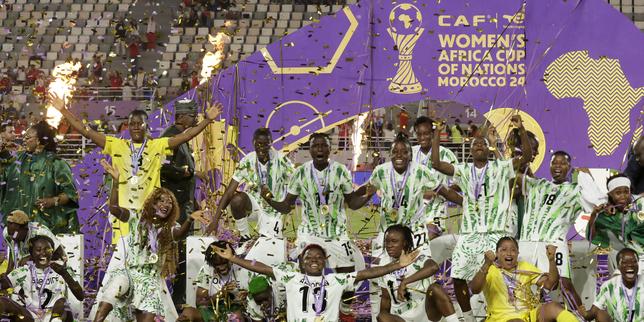
Fatima doesn’t look at the calendar anymore. For months, the date was circled in red ink—a jagged, hopeful sun drawn around July 2024. As a midfielder for a local club in Casablanca, that date wasn't just a tournament kickoff; it was a deadline for her dreams. She had spent the last year training under the brutal midday sun, her cleats worn thin, all for the chance to see the best players on the continent descend upon her home turf for the Women’s Africa Cup of Nations (WAFCON).
Then came the announcement. Or rather, the silence that preceded it.
The Confederation of African Football (CAF) didn't send a messenger to the dusty pitches where girls like Fatima play. They didn't hold a town hall for the fans who had already started saving for tickets. Instead, with the clinical coldness of a corporate ledger, the tournament was pushed back. Not by a week. Not by a month. It was shoved an entire year down the road to July 2025.
This isn't just a scheduling conflict. It is a heartbreak with a paper trail.
The Scheduling Tetris
The official reason given for the delay sounds logical on a spreadsheet. The 2024 Olympic Games in Paris created a "congested calendar." CAF President Patrice Motsepe spoke about the difficulty of finding a window that wouldn't overlap with other major global events. It’s a game of logistical Tetris where the pieces never quite fit.
But consider the optics. The men’s competitions rarely find themselves homeless on the calendar. When the Africa Cup of Nations for men faces hurdles, the continent moves mountains. Infrastructure is fast-tracked. Budgets are expanded. Governments intervene. For the women, however, the solution is always the same: wait.
The irony is thick. Morocco is ready. The stadiums are there, gleaming under the North African sky. The fans are ready, still buzzing from the record-breaking crowds of the 2022 edition where over 50,000 people packed the Prince Moulay Abdellah Stadium. The delay isn't about a lack of grass or concrete; it’s about a lack of priority.
The Invisible Cost of a Year
To a bureaucrat, a year is a fiscal cycle. To an athlete, a year is an eternity.
Imagine a player at the peak of her powers, perhaps 28 or 29 years old. This tournament was supposed to be her magnum opus, her final chance to catch the eye of a European scout or lead her nation to glory before her knees start to betray her. By July 2025, that window might be shut. An ACL tear in a meaningless mid-season friendly, a loss of form, or the simple, relentless march of time can turn a starter into a spectator.
It goes deeper than the individual. Think of the momentum. After the 2023 World Cup, where African nations like Nigeria, South Africa, and Morocco punched far above their weight, the iron was glowing hot. The world was finally watching.
When you postpone a tournament by twelve months, you don't just move the dates. You douse the fire. You tell the sponsors that their investment can wait. You tell the broadcasters that the content isn't urgent. Most damagingly, you tell the young girls watching from the sidelines that their time is negotiable.
A Pattern of Second Class Status
This isn't an isolated incident; it’s a symptom of a chronic condition. The 2020 edition was cancelled entirely due to the pandemic, while the men’s tournament was merely shifted. There is a persistent narrative that women’s football is a luxury item—something to be hosted only when the "important" business is concluded.
The "lack of consideration" cited by players and advocates isn't just a hurt feeling. It’s a measurable deficit in respect. While European leagues are breaking attendance records and signing multi-million dollar TV deals, African women’s football is being asked to sit in the waiting room.
The players aren't asking for charity. They are asking for a calendar they can trust. They are asking for the basic dignity of a schedule that doesn't evaporate two months before the first whistle.
The Ghost in the Machine
Let's look at a hypothetical scenario to ground this. Suppose a national team coach has spent two years building a specific tactical system designed to peak in 2024. They’ve scouted opponents, managed player workloads, and secured funding for a pre-tournament camp.
Suddenly, the target moves.
The funding, often precarious and tied to specific dates, vanishes. The veteran captain decides she can’t put off starting a family for another year. The chemistry that was humming in June is stagnant by December. You cannot simply "pause" a high-performance sports program and expect it to resume at the same frequency a year later. It's like trying to hold a breath for twelve months.
The Weight of the Silence
What hurts most isn't the delay itself—life is unpredictable, and logistics are a nightmare—but the ease with which the decision was made. There was no public outcry from the top levels of the sport’s governing bodies. There were no emergency summits to find a way to make 2024 work.
The silence suggests a belief that the fans won't mind, that the players will just be grateful to play whenever they are told, and that the "brand" of African women’s football isn't valuable enough to protect at all costs.
But go back to Casablanca. Go to the pitch where Fatima is still running sprints. She isn't silent. The anger among the players is a low, vibrating hum that should terrify those in charge. They are tired of being the "alternative" or the "afterthought."
They see the stadiums in Rabat and Marrakesh. They know the lights could be turned on tomorrow. The infrastructure is a testament to what Morocco can do, but the empty seats are a testament to what the leadership refuses to do.
A year from now, the flags will eventually fly. The anthems will play. The 2025 WAFCON will likely be a success because the talent on the pitch is too great to be suppressed forever. But we shouldn't forget the ghost of the 2024 tournament—the one that never happened, the one that cost players their peak years, and the one that proved, once again, that in the eyes of the decision-makers, "soon" is a perfectly acceptable substitute for "now."
The grass will stay green in Morocco. The stadiums will wait. But for a generation of women who have already spent their lives fighting for a seat at the table, being told to wait another year feels less like a delay and more like a closed door.
Every day that passes is a day of lost progress. Every month of delay is a month where a young girl picks up a different hobby because she doesn't see a path forward in a sport that treats its own championships as optional. The cost isn't just the millions in lost revenue or the logistical headache of re-booking hotels. The true cost is the erosion of trust.
You can rebuild a stadium. You can't rebuild a career that ran out of time.
The sun sets over the Atlantic, casting long, lonely shadows across the pitches of North Africa, where the only sound is the wind through the nets and the steady, defiant rhythm of a ball being kicked against a wall, over and over again, in the dark.