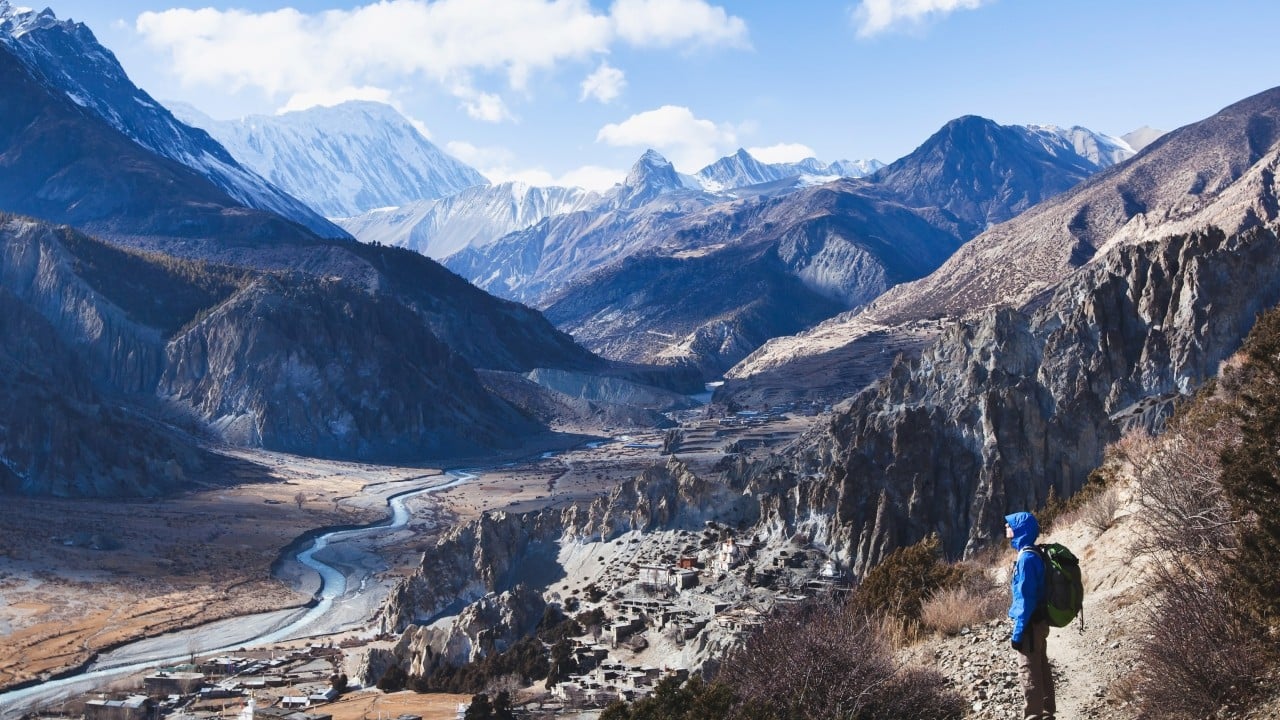
The stability of Nepal’s $2.5 billion trekking and mountaineering industry is currently being stress-tested by a fundamental shift in its consumer base. Escalating conflict in the Middle East, specifically the regional instability involving Iran and Israel, has created a structural barrier for Western European and North American travelers who rely on long-haul flight paths through these corridors. This is not a temporary dip in sentiment but a logistics-driven reallocation of market share. As Western participation rates stagnate due to increased flight costs, risk-aversion, and air-space closures, Nepal is forced to reorient its entire service architecture toward Eastern markets, specifically China and India.
The Friction Coefficient of Long-Haul Logistics
Tourism in the Himalayas operates as a high-intent, low-frequency luxury service. The "cost" of a trek is not merely the permit price or the guide's fee; it is the sum of financial outlay, time-intensity, and perceived safety. The current conflict in the Middle East increases this friction coefficient for Western travelers through three primary mechanisms:
- Airspace Contraction: Major carriers (Lufthansa, Air France, KLM) have rerouted flights to avoid Iranian and Israeli airspace. This adds two to four hours of flight time per leg. In aviation economics, time translates directly into fuel burn and crew costs, driving up the baseline ticket price for a flight to Kathmandu.
- Insurance and Risk Premiums: While Nepal itself remains safe, the perception of traveling through a conflict zone—or the risk of being stranded due to sudden airspace closures—deterrents the "risk-sensitive" demographic that typically fuels the luxury trekking sector.
- The Transit Bottleneck: Istanbul and Doha serve as the primary transit hubs for Americans and Europeans heading to Nepal. Increased military activity in the region creates a latent threat of hub closures, leading to a "flight-to-safety" in vacation planning where travelers choose alternative mountain ranges like the Alps or the Andes.
The Eastern Pivot A Structural Necessity
The decline in Western arrivals is being offset by a surge in "short-haul" regional travelers. This is not a direct one-to-one replacement in terms of economic output, but a survival-based pivot. The demographics of the Indian and Chinese traveler profiles differ significantly from the traditional Western trekker, requiring a complete overhaul of the Nepalese service model.
India: The Volume Driver
Indian tourists have historically been religious pilgrims (pashupatinath-bound), but a new demographic of urban, high-net-worth individuals from Mumbai and Delhi is entering the trekking space.
- Logistical Advantage: Surface transport and short 1-hour flights bypass the Middle Eastern airspace issues entirely.
- Seasonality Shift: Indian travelers are less deterred by the "shoulder seasons" (pre-monsoon and post-monsoon) compared to Westerners who strictly adhere to the October-November window.
- Spending Velocity: While Westerners tend to stay longer (14-21 days), Indian travelers have a higher spending velocity per day, opting for luxury helicopter tours and high-end accommodation over the traditional "teahouse" budget model.
China: The Infrastructure Link
China’s reopening post-pandemic, combined with increased bilateral cooperation, makes it the most critical growth engine for Nepal’s tourism recovery.
- Direct Connectivity: Flights from Chengdu, Guangzhou, and Kunming provide a stable supply of high-spending travelers.
- Infrastructure Synergy: Chinese-led infrastructure projects in Nepal, including the Pokhara International Airport, are designed to facilitate this specific corridor. However, the operationalization of these airports remains a bottleneck due to limited international carrier interest outside of the Chinese and regional orbits.
The Yield Gap and Economic Re-indexing
Replacing a German trekker with a Chinese trekker is not a neutral swap for the Nepalese economy. The industry is currently grappling with "The Yield Gap"—the difference in the economic multiplier effect between different traveler nationalities.
Western trekkers typically engage in "Long-Tail Consumption." They hire porters, stay in remote teahouses, and spend 14+ days in the backcountry. This distributes capital into the deep rural valleys of the Solu-Khumbu and Annapurna regions.
In contrast, the rising Eastern demographic tends toward "Concentrated Consumption." This involves:
- Higher spend on luxury hotels in Kathmandu and Pokhara.
- Heavy use of helicopter charters to Everest Base Camp (EBC), which bypasses the local teahouse economy.
- Shorter overall durations, which reduces the total number of wage-days for porters and guides.
This shift creates a spatial inequality in the tourism economy. While the headline arrival numbers might suggest a recovery, the rural mountain communities—the backbone of the industry—are seeing a diminishing return on each arrival.
The Resilience Framework for Trekking Operators
To survive this geopolitical realignment, trekking agencies are forced to move away from the "Western-Centric" legacy model. This involves a three-stage tactical adjustment:
1. Product Modularization
Eastern travelers prioritize flexibility and luxury over the "suffer-fest" endurance model favored by 20th-century Western climbers. Successful operators are breaking down 20-day itineraries into 5-to-7-day modules. These modules often include "fly-in, trek-out" options using helicopters to minimize the physical toll while maximizing the visual experience.
2. Linguistic and Cultural Re-tooling
The guide pool in Nepal is overwhelmingly English-speaking. There is a massive talent deficit in Mandarin and Hindi-speaking guides who understand the specific cultural nuances—such as dietary requirements and religious sensitivities—of the new primary markets. Agencies that fail to pivot their human capital toward these languages will find themselves unable to capture the high-margin segment of the Eastern market.
3. Digital Payment Integration
The Western booking system relies on credit cards and wire transfers. The Eastern market, particularly China, is built on WeChat Pay and Alipay. Nepal’s banking regulations have historically been a barrier here, but the systemic need for liquidity is forcing a rapid adoption of these digital payment gateways.
The Geopolitics of Air Rights
A significant but often overlooked constraint is the "India-Nepal-China" air rights triangle. India’s reluctance to grant high-altitude entry routes for flights coming into Nepal’s new international airports (Bhairahawa and Pokhara) complicates the pivot. These airports were intended to relieve pressure on Kathmandu and facilitate direct arrivals from India and China.
Without Indian approval for these flight paths, planes must take circuitous routes, increasing fuel costs and neutralizing the "short-haul" advantage. The tourism strategy of Nepal is thus tethered to its ability to navigate the diplomatic tensions between its two giant neighbors. This makes the "Eastern Pivot" as much a diplomatic challenge as a marketing one.
Structural Risks and The "Single-Market" Trap
The danger in pivoting so aggressively toward Eastern markets is the creation of a "Single-Market Dependency." Nepal has seen this before. In 2015, following the earthquake, and again during the 2020 lockdowns, the sudden evaporation of a single dominant market led to a total industry collapse.
By de-prioritizing the Western market—even if forced by the Middle East conflict—Nepal risks losing the "brand prestige" associated with being a global bucket-list destination. The Western market, despite its current logistical hurdles, provides a level of price inelasticity that the regional market does not. If a recession hits the Asian giants, Nepal’s tourism sector will have no safety net.
The Strategic Path Forward
The data indicates that the "Western era" of Nepalese trekking is not ending, but it is moving into a niche, ultra-luxury category. The mass-market volume will continue to flow from the East. To optimize for this bifurcated reality, Nepal must execute the following:
- Tiered Pricing for National Parks: Moving beyond a flat fee to a model that accounts for the "footprint" of the traveler. Helicopter-heavy itineraries should carry a "Carbon and Community" tax to subsidize the teahouse economies they bypass.
- Incentivized Air Corridors: The government must offer aggressive subsidies for carriers operating out of non-Kathmandu airports to decentralize the traffic and reduce the reliance on Middle Eastern transit hubs.
- Diversification of "The Mountain Product": Moving beyond the "Big 8" peaks to promote lower-altitude, culturally focused trekking in the Middle Hills, which appeals more to the Indian middle-class demographic than the high-altitude EBC trek.
The current conflict in the Middle East is the catalyst for a permanent re-indexing of Himalayan tourism. Operators who continue to wait for the "return to 2019" for Western arrivals are ignoring the fundamental shift in global mobility. The winners in this new landscape will be those who treat the Eastern market not as a temporary substitute, but as the new primary engine of growth.
The tactical move for 2026 is clear: divest from the traditional Western marketing funnels and aggressively acquire Mandarin and Hindi-speaking operational capacity. The geographical proximity of 2.8 billion people is a more stable long-term bet than a reliance on a fragile 7,000-mile-long supply chain through the world's most volatile airspace.