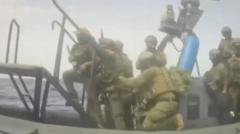
The media is buying the bait again hook, line, and sinker. On Monday, headlines exploded with the news that Israeli naval forces intercepted and boarded vessels from the Global Sumud Flotilla near Cyprus. Activists are already shouting from their digital rooftops about "broad daylight piracy" and "illegal operations in international waters." The predictable chorus of international outrage has tuned its instruments perfectly.
But if you look at this event through the lens of pure maritime mechanics and geopolitical strategy, the standard narrative falls apart entirely. This is not a humanitarian mission that was tragically thwarted. This is a highly calculated, meticulously engineered public relations exercise where the actual delivery of physical aid was always the lowest priority.
I have watched organizations blow millions of dollars on high-profile logistical stunts, and the script never changes. You do not assemble a massive, unwieldy convoy of 50 civilian vessels, announce your departure from the Turkish port of Marmaris weeks in advance, broadcast your coordinates in real-time, and genuinely expect to sneak past one of the most sophisticated, high-alert naval blockades on the planet. You do it precisely because you want to be stopped. The interception is not the failure of the mission; the interception is the climax of the show.
Let us dismantle the core legal and operational arguments that the activist network and lazy mainstream reporting are pushing.
First, the outrage over the interception occurring in international waters, roughly 250 nautical miles from Gaza within Cyprus's Search and Rescue zone. The immediate reaction from activist legal teams is to call this an unprecedented act of lawlessness. It is an effective talking point for anyone who does not understand international maritime law, specifically the San Remo Manual on International Law Applicable to Armed Conflicts at Sea.
Under established maritime warfare principles, if a state has declared a legally binding naval blockade, interception of vessels intending to breach that blockade does not have to wait until those vessels cross into territorial waters. Section 97 of the San Remo Manual explicitly states that merchant vessels believed on reasonable grounds to be breaching a blockade may be captured outside the blockaded area or the territorial sea of the blockading state.
By aggressively announcing their intention to breach the blockade, the organizers legally handed the Israeli Navy the justification to act anywhere in international waters. Waiting until a flotilla reaches the shallow, crowded coastal waters of Gaza is a tactical nightmare. Intercepting a sprawling fleet of dozens of boats in the deep waters off Cyprus is standard operational security. Pretending this is a shocking surprise is pure disingenuousness.
Second, consider the jaw-dropping logistical inefficiency of using a 50-ship civilian flotilla to transport aid. Shipping containers on commercial cargo vessels move goods at a fraction of the cost. If the primary objective of the Global Sumud Flotilla was to maximize the volume of food, medicine, and clean water reaching civilians in Gaza, they chose the absolute worst possible mechanism to achieve it.
Managing a convoy of small, disparate civilian vessels requires immense fuel, coordination, and administrative overhead. A single standard cargo ship can hold more tonnage than dozens of small activist boats combined, and it can do so securely. The choice of a highly visible, fragmented fleet proves that the cargo was never the point; the people on the boats were the cargo. The 426 participants from 39 countries were brought along to act as human props for a geopolitical confrontation.
The activists constantly ask: "Why won't Israel just let peaceful aid pass?" The premise of the question is fundamentally flawed because it ignores how modern asymmetric warfare functions. No sovereign military in the world will allow an uninspected, decentralized fleet of foreign civilian vessels to dock directly in a war zone under the control of a hostile entity.
To illustrate this, look at the mechanisms used by the United Nations and international bodies in other conflict zones, such as the Black Sea Grain Initiative or the automated inspection regimes in Cyprus itself. Legitimate aid delivery relies on rigorous, third-party verification, neutral port screenings, and tightly controlled supply corridors. It does not rely on a collection of activists refusing inspections and demanding blind trust at sea.
There is a distinct downside to pointing out this reality. Acknowledging that the flotilla is political theater can feel cold or dismissive of the genuinely catastrophic humanitarian crisis on the ground in Gaza. The shortages of food, water, and medicine are documented, severe, and desperate. But conflating a valid humanitarian crisis with a deeply flawed, performative activist tactic does a disservice to actual aid delivery.
When organizations prioritize media optics over scalable logistics, they burn through millions of dollars that could have funded verifiable, land-based or port-screened aid pipelines. They trade actual caloric intake for global headlines.
The Global Sumud Flotilla organizers knew exactly how Monday morning would play out. They knew the Israeli Navy would expand its operational footprint far beyond Gaza's coast, just as it did during the previous interception off Crete and Greece on April 30. They knew activists would be detained, transferred to naval vessels, and processed through Ashdod for deportation. They had the graphics ready, the social media copy written, and the press releases drafted before the first anchor was raised in Turkey.
Stop evaluating maritime confrontations through the emotional lens of activist press releases. The interception off Cyprus was not a disruption of a logistical pipeline; it was the flawless execution of a media strategy that traded effective aid delivery for a global PR battle.


