The vibration starts in the wrists, a rhythmic, bone-shaking percussion that feels like holding a jackhammer for six hours straight. It isn't just a bike race. It is a calculated flirtation with mechanical and physical collapse. Most professional cyclists spend their lives seeking the "flow state," that buttery smoothness of tires on fresh asphalt where the only sound is the hum of a carbon drivetrain. Paris-Roubaix is the violent antithesis of that dream. It is a relic of 1896 that refuses to die, a race through the industrial graveyard of Northern France where the road itself is the primary antagonist.
They call it the Queen of the Classics. They also call it the Hell of the North.
Imagine standing in a field in Picardy. The wind is a freezing, wet blade cutting across the flatlands. Beneath your feet are the pavé—granite cobblestones laid down in the era of Napoleon, never intended for thin rubber tires or the fragile carbon fiber of a $15,000 racing machine. These stones are uneven, slick with moss or buried in choking dust, and spaced with gaps wide enough to swallow a wheel whole. To ride them at 45 kilometers per hour is an act of madness. To race them for 250 kilometers is a test of the soul.
The Geometry of Suffering
There is a specific physics to Roubaix that dictates who survives and who shatters. Most races are won by the lightest men, the "climbers" who look like they might blow away in a stiff breeze. Roubaix favors the "oxen." These are riders like Wout van Aert or Mathieu van der Poel—men with the raw wattage to blunt the impact of the stones.
When a rider enters a five-star sector like the Trouée d'Arenberg, the body undergoes a frantic recalibration. You cannot grip the handlebars too tightly; do that, and the vibration will blister your palms within minutes. You must let the bike dance beneath you, a loose, terrifying shimmy that feels like losing control. Your heart rate spikes, not just from the effort, but from the adrenaline of knowing that a single lapse in concentration—a slick stone, a touch of wheels—will send you onto the granite at a speed that turns skin into ribbons.
The numbers tell a story of sheer attrition. In a standard Tour de France stage, a rider might burn 4,000 calories. At Roubaix, that number often clears 6,000. The average power output over the sectors of cobbles is roughly 400 to 500 watts, the equivalent of powering a large television by pedaling, while simultaneously being punched in the kidneys.
The Ghost of the Forest
Consider the Forest of Arenberg. It is a straight, mile-long trench through a dark wood, formerly a mining track. It is the most feared stretch of road in professional cycling. The stones here were laid so poorly that the gaps between them are irregular and jagged.
A hypothetical rider—let’s call him Marc—is entering the Forest for the third time in his career. He knows the ritual. The peloton approaches the entrance at 60 kilometers per hour, a frantic, elbow-to-elbow sprint just to get to the stones first. If you are fifty riders back, you are invisible. The dust kicked up by the lead cars and the first dozen bikes creates a literal fog. Marc can’t see the ground. He can only feel it. He hears the sound of snapping carbon—a fork breaking, a rim shattering—somewhere to his left. He hears the groan of a man hitting the deck.
Marc doesn't look back. In this race, looking back is a confession of defeat.
The Forest doesn't just break bikes; it breaks hierarchies. Even the greatest champions, legends like Eddy Merckx or Bernard Hinault, found themselves humbled here. Hinault famously hated the race, calling it "a pile of shit," yet he won it in 1981 just to prove he could. He understood that Roubaix isn't about being the fastest. It is about being the one who refuses to stop when everything—the bike, the weather, the very earth—is screaming at you to quit.
The Invisible Stakes
Why do they do it? There is no massive prize purse compared to other global sports. The winner receives a trophy that is quite literally just a cobblestone mounted on a wooden plinth.
The stakes are internal.
Cycling is a sport of precision, but Roubaix is a sport of chaos. It represents the one day a year where the modern world’s obsession with control is stripped away. On these roads, a flat tire isn't just a mechanical failure; it’s a stroke of fate. You can be the strongest man in the world, leading by two minutes, and a single sharp edge of granite can end your season.
This creates a unique psychological burden. Riders talk about the "Roubaix stare"—the wide-eyed, hollow look of a person who has spent six hours in a state of high-alert survival. By the time they reach the finish at the iconic Roubaix Velodrome, they are unrecognizable. Their jerseys are stiff with dried mud. Their faces are masks of grey dust, streaked only by the salt of their own sweat and perhaps a few tears of exhaustion.
The Social Fabric of the North
This race belongs to the fans as much as the riders. In the deindustrialized heart of Northern France, Roubaix is a day of communion. These are towns that have seen better days, places where the coal mines have closed and the textile mills are quiet. But on this Sunday in April, the world comes to their doorstep.
Families set up barbeques on the edge of the muddy fields. They drink heavy Belgian ales and wait for the thunder. And it is thunder. The sound of a hundred professional cyclists hitting a sector of cobbles is a low, guttural roar that vibrates in your chest. It lasts for thirty seconds, a whirlwind of colors and the smell of hot rubber and chain oil, and then it is gone, leaving only the dust settling over the quiet fields again.
There is a deep respect here for the "lanterne rouge"—the last rider to finish. While the winner is showering in the famous concrete stalls of the velodrome, the stragglers are still out there, grinding through the final sectors in the fading light. They are bruised, their gears are skipping, and their teams have long since moved on. Yet, they finish. To finish Roubaix is to earn a lifetime of credit in the peloton. It is the ultimate "I was there" badge.
The Anatomy of the Velodrome
The finish is a cruel irony. After 250 kilometers of the most brutal terrain on earth, the riders enter the Roubaix Velodrome—a smooth, banked concrete track. The transition is jarring. Suddenly, the noise of the stones stops. The bike stops bucking. The silence of the smooth concrete feels louder than the chaos that preceded it.
If a group arrives together, they must sprint. Imagine trying to find a burst of explosive speed when your legs have been drained of every gram of glycogen. Your hands are so numb you can barely feel the gear shifters. Your eyes are stung by the grit.
But the velodrome is also a place of grace. It is where the mud-caked warriors finally step off their machines. They often collapse directly onto the grass in the center of the track. They don't speak. They just sit there, staring at their hands, waiting for the world to stop shaking.
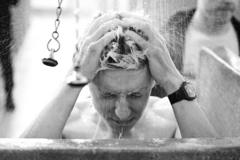
There is a specific shower room at the velodrome, a row of open concrete stalls with brass plaques commemorating past winners. It is the most sacred space in the sport. To wash the grime of the North off your body in those stalls is a rite of passage. It is the moment the "Hell of the North" ends and the legend begins.
The Cost of the Stone
The toll on the body persists long after the race. Many riders report that their hands continue to shake for forty-eight hours. The bruising on the sit-bones and the lower back takes weeks to fade. Some never truly recover their form; a bad crash on the stones can alter a career trajectory forever.
Yet, every year, the start list is full.
The race taps into something primal. We live in an era of padded corners and optimized surfaces. Everything is designed to be frictionless. Paris-Roubaix is the friction. It is the reminder that beauty can be found in the struggle against an indifferent, jagged world. It is the proof that a human being, powered by nothing but bread, water, and an irrational will, can overcome the most hostile terrain imaginable.
As the sun sets over the velodrome, the last of the riders roll in. The crowds begin to thin. The smell of grilled sausages and beer lingers in the cold air. The stones are still out there, settling back into the mud of the fields, waiting for next year. They aren't going anywhere. They have been there for two hundred years, and they will be there long after the last carbon fiber bike has turned to dust.
They are the only thing in this race that never breaks.