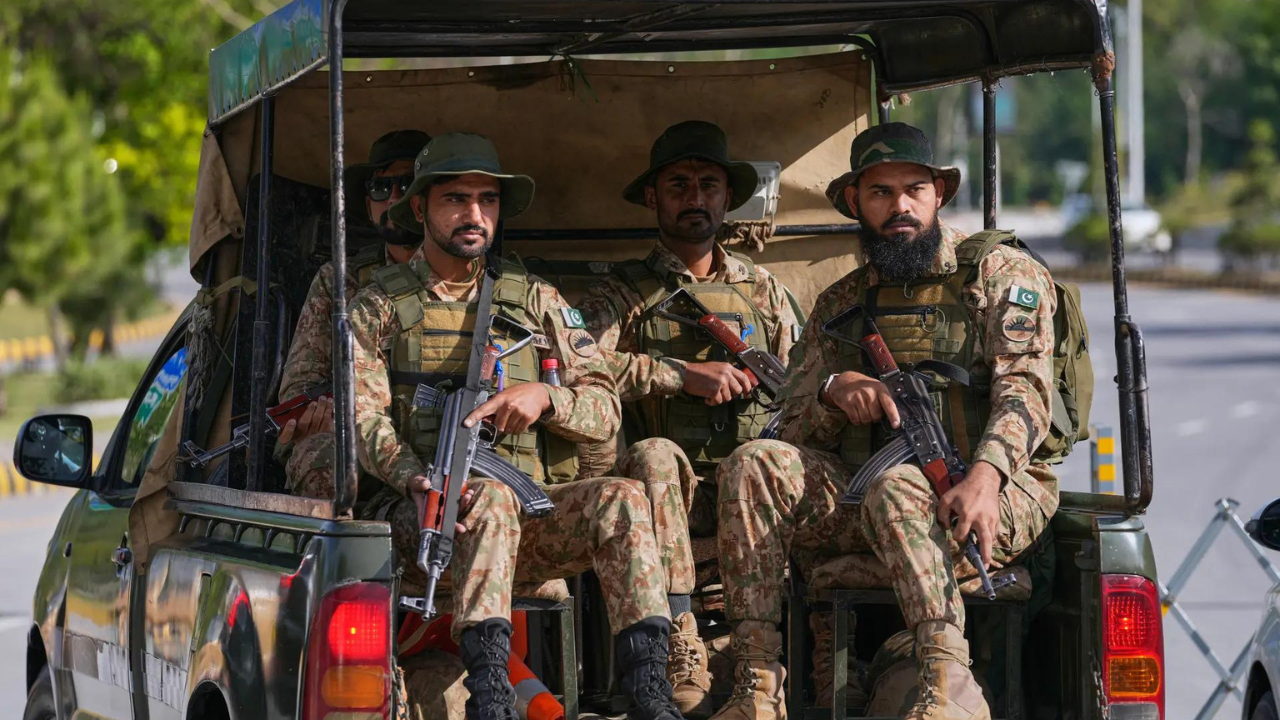
The heat in Riyadh doesn't just sit on you; it presses. It’s a weight that bears down on the shoulders of every laborer, diplomat, and soldier who walks the sun-bleached pavement of the Saudi capital. Somewhere near the tarmac of a high-security airfield, a group of men in crisp, desert-camouflage uniforms stepped off a transport plane and into that shimmering wall of air. They didn't arrive with the fanfare of a state visit or the explosive headlines of a new war. They arrived with the quiet, practiced efficiency of men who have been doing this for fifty years.
These are the soldiers of the Pakistan Army. Their arrival marks the latest chapter in a geopolitical marriage that remains one of the most misunderstood, yet vital, alliances in the modern world.
To the casual observer, the news blip is dry: a contingent of Pakistani troops has landed in the Kingdom of Saudi Arabia (KSA) as part of an ongoing bilateral security agreement. But if you look past the official press releases, you see a story of blood, debt, and a shared survival instinct that stretches across the Arabian Sea.
The Invisible Guard at the Gate
Imagine a house. It is the largest, wealthiest house in the neighborhood, filled with treasures that the entire world depends on to keep their cars running and their homes warm. Now, imagine that house sits in a neighborhood where the fences are perpetually on fire. To the north, there is instability. To the east, a rival with a long memory. To the south, a grinding conflict that refuses to end.
The owners of this house have immense wealth, but they have a small family. They cannot guard every window and door alone. So, they call upon an old friend—a friend who is perhaps less wealthy, but who has spent his entire life learning how to fight, how to endure, and how to stand watch in the darkest hours of the night.
That is the essence of the Pakistan-Saudi military relationship.
When these troops land, they aren't there to invade. They aren't even there to participate in active combat operations outside the Kingdom’s borders. Their mission is "training and advisory." In the language of international relations, that is a polite way of saying they are the ultimate insurance policy. They are the professional backbone that helps stabilize a region that the global economy simply cannot afford to see collapse.
A Legacy Written in Dust
This isn't a new arrangement born of recent panic. To understand why a Pakistani sergeant is standing in the Saudi sun today, you have to look back to 1967. While the rest of the world was focused on the Summer of Love, Pakistani pilots were flying Saudi jets to protect the Kingdom’s southern borders. In the 1980s, during the height of the Iran-Iraq war, there were nearly 15,000 Pakistani soldiers stationed in Saudi Arabia.
It is a bond forged in necessity.
Pakistan possesses one of the most battle-hardened militaries on the planet. They have spent decades navigating the treacherous terrain of the Hindu Kush and the volatile borders of the Punjab. They understand the nuances of asymmetric warfare and the crushing discipline required for desert survival. Saudi Arabia, conversely, possesses the geographical "heart of Islam" and the world’s most critical energy reserves.
The exchange is simple but profound: Saudi Arabia provides the financial oxygen that keeps Pakistan’s struggling economy gasping for air, and Pakistan provides the human shield that ensures the House of Saud remains secure.
The Human Weight of the Mission
Consider a hypothetical officer—let’s call him Major Khan.
Khan has spent the last three years in the rugged mountains of Waziristan. He is used to cold nights, thin air, and the constant, prickly tension of an unseen enemy. Now, he finds himself in the vast, flat expanse of the Rub' al Khali. His family is back in Rawalpindi, supported by the remittances and the "special duty" pay that comes with a Saudi posting.
For Khan, this isn't about "bilateralism" or "regional hegemony." It’s about the strange, solemn pride of being the exported muscle of his nation. He is a part of Pakistan’s most successful export: security.
When he trains a young Saudi recruit on the mechanics of a tank or the strategic layout of a defensive perimeter, he is participating in a transfer of institutional knowledge that has been refined over half a century. He represents a bridge between two cultures that share a religion but inhabit vastly different social realities.
The Quiet Diplomacy of Boots on the Ground
Why does this matter to someone sitting in London, New York, or Tokyo?
Because the world is a delicate machine of interconnected gears. When the gear that represents Saudi stability slips, the global price of oil spikes. When the price of oil spikes, the cost of shipping food increases. When food becomes too expensive, governments in distant nations begin to tremble.
The Pakistani contingent is the grease between those gears.
Their presence provides a psychological deterrent. It sends a message to regional rivals: If you move against the Kingdom, you are not just dealing with the Saudi National Guard. You are dealing with the professional military of a nuclear-armed nation with a long memory. It is a "soft power" move executed with "hard power" tools. By placing boots on the ground, Pakistan secures its seat at the table of Middle Eastern politics. It ensures that when the big decisions are made—decisions about oil, about investment, about the future of the Islamic world—Islamabad is in the room.
The Complexity of the Handshake
Nothing this significant is ever simple. This relationship is often a tightrope walk over a canyon of conflicting interests.
Pakistan has a massive Shia population and shares a long, porous border with Iran. It cannot afford to be seen as a mere mercenary for the Sunni bloc. In 2015, when Saudi Arabia asked Pakistan to join the active war in Yemen, the Pakistani Parliament did something unexpected: they said no. They chose neutrality over a blank check.
This latest landing of troops is a return to the "middle path." It is a reaffirmation of the core promise—protection of the Kingdom’s internal security and its holy sites—without getting dragged into the messy, external proxy wars that define the region.
It is a distinction that requires immense diplomatic finesse. The soldiers on that tarmac are as much diplomats as they are infantrymen. Every drill they conduct and every patrol they lead is a calibrated act of communication.
The Silent Sentinel
As the sun sets over the desert, turning the sky a bruised purple, the heat finally begins to lift. In the barracks, the men from Pakistan settle into a routine that feels both alien and familiar. They are thousands of miles from home, yet they are standing on ground that their fathers and grandfathers guarded before them.
They are the physical manifestation of a pact that exists beyond the reach of elections or shifting political winds. It is a pact based on the most primal human requirement: the need for a brother who will stand at your back when the horizon grows dark.
The world will continue to talk about "geopolitical shifts" and "changing alliances." Analysts will pore over maps and debate the decline of Western influence in the Gulf. But on the ground, the reality remains unchanged. The dust kicked up by a Pakistani boot on Saudi soil is a reminder that some connections are written in something more permanent than ink.
The handshake continues. The watch goes on. The desert holds its breath, and for another night, the gears of the world keep turning in their uneasy, hard-won silence.